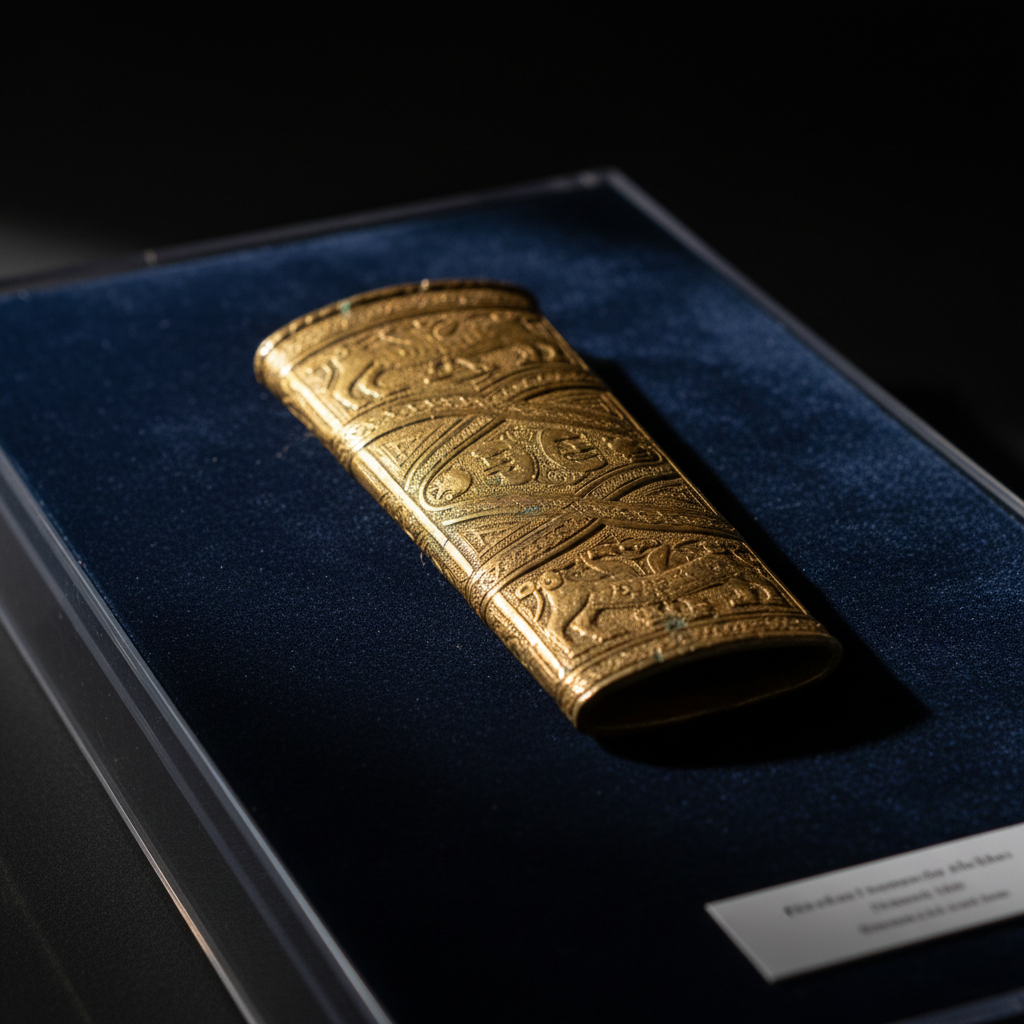
A hiker in Norway has stumbled onto one of the most striking archaeological finds in recent Scandinavian memory: a sixth-century gold scabbard fitting, buried beneath a fallen tree and untouched for roughly 1,500 years. The ornate piece dates to the Migration Period — a convulsive era of tribal warfare, dynastic power plays, and ritual sacrifice that forged the warrior cultures later romanticized in Norse mythology.
This isn't a coin hoard or a cache of silver. It's a singular, high-craft object that almost certainly belonged to someone of exceptional status. Gold sword fittings from this period are extraordinarily rare in the archaeological record, and the craftsmanship involved — intricate metalwork consistent with elite Germanic and Scandinavian goldsmithing traditions of the 400s–600s CE — places this piece at the very top of the social hierarchy it came from.
What the Object Actually Is
A scabbard fitting is the decorative hardware that adorned the sheath of a sword — the chape at the tip, the locket at the mouth, or the intermediate mounts along the body. In the Migration Period, these weren't decorative afterthoughts. They were statements of political and martial identity, often inlaid with garnet, filigree, or cloisonné enamel work. Gold versions were reserved for kings, war chiefs, and the uppermost tier of the warrior elite.
The sixth century sits in a particularly fascinating window for collectors and historians of ancient metalwork. It predates the Viking Age by roughly 200 years, meaning this piece belongs to the shadowy proto-Norse world — the world of Beowulf's contemporaries, of the Vendel-period chieftains whose ship burials at Valsgärde and Vendel in Sweden have yielded some of the most spectacular early medieval artifacts ever recovered.
Comparables are scarce almost by definition. The Sutton Hoo helmet and its associated sword fittings, excavated in Suffolk, England in 1939, represent the benchmark for Migration and early Anglo-Saxon period elite metalwork — and those pieces are housed in the British Museum, permanently off the market. Norwegian finds of this caliber surface once in a generation, if that.
Ritual Sacrifice and the Context of Discovery
The circumstances of the find matter as much as the object itself. Unearthed beneath a fallen tree — not in a grave, not in a structured hoard — the scabbard fitting raises immediate questions about intentional deposition. Ritual sacrifice of weapons and high-value objects was a documented practice across Iron Age and early medieval Scandinavia. Votive offerings were cast into bogs, rivers, and lakes, or buried at liminal landscape features. A gold sword fitting deposited alone, without a body or accompanying grave goods, fits that pattern precisely.
That context transforms the object from a lost possession into a deliberate act — someone, 1,500 years ago, chose to remove this from circulation permanently. The theological weight of that decision is difficult to overstate in a culture where a warrior's sword was among his most sacred possessions.
Norwegian law requires that archaeological finds of this nature be reported to the state, and the piece will almost certainly enter the national heritage system rather than private hands. The Museum of Cultural History in Oslo and regional county archaeologists typically take custody of significant finds, with the original discoverer eligible for a finder's reward assessed against the object's cultural value.
Why the Antiquities Market Is Watching
Legally, this piece is going nowhere near an auction block. But the discovery has immediate ripple effects for the broader ancient and medieval metalwork market — a category that has seen sustained institutional and private collector interest over the past decade.
Migration Period goldwork that does surface through legitimate, documented channels — typically from older European estate collections with pre-1970 provenance, the threshold established by the 1970 UNESCO Convention — commands extraordinary premiums. A documented sixth-century gold fitting with clean provenance would realistically benchmark against comparable Germanic or Frankish pieces that have cleared six figures at auction through houses like Christie's, Sotheby's, and Bonhams' antiquities departments.
The Norwegian find won't trade. But it validates the category, reinforces the historical significance of Migration Period material, and will almost certainly generate scholarly publication that raises the profile of comparable pieces already in private and institutional hands. In the antiquities world, a high-profile discovery like this functions as a market signal even when the object itself is untouchable.
For collectors working in ancient metalwork, the lesson is straightforward: the supply of authenticated, legally clear Migration Period goldwork is structurally constrained. Every new discovery that goes into a national museum — rather than onto the market — tightens that supply further. The pieces that do have clean provenance aren't getting cheaper.