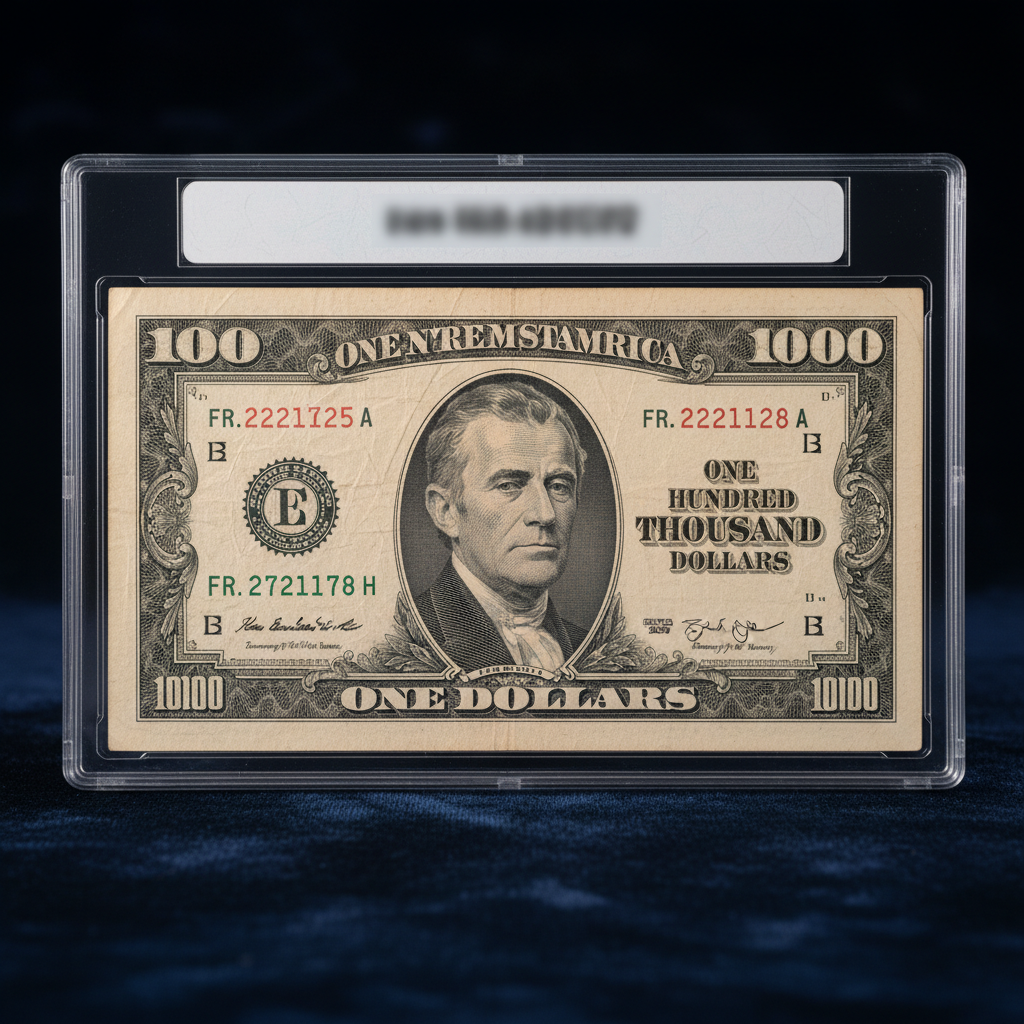
There is exactly one 1934 $100,000 Gold Certificate Uniface Front Specimen in private hands. As of August 2025, it belongs to Arizona Coin & Bullion.
The Phoenix-based dealer acquired the note this month, securing what is almost certainly the single most exclusive piece of American paper money that a private collector can actually own. PMG certified it Choice Uncirculated 63 — a grade that, given the note's nature as a specimen piece never intended for circulation, feels almost beside the point. This isn't a note that survived a cash drawer. It was never meant to.
What This Note Actually Is
The 1934 $100,000 Gold Certificate was not legal tender. It was never issued to the public. The Federal Reserve used these certificates exclusively for internal transfers between Federal Reserve Banks — a bookkeeping instrument for the largest monetary transactions of the era, denominated at a face value that represented extraordinary purchasing power in Depression-era America.
The Uniface Front Specimen designation makes this particular example even more singular. Specimen notes are produced outside of regular print runs, typically for archival, educational, or official presentation purposes. A uniface specimen — printed on one side only — represents the earliest stage of that process, a proof of the face design before the back plate was ever applied. It is, in the most literal sense, a fragment of the note's creation.
Most surviving $100,000 Gold Certificates reside in Federal Reserve Banks or the Smithsonian Institution. They are not available to collectors. They are not going to become available to collectors. This specimen is the outlier — the one that escaped the institutional vault and entered private commerce, and PMG's population data reflects just how alone it stands.
The Market for Extreme American Currency Rarities
Benchmarking a note like this against recent auction comps is an exercise in humility. The market for ultra-rare U.S. large-denomination paper money is thin by design — there simply aren't enough examples to establish a reliable price curve. What the broader currency market does tell us, though, is directional.
High-grade examples of the 1928 $500 and $1,000 Federal Reserve Notes have seen sustained demand from crossover buyers — collectors who move between coins, currency, and alternative assets depending on where scarcity is most compelling. The 1890 $1,000 Treasury Note, the so-called Grand Watermelon, fetched $3.29 million at Heritage Auctions. A 1891 $1,000 Silver Certificate graded PMG 45 realized $2.585 million at Stack's Bowers. These are the comps that matter — not because the $100,000 Gold Certificate trades in the same tier, but because they establish the appetite for irreplaceable American monetary artifacts among serious buyers.
A one-of-a-kind specimen of the highest denomination note ever produced by the U.S. government, graded Choice Uncirculated, in private hands for the first time? The pricing conversation starts somewhere north of those figures and doesn't come down easily.
Arizona Coin & Bullion has not publicly disclosed an asking price. Given the nature of the piece, that's not surprising — transactions at this level are negotiated privately, often over months, between the dealer and a very short list of potential buyers who have both the capital and the institutional-grade appetite for something this singular.
Why Arizona Coin & Bullion's Acquisition Signals Something Larger
Regional dealers landing trophy-tier numismatic rarities is not a new phenomenon, but it remains notable when it happens. Arizona Coin & Bullion's acquisition of this certificate reflects the continued decentralization of the high-end numismatic market — a trend that has accelerated as established dealers outside the major auction-house ecosystem have built the capital reserves and collector networks to compete for landmark pieces.
For the broader currency collecting community, the more significant development is simply that this note is now visible. When a piece of this magnitude sits in an institutional collection, it effectively disappears from the market's consciousness. When it changes hands privately, it re-enters the conversation — and that conversation, at the $100,000 Gold Certificate level, involves a remarkably small number of people who are paying very close attention.
The note graded PMG CU-63. The denomination is $100,000. The population of privately owned examples is one. Some stories don't need a conclusion — they just need those three facts in the same sentence.