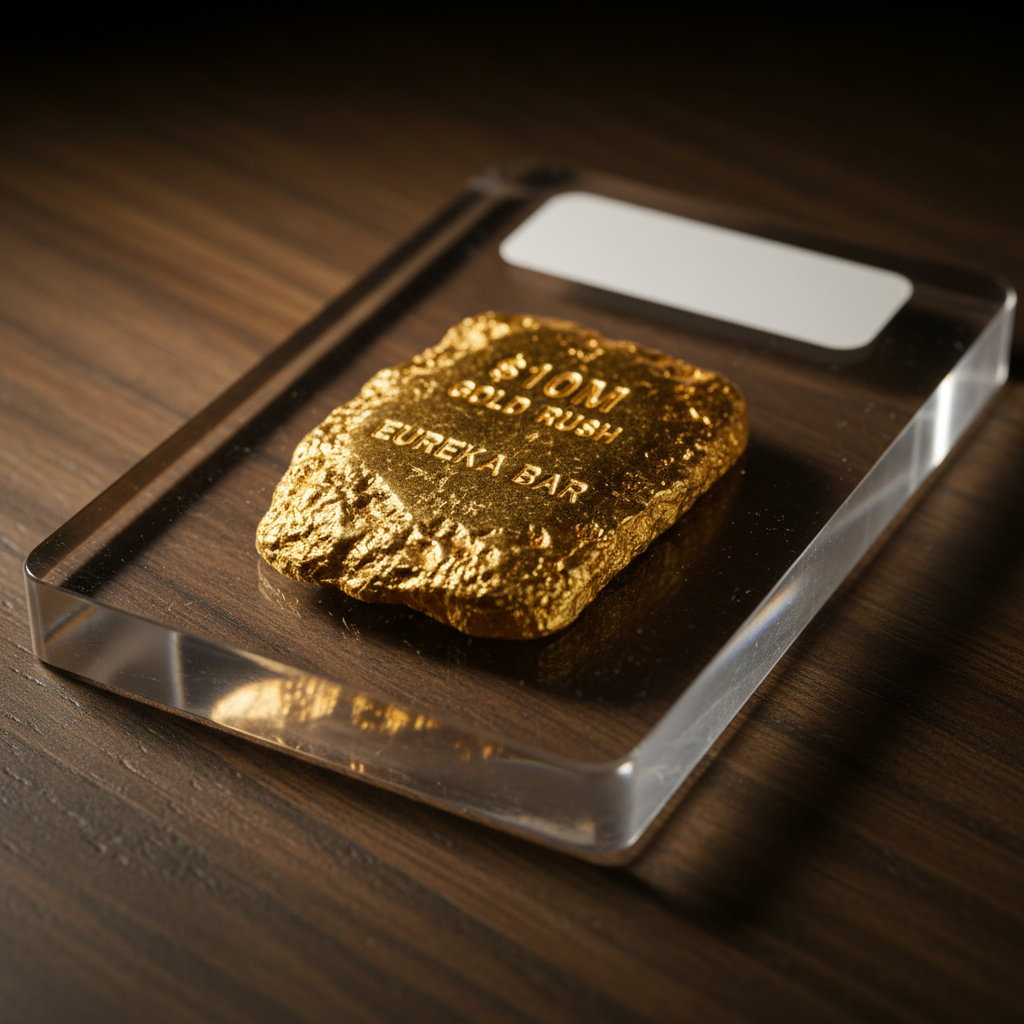
The most storied gold ingot in American numismatic history just got a new chapter. The Eureka Bar — a 64-pound gold ingot recovered from the wreck of the SS Central America and valued at approximately $10 million — is now available for fractional ownership, marking the first time a singular artifact of this magnitude has been structured as a retail investment vehicle for everyday collectors and investors.
This isn't a replica. It isn't a commemorative. It's the real thing: a massive California Gold Rush-era ingot stamped and assayed during the 1850s, lost at sea in 1857 when the SS Central America sank off the Carolina coast in a hurricane, and recovered from roughly 7,200 feet of water during the landmark 1988 salvage operation led by Tommy Thompson and the Columbus-America Discovery Group. The bar carries the assay stamp of Kellogg & Humbert, one of San Francisco's most respected Gold Rush-era assay houses, and its provenance is as clean as it gets in the world of historic artifacts.
The Ship, the Bar, and the Legend
The SS Central America disaster claimed over 400 lives and sent an estimated 30,000 pounds of California gold to the ocean floor — a loss so catastrophic it helped trigger the Panic of 1857. The ship's recovery more than 130 years later produced some of the most significant numismatic and bullion finds in history, including pristine 1857-S Double Eagles that had never circulated and gold ingots that redefined what collectors understood about Gold Rush-era assay work.
The Eureka Bar is the crown jewel of that haul. At 933 troy ounces of gold, its melt value alone hovers around $1.9 million at current spot prices. The premium over melt — roughly 5x — reflects its irreplaceable historical status, its condition (essentially pristine after 130 years on the ocean floor, owing to gold's corrosion resistance), and the near-mythological narrative attached to the SS Central America story. No comparable artifact exists. The Eureka Bar is genuinely one of a kind.
For context: individual 1857-S Double Eagles recovered from the same wreck have sold at Heritage Auctions for six figures apiece in high grades. A complete set of SS Central America gold coins in top condition would run well into the millions. The Eureka Bar occupies an entirely different category — it's not a coin, it's not bullion in any conventional sense, and it doesn't fit neatly into existing grading or auction frameworks. That's precisely what makes the fractional ownership structure both innovative and, frankly, necessary.
Fractional Ownership: Smart Structure or Speculative Leap?
The mechanics of the fractional offering place the Eureka Bar into an ownership vehicle that allows multiple investors to hold a stake in the physical artifact. The bar itself remains in secure, insured storage — it isn't going to be divided or melted. Investors are buying a documented interest in the asset, not a piece of gold they can hold in their hands.
This model has precedent in fine art and real estate, and it's been gaining traction in high-end collectibles. Platforms like Otis and Rally spent years proving the concept with vintage cars, rare sneakers, and sports cards before largely retreating or restructuring. The Eureka Bar offering applies the same logic to a harder asset — one with a fixed supply of exactly one, a verified provenance chain, and a floor value anchored to gold spot price.
That floor matters. Unlike a PSA 10 1952 Topps Mantle or a CGC 9.8 Amazing Fantasy #15, whose values are entirely sentiment-driven, the Eureka Bar carries intrinsic commodity value underneath its historical premium. If the collectibles market corrects sharply, the melt floor provides a cushion that pure paper collectibles simply don't have. That's a meaningful structural difference for investors thinking about downside risk.
The skeptic's case is straightforward: liquidity. Fractional ownership in a unique physical artifact is only as good as the exit mechanism. Buyers need to understand what it takes to sell their stake, who the likely counterparties are, and how pricing is determined in a secondary market that doesn't yet have deep volume or established comps for this specific structure.
What This Signals for the High-End Market
The Eureka Bar offering is a bellwether. The collectibles market has been searching for credible ways to bring institutional-scale assets to a broader investor base without compromising the integrity of the underlying artifact. Coins, cards, and comics have largely solved this through grading and auction transparency. Singular artifacts — items where there's no population report, no comp set, no grade — have remained the exclusive domain of ultra-high-net-worth buyers.
Fractional ownership doesn't fully solve that problem, but it opens the door. If the Eureka Bar offering performs well — if it fills, if secondary trading develops, if the asset appreciates — it creates a template for other landmark pieces: major shipwreck treasures, museum-deaccessioned artifacts, historically significant bullion.
The SS Central America already occupies a permanent place in American history. At $10 million, the Eureka Bar is asking investors to believe that place is worth paying for. Given the alternative — waiting for a private buyer with eight figures to spend and an appetite for Gold Rush mythology — fractional ownership might be the most realistic path this bar has ever had to finding its true market.