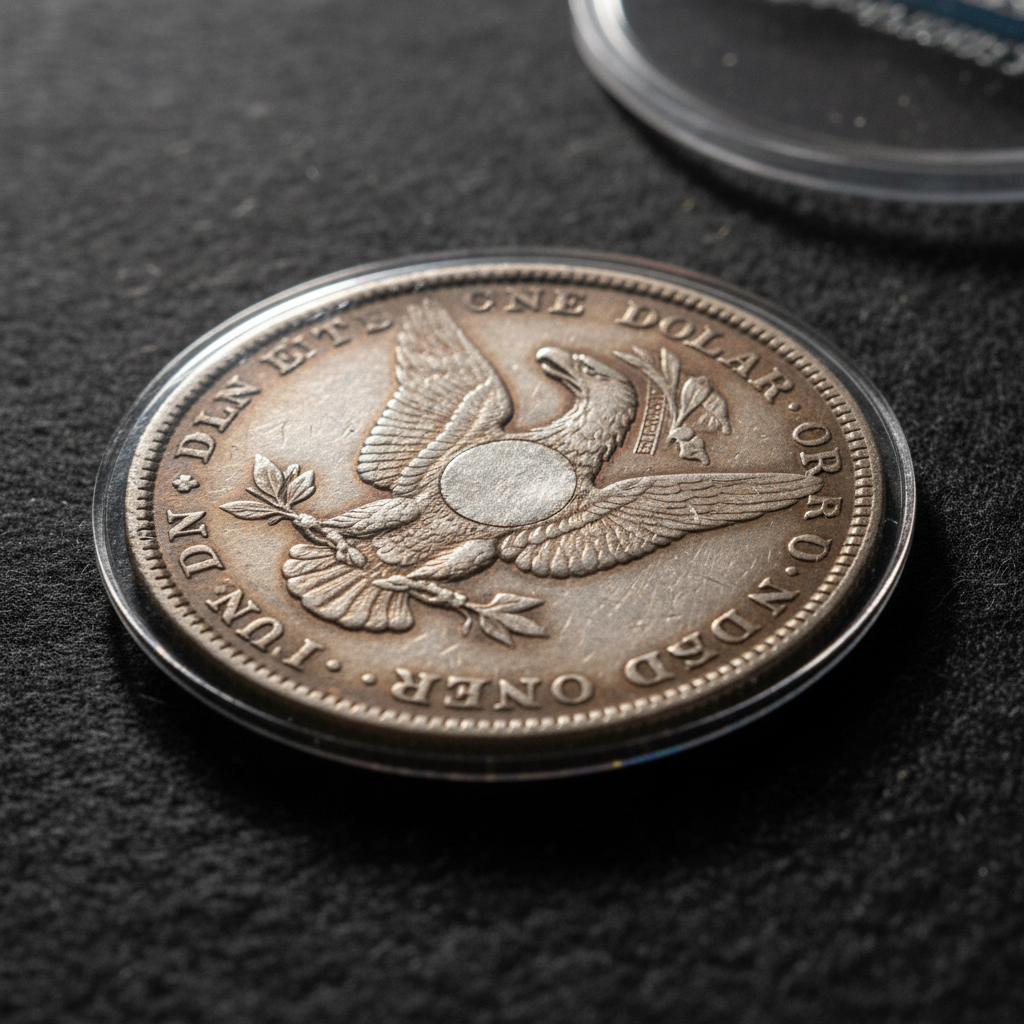
A 1795 Flowing Hair Silver Dollar bearing one of early American coinage's most peculiar and historically loaded features — a hand-inserted silver plug at its center — is heading to auction at GreatCollections, with bidding closing on May 3, 2026. Graded PCGS AU-55 and catalogued as B-7/BB-18, the coin comes from the MJ Sullivan Collection of Early Half Dollars and Dollars, a consignment that alone signals serious provenance.
This isn't just a high-grade early dollar. The silver plug transforms it into a primary document of monetary improvisation at the infant U.S. Mint.
What the Plug Actually Means
When the Philadelphia Mint struck its first silver dollars in 1794 and 1795, it was operating under brutal constraints — hand-powered presses, inconsistent planchet preparation, and a legal mandate to hit precise weight standards. The Coinage Act of 1792 fixed the silver dollar at 416 grains. When a finished planchet came in light, the solution was blunt and direct: drill a small hole in the center, insert a plug of pure silver, and strike the coin over it.
The result is visible to the naked eye on surviving plug examples — a faint circular mark at the coin's core, sometimes slightly raised, sometimes barely perceptible depending on strike and wear. On an AU-55 example like this one, with meaningful original detail still present, that plug is a tactile artifact of an era when the federal government was quite literally figuring out how to make money.
Silver-plug dollars are scarce by any measure. Among all 1795 Flowing Hair Dollar varieties, plugged examples represent a small fraction of surviving population, and high-grade survivors are rarer still. PCGS has certified relatively few AU-55 or better plug dollars across all die marriages, making this coin's grade as significant as its variety designation.
The BB-18 Variety and Why Die Marriage Matters
The B-7/BB-18 designation situates this coin within the Bolender and Bowers-Borckardt reference systems — the two authoritative frameworks for early dollar attribution. Variety collecting in early American coinage isn't a niche hobby; it's the dominant collecting paradigm. Die marriages determine rarity, historical sequence, and ultimately value in ways that grade alone cannot.
Among 1795 Flowing Hair Dollar varieties, the BB-18 is a recognized silver plug marriage, which means its plug status is variety-confirmed rather than incidental. That distinction matters enormously. A plug coin that happens to be a plug coin is interesting. A plug coin whose die marriage is specifically associated with the plug technique is a documented chapter in Mint history.
The MJ Sullivan Collection provenance adds another layer. Named collections — especially those focused on early U.S. coinage — carry collector cachet that translates directly to auction premiums. Buyers aren't just acquiring a coin; they're acquiring a coin with a documented ownership history in a curated, serious collection. In the early dollar market, that pedigree routinely adds 10–20% to realized prices versus comparable ungrouped examples.
Pricing the Unpriceable
AU-55 is a compelling grade for a coin like this. It's firmly in the About Uncirculated tier — original luster still present in protected areas, major design elements sharp — without carrying the stratospheric premium of MS-60 and above, where early dollar prices can climb past $100,000 for common varieties and multiples of that for rare ones.
Recent Heritage and Stack's Bowers auction results for PCGS AU-55 Flowing Hair Dollars without the plug feature have landed in the $30,000–$55,000 range depending on variety and eye appeal. The silver plug premium on verified examples has historically pushed realized prices 15–30% above comparable non-plug coins at the same grade — a premium that reflects both scarcity and the storytelling power the feature carries.
GreatCollections has built a legitimate reputation in the early American coin space, offering serious material to a broad bidder base with lower buyer's premiums than the major houses. For a coin of this caliber, that fee structure could meaningfully affect net cost to the winning bidder.
The 1795 Flowing Hair Dollar was minted for only two years before the design gave way to the Draped Bust type. Every surviving example is, by definition, a relic of the first generation of American silver coinage. Add a silver plug, a named collection, and an AU-55 grade, and you have a coin that doesn't need to be oversold. The history is already doing the work.