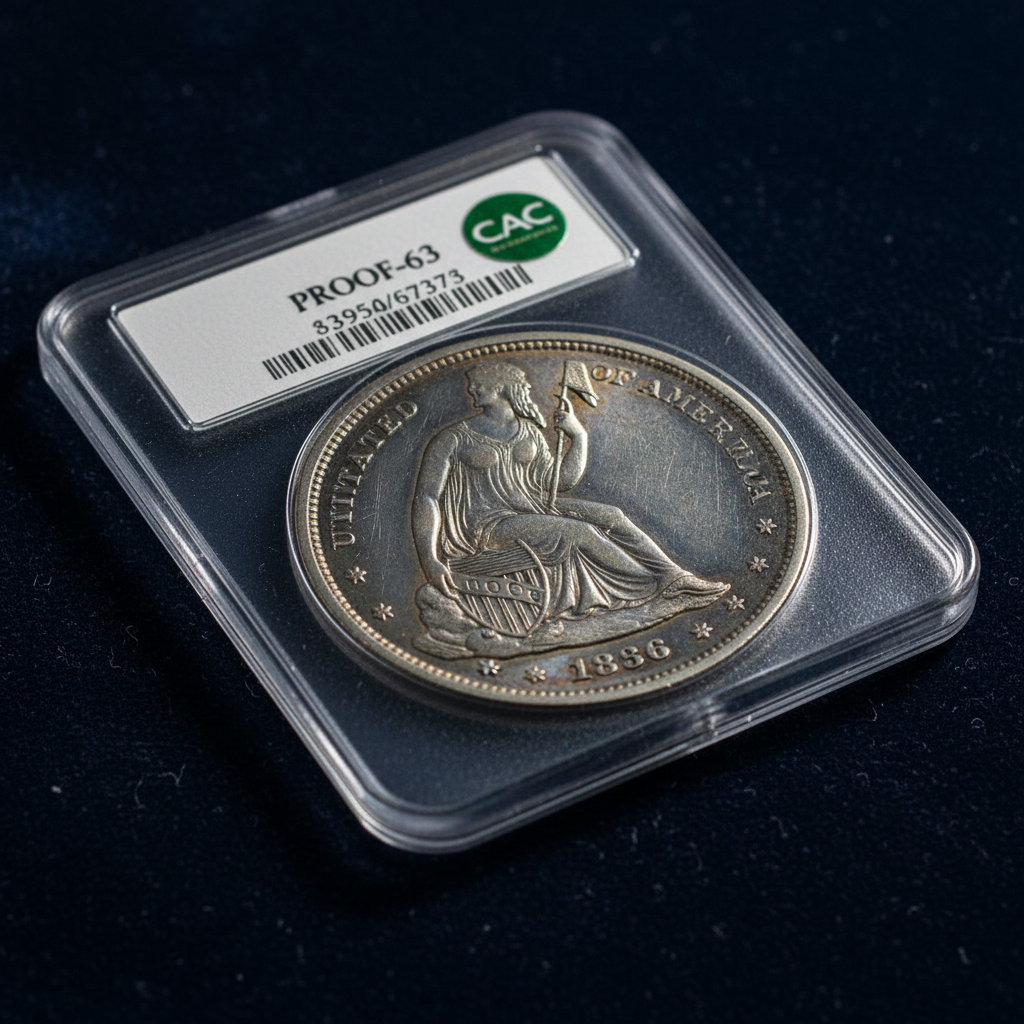
Few coins in American numismatics carry the symbolic weight of the 1836 Gobrecht Silver Dollar. This was the coin that broke a 35-year silence — the U.S. Mint had not struck a circulating silver dollar since 1804's production halt, and the Gobrecht was the prototype that proved the country was ready to try again. Now, a PCGS Proof-63 example with a CAC Green sticker is heading to auction through GreatCollections, with bidding closing Sunday, May 17, 2026, at 5:39 p.m. Pacific Time.
The coin is catalogued as GC Item ID 2101782, certified under PCGS certification number 21718963. Medal alignment. Original dies. The full package.
Why the 1836 Gobrecht Is Different From Every Other Early Dollar
Christian Gobrecht's design — the seated Liberty obverse that would define American coinage for decades — debuted on this very issue. The 1836 Gobrecht Dollar wasn't just a new coin; it was a design manifesto. Gobrecht's flowing, classically-inspired Liberty replaced the earlier bust portrait and set the aesthetic template that persisted through the Seated Liberty series well into the 1870s.
The 1836 issue comes in two primary orientations: coin alignment (dies set so that obverse and reverse rotate 180 degrees relative to each other, standard for U.S. coinage) and medal alignment (dies set so both sides orient the same direction, as with medals). This example is medal alignment, which corresponds to the original striking intended for presentation and circulation trials. That distinction matters enormously to specialists. The medal-alignment 1836 Gobrecht is the historically authentic configuration — the one Mint Director Robert Patterson and Treasury officials actually handled when approving the design.
Original strikings from 1836 are distinguished from the restrikes produced in the 1850s and 1870s, when Mint officials quietly restruck Gobrecht dollars to satisfy collector demand — a practice that was, to put it diplomatically, ethically complicated. Identifying originals versus restrikes requires careful die analysis and alignment verification. PCGS's designation here as an original, combined with the medal alignment, puts this coin in the most historically significant tier of the entire Gobrecht series.
The Grade, the CAC Sticker, and What the Market Is Saying
At Proof-63, this coin sits in the middle of the proof grade spectrum — above the problem-coin territory of PR-60 and PR-61, but below the pristine surfaces that command exponential premiums at PR-65 and above. For a coin approaching 190 years old, PR-63 represents a genuinely collectible example with visible eye appeal and only modest contact marks or hairlines under magnification.
The CAC Green sticker adds a meaningful layer of validation. CAC — the Certified Acceptance Corporation — reviews PCGS and NGC-graded coins and awards a green sticker only when the coin is considered solid for its grade. In a series where surface cleaning, artificial toning, and questionable originality are persistent concerns, CAC's endorsement on a Gobrecht is not a formality. It's a substantive signal to advanced buyers.
Comparable sales tell a compelling story. PCGS PR-63 examples of the original 1836 Gobrecht in medal alignment have traded at major auction houses — Heritage, Stack's Bowers — in ranges from roughly $50,000 to over $100,000 depending on eye appeal, surface quality, and the specific auction cycle. The CAC sticker on this example positions it toward the stronger end of that range, though GreatCollections' platform, which skews toward competitive internet bidding rather than floor-driven auction theater, sometimes produces results that surprise in both directions.
The population of PCGS-graded original 1836 Gobrecht Dollars in all proof grades is genuinely small — this is not a coin where thousands of examples exist across the registry. The series is rare by any modern standard, and original medal-alignment pieces represent a fraction of that already-thin population.
GreatCollections as the Venue
GreatCollections has built a credible reputation for handling significant early American coinage without the overhead — and buyer's premiums — of the major auction houses. For a coin at this price point, the platform choice is deliberate. Serious early American collectors have learned to watch GreatCollections closely; the platform has moved multiple six-figure coins in recent years, and its transparent bidding history gives buyers confidence in the final price discovery process.
The May 17 deadline creates a defined window. Collectors interested in this piece should be tracking the lot now — GreatCollections' closing-time bidding can be aggressive on major early American coins, and last-minute sniping on a Gobrecht with CAC endorsement is essentially guaranteed.
The 1836 Gobrecht Silver Dollar is one of those coins that collectors either understand immediately or need to study before they appreciate. Once you understand what it represents — the restart of American dollar coinage, the birth of a design language that lasted 40 years, the physical artifact that passed through the hands of 19th-century Mint officials deciding the future of American money — the price starts to look like a bargain for what you're actually acquiring.