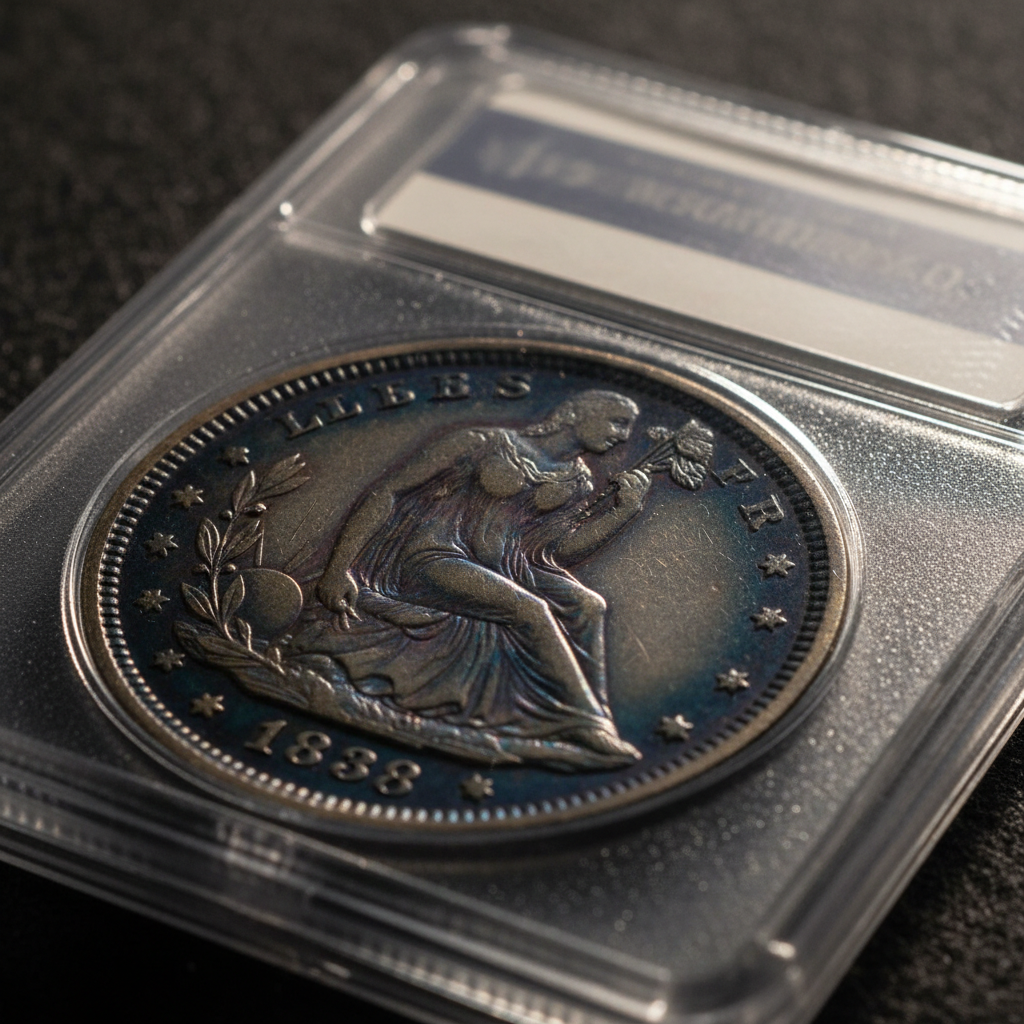
Only about nine to twelve examples of the 1838-O Capped Bust half dollar are believed to exist. That's not a misprint. For a coin struck at a functioning United States Mint in its inaugural year of operation, that survival rate borders on the inexplicable — and it's precisely what makes the 1838-O one of the most coveted silver rarities in all of American numismatics.
When the New Orleans Mint opened its doors in 1838, it was a political statement as much as a practical one. The federal government wanted coinage infrastructure in the South to service a booming cotton economy and reduce dependence on Eastern financial centers. The facility was authorized, constructed, and operational within a few years — a genuine achievement for the era. Yet the half dollars it struck in that first year essentially vanished.
What the Production Record Does — and Doesn't — Tell Us
The Mint's own records suggest a modest number of half dollars were produced at New Orleans in 1838, but the documentation is incomplete enough that numismatists have long debated whether the surviving coins represent proof-like presentation pieces, early die trials, or simply an extremely limited regular-issue run that was largely melted or lost to circulation attrition. The coins bear the O mintmark — the first time that mark appeared on a United States coin — tucked above the date on the obverse, a placement that would later migrate to the reverse on subsequent issues.
That mintmark placement detail alone makes the 1838-O historically significant independent of its rarity. It marks a transitional moment in how the U.S. Mint communicated the origin of its coinage to the public. Branch mint coins had existed before, but the 1838-O half dollar is where the modern mintmark convention effectively begins.
The surfaces on surviving examples tend toward prooflike fields with sharp, well-defined devices — consistent with coins struck from fresh dies with care, possibly for distribution to dignitaries or government officials at the mint's opening. That theory has never been definitively proven, but it aligns with the physical evidence and the survival pattern. Coins handled as keepsakes from day one tend to survive. Coins dropped into commerce in 1838 New Orleans do not.
Where the Market Stands
The last major auction appearances of the 1838-O half dollar have been events. A PCGS MS-62 example sold through Stack's Bowers for over $500,000, a figure that reflects both the coin's absolute scarcity and the sustained demand from advanced type collectors and early American specialists who regard it as a cornerstone piece. Even problem-free circulated examples — genuine, unaltered coins grading VF or EF — routinely clear $100,000 to $200,000 at major auction houses including Heritage Auctions and Goldberg Coins.
For context: the 1838-O is frequently mentioned alongside the 1804 Silver Dollar and the 1913 Liberty Head Nickel as coins where provenance and pedigree matter as much as grade. When a specimen surfaces with documented lineage — traced through major collections like Eliasberg, Bass, or Pittman — the premium over a coin of identical technical grade can be substantial. Collectors in this tier are not just buying metal and design. They are buying history with receipts.
Population data underscores the scarcity in stark terms. PCGS and NGC combined have certified fewer than a dozen distinct examples across all grades — a number that has not meaningfully changed in decades because there simply are no more coins to find. The population is effectively closed. When one comes to market, it is almost certainly a coin that has appeared before, and serious bidders arrive with research already done.
The Collector Reality
Assembling a complete set of Capped Bust half dollars by date and mintmark is considered one of the most demanding pursuits in early American coinage. The series runs from 1807 to 1839 and contains numerous scarce dates — the 1815/2, the various early Philadelphia issues with low mintages — but the 1838-O is the wall that stops nearly every set builder cold. It is not a coin you find at a show. It is a coin you wait years to have the opportunity to buy, and then you need the resources to act when it appears.
That dynamic creates a secondary market effect worth watching. As generational wealth transfers accelerate and major collections come up for settlement, the 1838-O will surface with increasing frequency over the next decade — relatively speaking. Perhaps one or two auction appearances every few years rather than one per decade. Each appearance will reset the price benchmark. Each one will remind the market that certain coins exist in a category beyond scarcity.
The New Orleans Mint operated until 1909, striking hundreds of millions of coins across seven decades. Its first year produced one of the rarest American coins ever made. That irony is not lost on anyone who has held one.