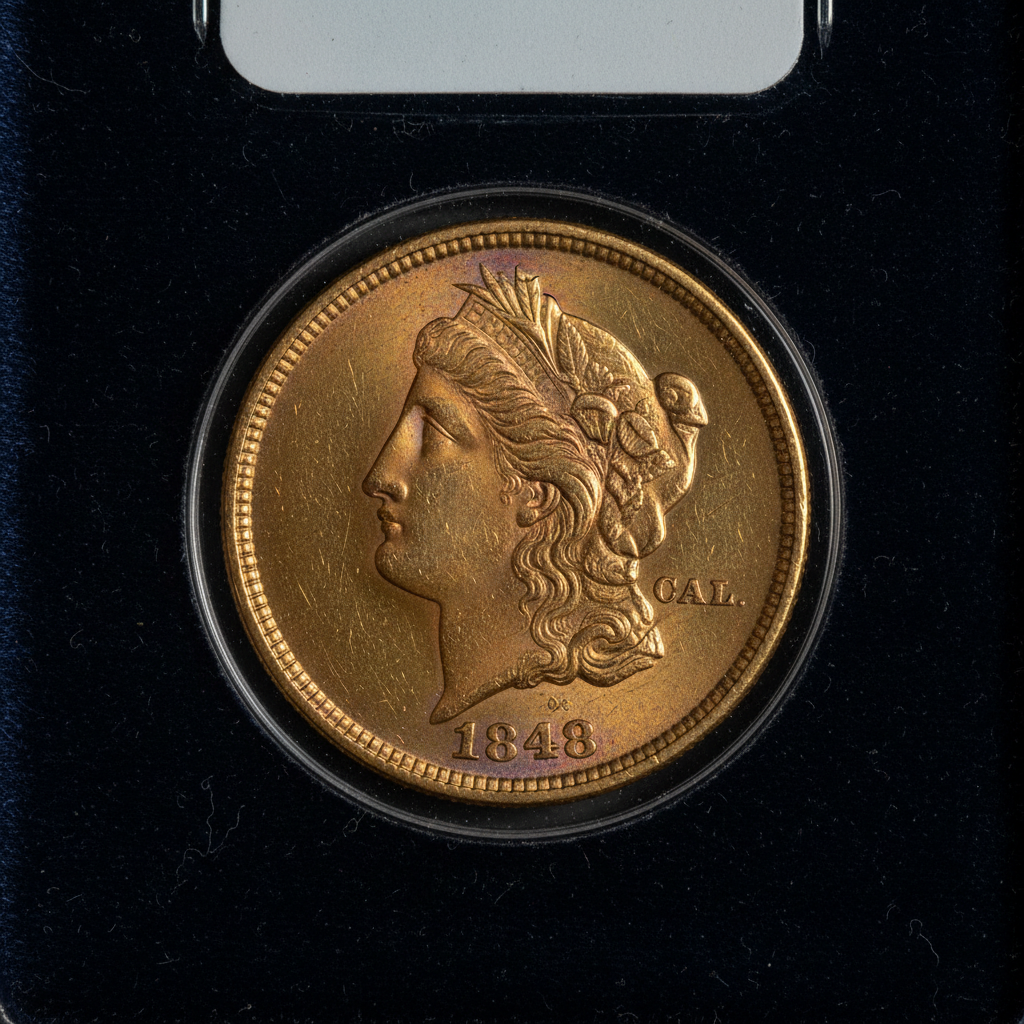
Only 1,389 examples of the 1848 CAL. Liberty Head Quarter Eagle were ever struck — and every single one carries a counterstamp that makes it unlike any other coin in American history. This is not a mint variety or a die anomaly. It is a deliberate, government-sanctioned mark pressed into gold that was physically carried overland from California to Washington, D.C., arriving at the Philadelphia Mint as direct proof of a nation-changing discovery.
James Wilson Marshall's find at Sutter's Mill in January 1848 set off one of the most consequential migrations in American history. But the federal government's response was measured, even bureaucratic. California was not yet a state. The newly acquired territory — ceded by Mexico under the Treaty of Guadalupe Hidalgo just days after Marshall's discovery — had no operating mint. When Colonel Richard Barnes Mason, the military governor of California, dispatched a courier east with roughly 230 ounces of placer gold as physical evidence of the find, the Mint had to decide what to do with it.
The answer was elegant in its simplicity: coin it, and mark it. The resulting quarter eagles — struck in 1848 and counterstamped CAL. on the reverse above the eagle — became the first U.S. coins produced from California gold. That provenance is baked into the metal itself.
Why the Counterstamp Changes Everything
Most numismatic varieties derive their value from scarcity alone. The 1848 CAL. is different. Its rarity is inseparable from its narrative. The counterstamp was applied at the Mint before the coins were struck, meaning it appears on the die-struck reverse, not as an afterthought. Every coin in the issue carries the same mark. There are no examples without it.
That distinction matters to graders and collectors alike. PCGS and NGC both recognize the CAL. designation as a distinct issue, not a variety of the standard 1848 quarter eagle — and they grade it accordingly. The population data reflects just how carefully these coins have been preserved relative to their mintage. PCGS has certified examples across a wide grade range, with the bulk of survivors clustering in the VF-20 through EF-45 range. Mint State examples exist but are genuinely rare; a PCGS MS-62 or better commands a premium that reflects both condition scarcity and the issue's historical weight.
At auction, the numbers tell a clear story. A PCGS-graded MS-62 example sold through Heritage Auctions for approximately $72,000 in recent years, while high-end Mint State pieces with CAC approval have pushed past $100,000. Even circulated examples in the VF-30 to EF-40 range routinely bring $5,000 to $12,000 depending on strike quality and eye appeal. This is not a coin where condition alone drives the market — originality and surface quality matter enormously to serious buyers.
Design, Specifications, and What to Look For
The coin itself is a product of Christian Gobrecht's Liberty Head design, which had been in use on quarter eagles since 1840. The obverse features a left-facing Liberty wearing a coronet inscribed LIBERTY, surrounded by thirteen stars and dated 1848. The reverse carries the heraldic eagle standard to the series — and, critically, the CAL. counterstamp punched above the eagle's head.
- Denomination: Quarter Eagle ($2.50 gold)
- Composition: 90% gold, 10% copper
- Weight: 4.18 grams
- Diameter: 18mm
- Mintage: 1,389 pieces
- Designer: Christian Gobrecht
- Mint: Philadelphia (no mintmark)
When evaluating an example, focus on the sharpness of the counterstamp itself. Weak or mushy CAL. impressions can indicate a late die state and typically soften collector interest. The strike on the eagle's breast feathers and Liberty's hair above the ear are the standard weak points for this issue. Original skin — meaning undipped, naturally toned surfaces — is increasingly valued as the market matures.
Market Position in 2024 and Beyond
The 1848 CAL. sits at an interesting intersection in today's market. It is expensive enough to be out of reach for most casual collectors, yet accessible enough that serious type collectors and early American gold specialists actively pursue it. It is not a six-figure rarity in average grades, which means it competes directly with other meaningful early gold issues for wallet share.
What works in its favor is the story. In an era when provenance and narrative increasingly drive auction results — see the sustained premiums on coins with documented pedigrees or historical connections — the 1848 CAL. has a provenance that is literally struck into the coin. You do not need paperwork. You do not need a prior owner's name. The coin announces its own history.
The California Gold Rush bicentennial window has already passed, but demand for this issue has not softened meaningfully. If anything, the pool of available examples in original, problem-free condition continues to shrink as more coins enter long-term collections. For a 176-year-old gold coin with a mintage under 1,400, that trajectory only moves in one direction.