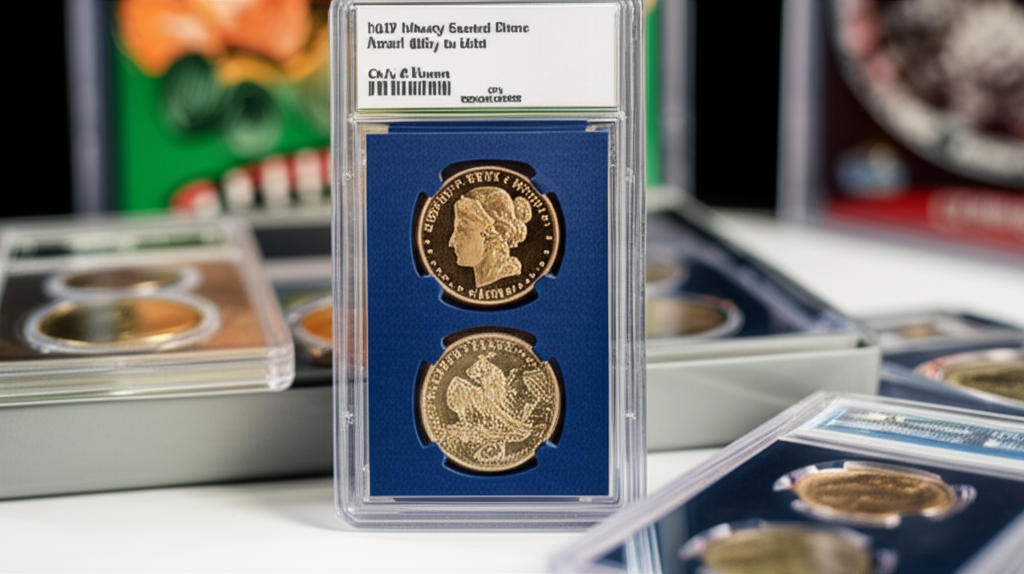
Four coins. That's the entire known population of the 1849 Liberty Seated Dime Proof — one of the most elusive numismatic artifacts the Philadelphia Mint ever produced, and a piece so rare it barely registers on conventional rarity scales because there's almost nothing to compare it against.
The Mint struck 839,000 Liberty Seated Dimes for general circulation that year. The Proof production was an afterthought by volume — estimated at no more than 10 pieces, possibly fewer. Of those, only four have surfaced in the historical record. Every single one carries a documented provenance trail connecting it to major collections or significant auction appearances. This isn't a coin that slips quietly through estate sales unrecognized.
Understanding the Rarity Designation
The Fortin-107 die variety designation places this coin within the specialized classification system developed for Liberty Seated coinage, and its Rarity-7+ rating under the Sheldon rarity scale tells you almost everything you need to know about supply. R-7 coins are defined as having 4 to 12 known examples. The plus modifier pushes this specimen toward the absolute floor of that range — effectively, it's a coin that exists more as a concept than a market.
For context: an R-5 coin, considered quite rare, might have 31 to 75 known examples. An R-6 drops to 13 to 30. At R-7+, you're in territory where a single example changing hands is a market-defining event, not a data point in a trend line.
Proof coinage from this era was never meant for mass distribution. The Philadelphia Mint produced Proofs primarily for presentation purposes, foreign dignitaries, and the occasional collector who had the right connections and the right timing. Record-keeping was inconsistent at best. The gap between estimated mintage — up to 10 pieces — and confirmed survivors — exactly 4 — reflects both the fragility of 19th-century record-keeping and the brutal attrition that time inflicts on even the most carefully preserved coins.
What the Market Actually Looks Like
Pricing an 1849 Liberty Seated Dime Proof is an exercise in extrapolation rather than comparison. There is no active market. There is no recent auction comp to anchor a valuation. When a coin exists in a population of four, its price is whatever the room decides on the day it appears — which is precisely what makes these appearances so significant when they do occur.
Heritage Auctions and Stack's Bowers are the houses most likely to handle material of this caliber, and both have deep experience moving coins where the collector base is narrow and the stakes are high. A coin like this doesn't sell to a casual bidder who wandered in looking for a type set filler. It sells to a specialist — someone who has spent years, possibly decades, waiting for the opportunity.
Grading services present their own complications here. With only four examples in existence, population reports from PCGS or NGC carry unusual weight. Each certified example is effectively a known quantity in the numismatic community, tracked and discussed with the kind of attention usually reserved for major rarities in any collectibles category. The grade on any individual example matters enormously — the difference between a PR-62 and a PR-65 on a coin this scarce isn't just a number, it's a meaningful distinction in what is, functionally, a private market.
The Provenance Factor
Every one of the four known 1849 Proof dimes carries documented collection history. That's not a coincidence — it's a function of how rare coins of this magnitude survive. They don't sit in shoeboxes. They move through major collections, appear in landmark auction catalogs, and accumulate provenance the way significant art accumulates exhibition history.
Provenance on a coin this rare does more than authenticate. It narrates. A piece that passed through a celebrated 19th-century collection before appearing at a major early-20th-century auction sale before landing in a modern specialist collection carries a story that collectors pay for, sometimes significantly. In a market with no pricing floor and no ceiling, story is a legitimate variable.
The 1849 Liberty Seated Dime Proof isn't a coin most collectors will ever own, or even see in hand. But it represents something the broader collectibles world consistently undervalues: the category of objects so rare that their significance is almost entirely qualitative. Four examples. Estimated mintage of ten. A rarity rating that sits at the outer edge of the scale. This is what genuine scarcity looks like — not a short print run of thousands, but a production measured in single digits and a survival rate that makes every known example a numismatic landmark.