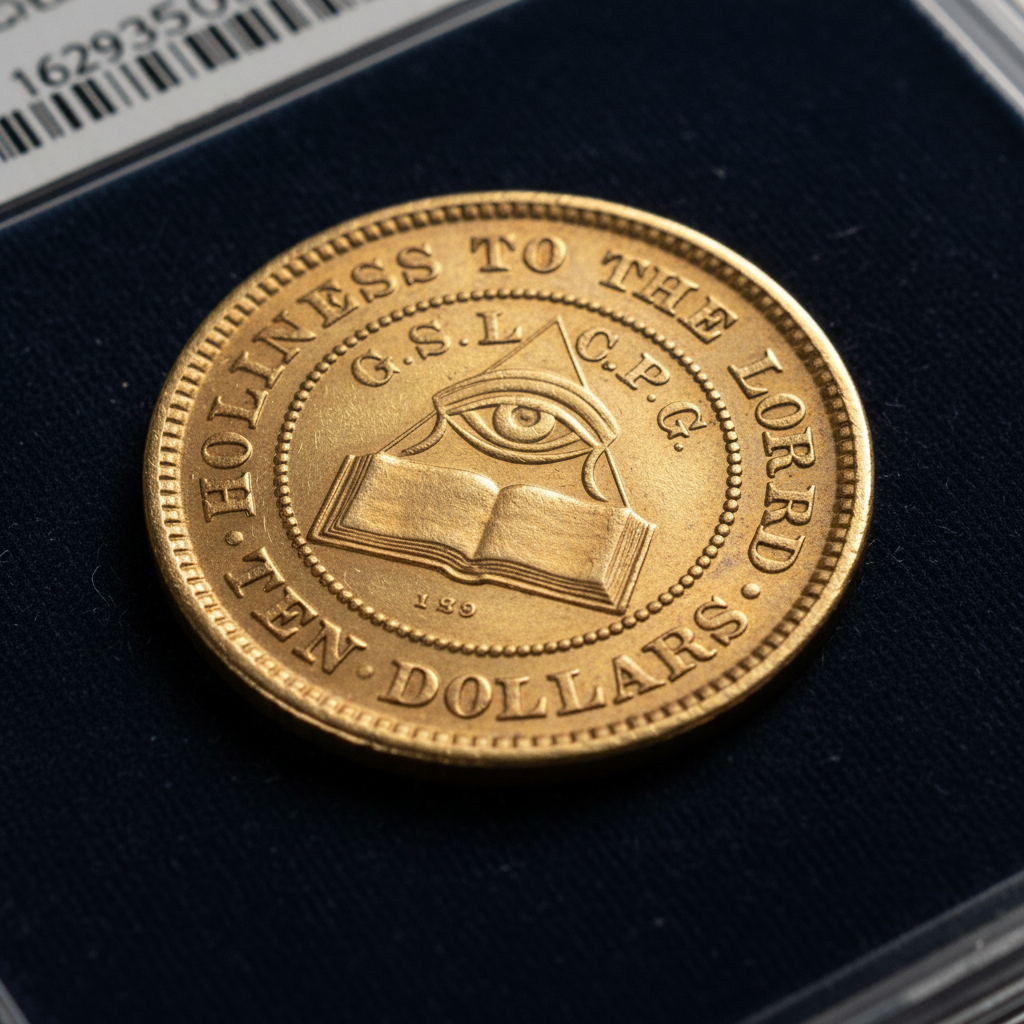
Fewer than ten examples of the 1849 Mormon $10 gold piece are confirmed to exist. That population figure alone places it in rarefied company — not just among territorial gold issues, but among all American numismatic rarities, full stop. So when one surfaces at public auction carrying a four-generation pedigree, the market pays attention.
In December 2020, Stack's Bowers Galleries offered exactly that: a specimen from the Larry H. Miller Collection, tracing its documented ownership through the Green-Kern-Carter-Miller pedigree — a lineage that reads like a who's-who of serious American coin collecting across the better part of a century. Pedigree matters in this market. For a coin this scarce, it's often the difference between a transaction and an event.
The Context Behind the Coin
The 1849 Mormon $10 was struck by the provisional government of Deseret — the theocratic state established by Brigham Young and the Latter-day Saints in the Utah Territory before federal authority asserted itself. The coins were produced at the Salt Lake City mint using California gold dust brought back by Mormon Battalion veterans who had passed through the goldfields. They were crude by Philadelphia Mint standards, intentionally so: function over form, necessity over aesthetics.
That utilitarian origin is precisely what makes them historically irreplaceable. These weren't vanity issues or commemoratives. They were working money, minted under extraordinary circumstances by a community that had been driven from Missouri and Illinois and was now trying to build a civilization in the desert. The coins circulated, wore down, and largely disappeared. The handful that survived did so almost by accident.
The $10 denomination is the rarest of the 1849 Mormon series, which also includes $2.50 and $5 pieces. Where the smaller denominations occasionally appear at major sales — Heritage and Stack's Bowers have handled a handful of examples across the past two decades — a $10 offering is genuinely uncommon. When it arrives with documented provenance dating back multiple generations of prominent collectors, it becomes a singular opportunity.
What the Pedigree Adds
The Green-Kern-Carter-Miller chain isn't window dressing. In American numismatics, a multi-generation pedigree on a coin of this rarity serves several functions simultaneously. It authenticates the piece through a chain of custody that predates modern third-party grading services. It anchors the coin's market history, giving bidders a reference point for how the piece has been valued across different eras of the hobby. And it connects the coin to collectors whose reputations themselves carry weight.
Larry H. Miller — the Utah businessman and longtime owner of the Utah Jazz — assembled one of the more distinguished numismatic collections in the Mountain West, with a particular focus on coins tied to Mormon and Utah history. That curatorial focus makes the provenance feel organic rather than opportunistic. Miller didn't just own this coin; it fit a coherent collection built around a specific historical narrative.
Stack's Bowers was the natural home for the sale. The firm has handled more significant American territorial gold than any other auction house, and their December 2020 catalog positioned the Miller Collection material as the centerpiece it deserved to be.
Territorial Gold as an Asset Class
The broader market for American territorial gold has shown remarkable resilience over the past decade, outperforming many other areas of classic American numismatics. Issues from the California private mints — Moffat, Kellogg, Wass Molitor — have seen consistent demand from both dedicated specialists and crossover buyers from the broader rare coin market. The Mormon issues occupy a distinct niche within that universe, combining territorial rarity with religious and pioneer history in a way that attracts collectors who might not otherwise focus on pre-federal coinage.
For a coin with a surviving population that can be counted on two hands, the concept of a market comp barely applies. Each transaction is essentially its own data point. What the auction record does establish is a floor — and for the 1849 Mormon $10, that floor has historically been set at a level that reflects the coin's status as one of the genuinely irreplaceable artifacts of American westward expansion.
Ten coins. One just changed hands with full provenance intact. The next time one surfaces — and there's no predicting when that will be — this sale will be the reference point every serious bidder consults first.