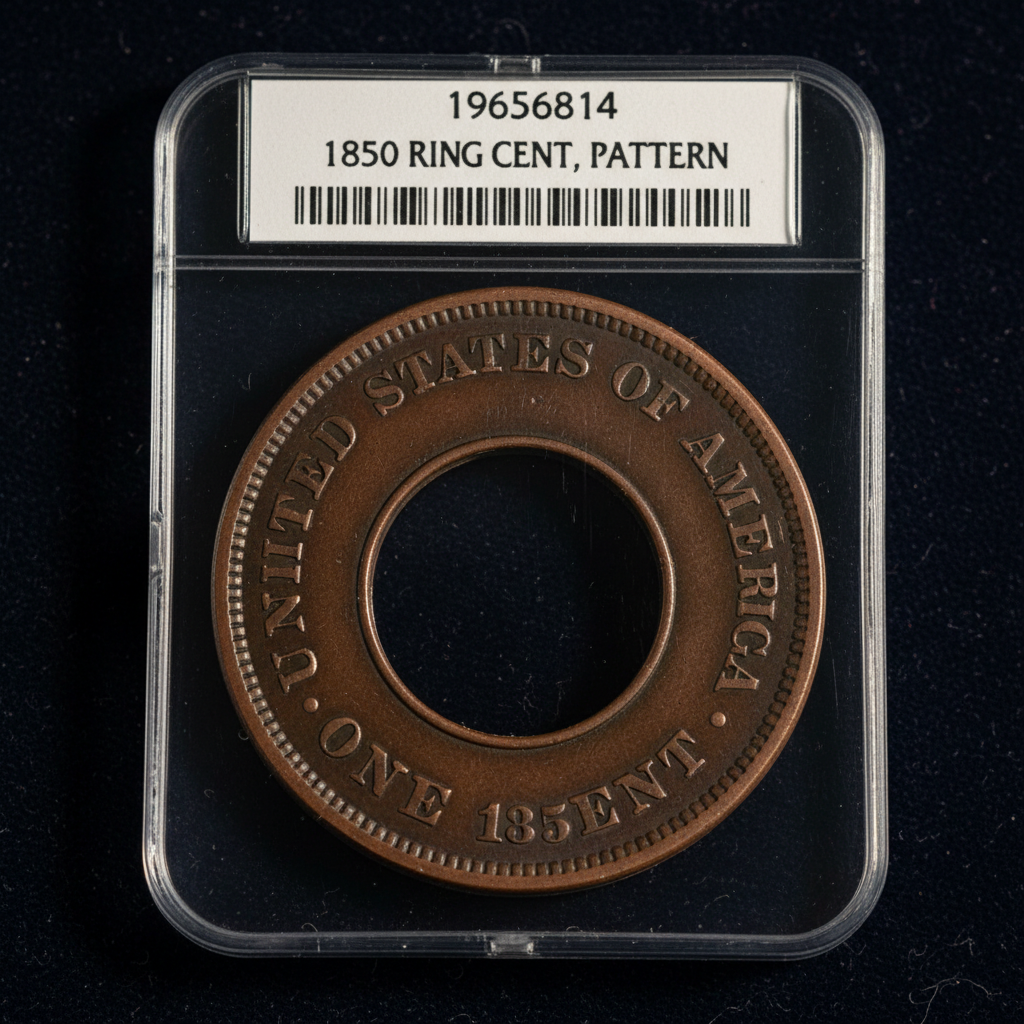
Before the Flying Eagle cent landed in American pockets in 1857, the U.S. Mint was already deep into an identity crisis over the penny. Copper was expensive. The large cent — nearly the size of a modern half dollar — had become an embarrassment of material cost. And in 1849, Congressman Samuel F. Vinton pushed Mint Director Robert M. Patterson for something better. What Patterson's team produced was one of the strangest, most audacious pattern coins in American numismatic history: the 1850 Ring Cent.
The concept was simple and radical in equal measure. Strike a smaller cent from a copper-nickel alloy, but punch a hole through the center — a ring shape — to give it a size and feel distinct from any other coin in circulation. The hole wasn't decorative. It served a mechanical purpose: by removing material from the middle, the Mint could produce a coin with a larger diameter than its weight alone would justify, making it harder to confuse with other denominations. Think of it as 19th-century UX design.
Several design variations were struck as patterns, including pieces attributed to engraver James B. Longacre. The obverses carried a head of Liberty; the reverses bore the denomination and wreath motifs consistent with the era. These were never intended for public circulation — they were proof-of-concept strikes meant to persuade legislators and Treasury officials that a new cent was viable.
Why the Ring Cent Never Made It
The Ring Cent died in committee, essentially. Congressional appetite for coinage reform in the early 1850s was inconsistent, and the Mint faced technical objections about striking a holed coin at scale. There were also aesthetic concerns — a coin with a hole looked foreign, more like something from the Netherlands or Japan than from the American Republic. The design felt imported, not invented.
What ultimately killed it was timing. The small-cent debate dragged on through the early 1850s, and by the time Congress passed the Act of February 21, 1857, the Flying Eagle cent — a solid, no-hole design in 88% copper and 12% nickel — had won the internal argument. The Ring Cent became a footnote. A beautiful, collectible footnote.
The large cent it was meant to replace was officially retired that same year, ending a 63-year run. The Ring Cent never got its moment. The Flying Eagle did — briefly, before being replaced itself by the Indian Head cent in 1859.
What These Patterns Fetch Today
Pattern coins from this era occupy a peculiar and coveted corner of the U.S. coin market. They exist in tiny populations — most Ring Cent varieties are believed to survive in quantities of fewer than a dozen examples — and they appeal to both type collectors and serious pattern specialists.
At Heritage Auctions, pattern cents from the 1850s in grades of PR-63 to PR-65 have consistently cleared five figures, with exceptional examples pushing into the $30,000–$60,000 range depending on variety and eye appeal. The Ring Cent variants catalogued in the Judd reference — the standard guide for U.S. pattern coins — carry individual Judd numbers that specialists track obsessively. A Judd-128 or adjacent variety in a PCGS or NGC holder at PR-64 is not a coin you find at a coin show. It's an auction event.
The broader pattern coin market has strengthened meaningfully over the past decade. Collectors who once focused purely on regular-issue series have migrated toward patterns as a way to own genuine Mint history in a format that's rarer than almost any business-strike rarity. A pattern coin isn't a mistake or an anomaly — it's a deliberate artifact of a decision that was almost made. That narrative premium is real, and the market prices it accordingly.
For the Ring Cent specifically, condition is everything. These were struck as presentation pieces, so survivors in problem-free PR-64 or better command a dramatic premium over cleaned or impaired examples. PCGS and NGC population reports for the various Judd-numbered Ring Cent varieties show single-digit certified totals across most grades — which means a fresh-to-market example in a major auction can genuinely reset the comp.
The 1850 Ring Cent didn't change American coinage. But it documented the moment the Mint was willing to try anything. In a hobby where provenance and historical weight drive value as much as metal and grade, that's not nothing. That's the whole story.