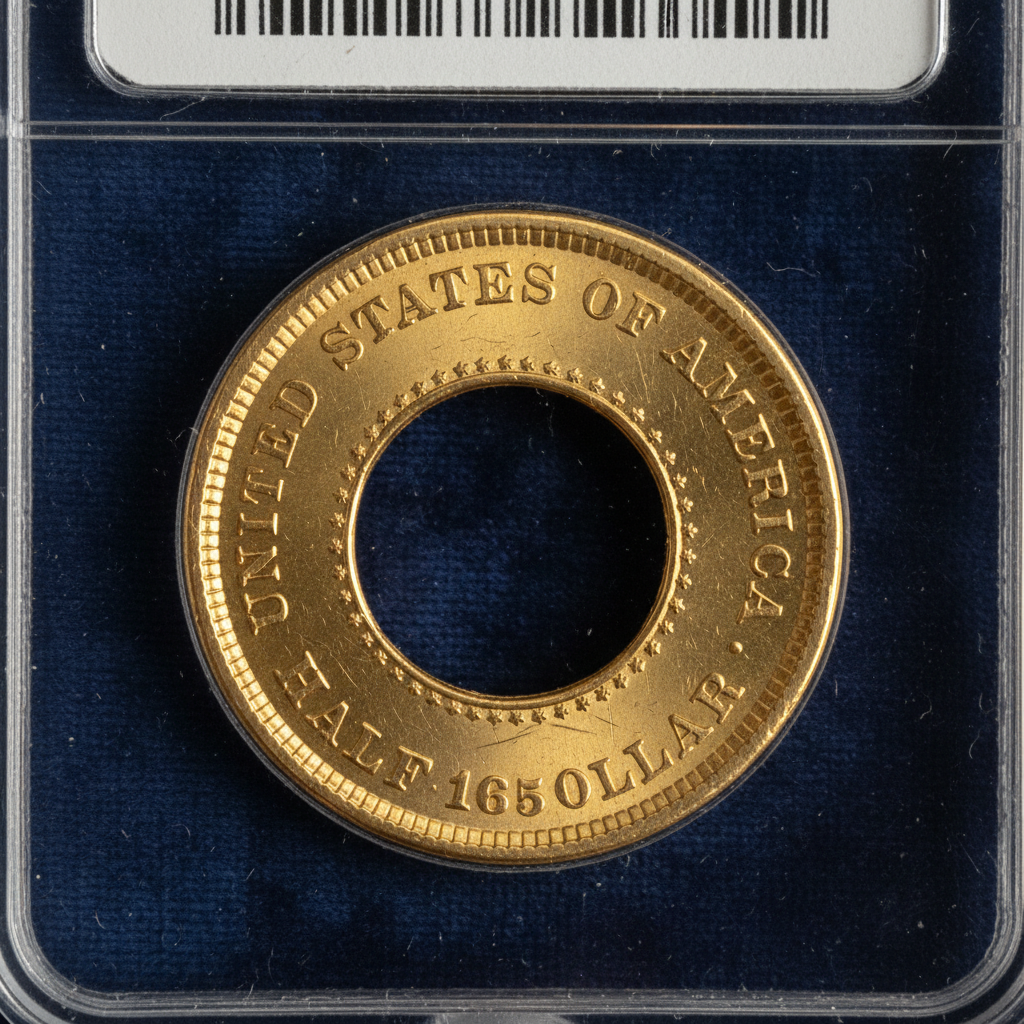
The U.S. Mint has produced its share of oddities over two and a half centuries, but few experiments are as visually arresting — or as historically loaded — as the 1852 Pattern Annular Gold Half Dollar. Ring-shaped. Gold. Struck in the middle of a monetary crisis. And today, fewer than a dozen confirmed examples exist anywhere in the world.
That survival rate alone would make this a significant numismatic rarity. The backstory makes it extraordinary.
A Gold Shortage and a Radical Fix
By 1851, the California Gold Rush had done something counterintuitive to American commerce: it made gold too abundant, which caused silver coins to vanish from circulation almost overnight. As gold flooded the economy, the market value of silver rose above its face value in coinage. Rational actors — merchants, banks, ordinary citizens — melted silver coins for bullion profit. The result was a crippling shortage of small-denomination silver coinage that paralyzed everyday transactions.
Congress responded in 1853 with the Coinage Act, which reduced the silver content of subsidiary coins. But in the months before that legislative fix arrived, the Mint was already exploring alternatives. One proposal: introduce new gold denominations at the low end — a gold dollar, a gold three-dollar piece — to fill the gap left by vanishing silver. Another, stranger idea emerged alongside it. What if a small gold coin could be made physically distinctive enough to prevent confusion with other denominations? What if it had a hole in the middle?
The annular design — a ring coin with a circular void at its center — had precedent in Asian monetary tradition but was essentially alien to American coinage. That didn't stop the Mint from striking experimental pieces in 1852 to test the concept. The denomination proposed was the half dollar, though the physical format was unlike any half dollar before or since.
What Survives, and What It's Worth
Pattern coins occupy a peculiar corner of numismatics. They aren't circulated currency. They aren't quite medals. They're proposals in metal — physical arguments made by Mint engravers and officials to Congress or the Treasury about what American money could be. Most patterns were struck in tiny quantities, often fewer than 25 pieces, and the 1852 Annular issue is among the rarest of a rare category.
Confirmed survivors number somewhere between eight and twelve examples, depending on whose census you trust — and in a series this thin, population tracking is more archaeology than data science. The coins appear in multiple metals, a standard practice for pattern issues, with gold examples commanding the sharpest collector attention. NGC and PCGS have both certified examples, though combined certified populations remain in the single digits for the gold format specifically.
When these coins surface at auction, they do so infrequently and expensively. Heritage Auctions has handled examples in recent decades, with high-grade specimens in gold attracting six-figure bids. The broader pattern coin market has strengthened considerably since the early 2000s, driven partly by a generation of advanced collectors who've exhausted the more accessible segments of early American coinage and turned to experimentals, proofs, and die trials for their next frontier. The 1852 Annular sits comfortably at the apex of that category.
For context: a PCGS PR-64 example of a comparable mid-19th century gold pattern — say, an 1854 gold dollar pattern or an 1859 double eagle pattern — can clear $80,000 to $150,000 at major auction depending on eye appeal and provenance. The annular issue, given its unique design and lower surviving population, has historically pushed past those benchmarks when examples in original, problem-free condition appear.
The Coin That Never Was — and Why That Matters Now
Congress never adopted the annular design. The 1853 Coinage Act solved the silver shortage through more conventional means, and the ring-shaped gold half dollar was shelved permanently. No collector ever spent one. No merchant ever made change with one. These pieces exist purely as artifacts of institutional imagination — what the Mint thought might be necessary, frozen in gold at a moment of genuine monetary uncertainty.
That context resonates differently in today's market. Collector appetite for coins with documented historical significance — not just rarity, but narrative rarity — has intensified sharply. The 1933 Saint-Gaudens Double Eagle commands its stratospheric prices not solely because of its grade or gold content, but because of what it represents: a policy decision, a legal battle, a moment when government and collector interest collided. The 1852 Annular operates on a smaller but structurally similar logic. It is a physical record of a problem that once threatened to break American commerce, and a solution that almost was.
Fewer than a dozen pieces carry that entire story. That's not a population report. That's a short list of the luckiest survivors in American numismatic history.