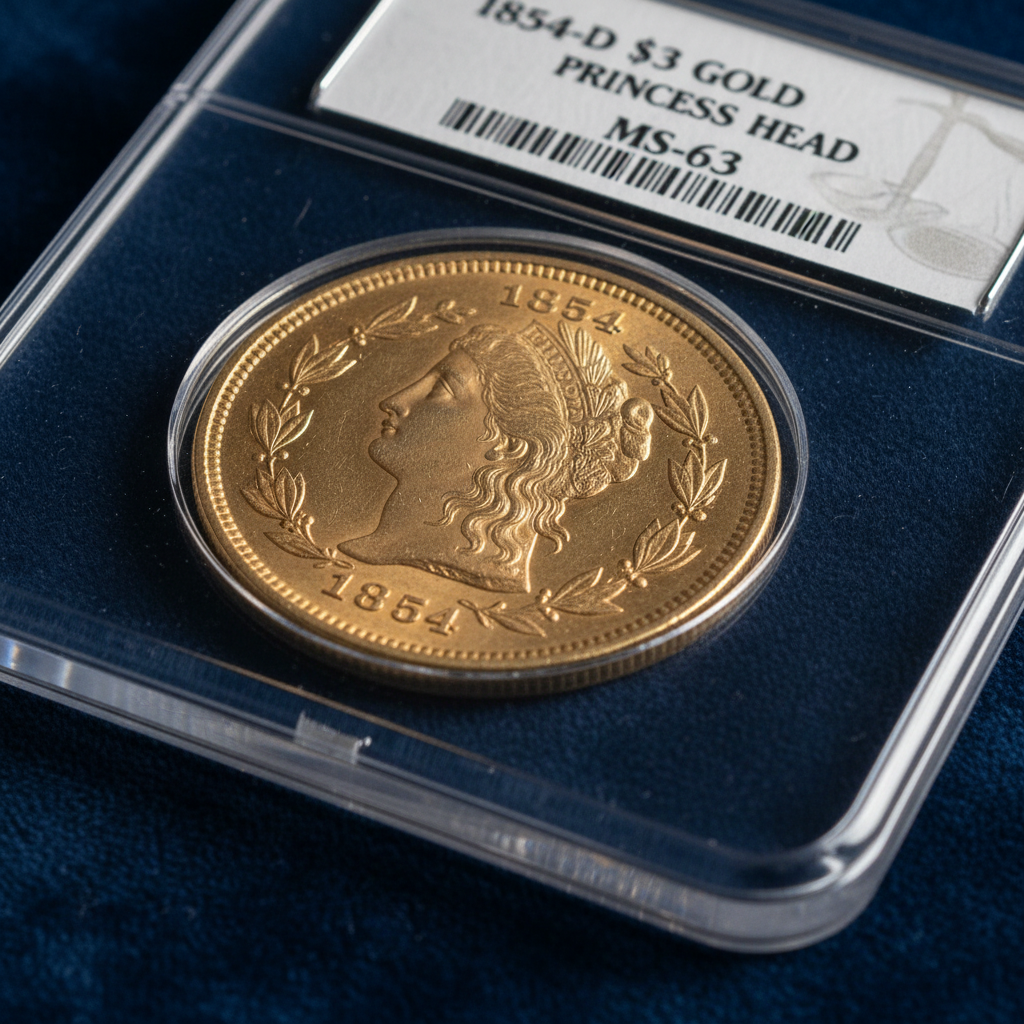
Only a handful of U.S. coins can claim a single-year mintage, a defunct Southern mint, and a direct line to some of the most celebrated cabinet collections in American numismatic history — all at once. The 1854-D Three-Dollar Gold Piece does exactly that, and it has commanded the attention of serious collectors for the better part of 170 years.
The coin is not rare simply because few were made. It is rare because of what it represents: the only year the Dahlonega Mint in northern Georgia ever struck the Three-Dollar Gold denomination. Congress authorized the $3 gold piece in February 1853, and the Dahlonega facility — already winding down its relevance as California's Sierra Nevada eclipsed the Georgia goldfields — produced the coin for one year and one year only. That makes the 1854-D a one-year type coin, a status that elevates demand far beyond what raw survival numbers alone would justify.
A Mint on the Margins
The Dahlonega Mint operated from 1838 to 1861, when Georgia's secession from the Union shuttered it permanently. Throughout its run, it was the smallest and most remote of the branch mints, processing gold drawn directly from the Appalachian foothills. Its output was modest by Philadelphia standards, and its coins carry a distinctive character — slightly softer strikes, warmer color from the local alloy mix, and a provenance that collectors have romanticized for generations.
For the Three-Dollar series specifically, Dahlonega struck an estimated 1,120 pieces in 1854. That number is almost certainly optimistic when it comes to survivors. Attrition through circulation, melt, and simple loss over nearly two centuries has reduced the known population to a figure most specialists place well below 50 examples in all grades combined. NGC and PCGS combined certified populations hover in the range of 25 to 35 coins, depending on the census snapshot — a number that has barely moved in years, suggesting the market has largely absorbed what exists.
The grade distribution skews heavily toward the lower end. Most survivors land in the VF-20 to EF-45 range, reflecting actual circulation use rather than cabinet storage. Mint State examples are essentially unicorns. A single PCGS MS-61 example represents the top of the certified population, and its last public auction appearance generated the kind of bidding war that reminds you why Dahlonega gold has its own gravitational pull among advanced collectors.
Pedigrees That Define the Coin
What separates the 1854-D Three-Dollar from other low-mintage 19th-century gold coins is the weight of its pedigree trail. Specific examples have passed through the Eliasberg Collection, the Bass Collection, and several other landmark assemblages that define the canon of American numismatics. When a coin appears in Louis Eliasberg's holdings — the only collector ever to assemble a complete set of U.S. coins by date and mint — it carries a provenance premium that transcends grade alone.
Heritage Auctions and Stack's Bowers have both handled significant examples in the past two decades. Realized prices for mid-grade circulated specimens — think EF-40 to AU-50 — have ranged from roughly $80,000 to $180,000 at major sales, depending on eye appeal, originality of surfaces, and the pedigree attached. A coin with Eliasberg or Bass provenance will push through the top of that range without hesitation. The MS-61 outlier is in a different conversation entirely.
For context: a comparable one-year type rarity in U.S. gold, the 1875 Three-Dollar Gold Piece, carries a similar dynamic — tiny mintage, outsized demand, prices that seem disconnected from grade until you understand the scarcity math. The 1854-D operates in the same ecosystem but adds the Dahlonega mystique on top.
The Market Case for Dahlonega Gold
Southern branch mint gold has been one of the more durable sub-categories in U.S. numismatics over the past 15 years. While the broader rare coin market has experienced its share of volatility — particularly in the generic gold and type coin segments — coins from Dahlonega, Charlotte, and New Orleans have held value with unusual consistency. Collectors who focus on branch mint gold tend to be long-term holders, which suppresses supply at auction and keeps realized prices firm even in softer market cycles.
The 1854-D Three-Dollar sits at the apex of that category. It is simultaneously a branch mint rarity, a one-year type coin, and a piece with documented ties to the most important private collections ever assembled. That triple convergence is genuinely uncommon in any collectibles market.
Collectors who encounter one should understand they are not simply buying a coin. They are buying a fixed-supply asset with a 170-year track record of institutional demand — and a story that the American numismatic market has never stopped telling.