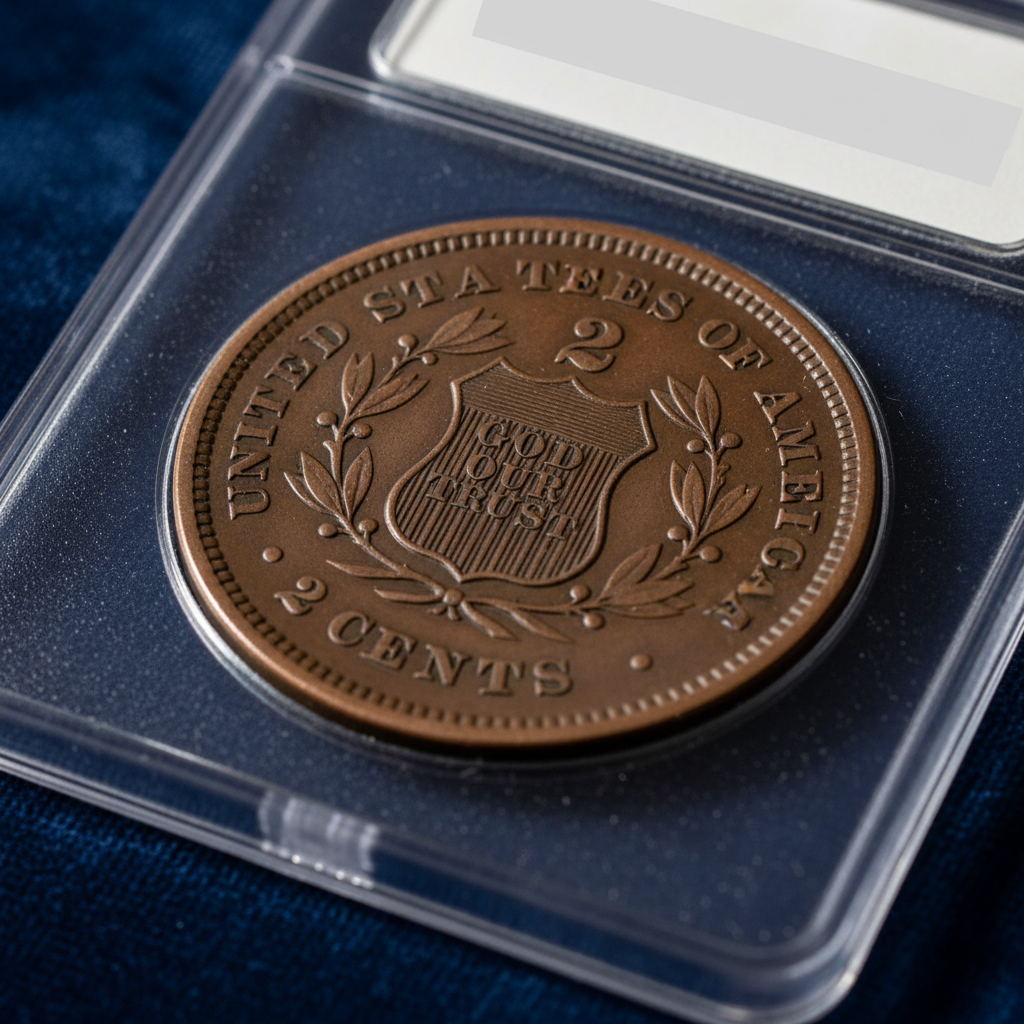
The United States Mint has produced thousands of coin denominations across its history, but few had a shorter lifespan — or a more consequential debut — than the two-cent piece. Introduced by the Coinage Act of 1864, it was the first American coin to bear the motto IN GOD WE TRUST. That alone makes it historically significant. That it was also struck for only a decade before Congress abolished it makes every surviving example a tangible relic of one of numismatics' great experiments.
The mid-1860s were a strange time for American coinage. Wartime hoarding had stripped copper, silver, and gold coins from everyday commerce. Citizens resorted to postage stamps and privately issued tokens to make change. Congress responded with a flurry of new denominations — the Three-Cent Nickel, the Twenty-Cent Piece, the short-lived Stella $4 gold coin — each an attempt to plug a different gap in circulation. The two-cent piece was the most practical of the bunch, and for a few years, it actually worked.
What the 1864 Issue Looks Like — and What to Look For
The coin was designed by James B. Longacre, the same engraver responsible for the Indian Head cent. The obverse features a Union shield flanked by arrows and wheat stalks, with the now-historic motto scrolled above. The reverse carries a simple wreath encircling the denomination. Struck in bronze — 95% copper, 5% tin and zinc — the two-cent piece was a departure from the pure copper large cents that preceded it.
The 1864 issue comes in two distinct varieties that every serious collector needs to understand: Small Motto and Large Motto. The Small Motto is the scarcer of the two. The letters in IN GOD WE TRUST are noticeably thinner and more compressed, and the D in GOD has a distinctive pointed appearance. Mintage figures for the Small Motto are not precisely isolated from the total 1864 production run of roughly 19.8 million coins, but auction records and population data make clear it is significantly rarer than its Large Motto counterpart.
In circulated grades, the Large Motto 1864 is genuinely affordable — Fine examples regularly trade in the $30–$60 range, and even VF-30 pieces can be had for under $100. The Small Motto commands a steep premium at every grade level. A Small Motto in VF-20 routinely brings $300 to $500, and certified Mint State examples can push well past $2,000 depending on strike quality and eye appeal.
The Graded Market: Where the Real Action Is
PCGS and NGC have both certified substantial populations of 1864 two-cent pieces, though the numbers skew heavily toward lower circulated grades — which makes sense given the coin's actual use in commerce. For the Large Motto variety, PCGS has certified examples across the full grade spectrum, with MS-64 and MS-65 Red examples representing the true condition rarities. A PCGS MS-65 RD Large Motto last appeared at Heritage Auctions with a hammer price north of $1,800. Full Red designation is the target — coins that retain 95% or more of their original mint luster command dramatic premiums over Red-Brown or Brown examples at the same numeric grade.
The Small Motto in Mint State is a different conversation entirely. PCGS population data shows fewer than two dozen examples graded MS-64 or better across both services combined — a genuine rarity by any standard. When one surfaces at auction, expect aggressive bidding. A PCGS MS-63 RB Small Motto brought over $3,500 at a Stack's Bowers sale, and the coin had no particular provenance premium attached to it. Just scarcity doing its work.
Proof strikes of the 1864 two-cent piece add another dimension. Proof mintages were tiny — roughly 470 Proof coins for the 1864 issue — and cameo examples with deep mirror fields are genuinely difficult to locate. A PCGS PR-65 RD CAM is a trophy coin by any measure, and prices at that level have held firm even as the broader coin market has seen softness in some series.
Why Collectors Keep Coming Back to This Series
The two-cent piece ran from 1864 through 1873, giving collectors a tight, completable series of just ten business-strike dates plus proofs. That accessibility is a genuine draw. You can build a high-quality complete set without the six-figure commitments required by, say, early American copper or Seated Liberty coinage.
The 1871 and 1872 dates are the condition rarities of the later series — both had low mintages and saw heavy circulation, meaning Mint State survivors are scarce. But the 1864 Small Motto remains the key date, the coin that separates a decent collection from a serious one.
Beyond the numbers, there's the historical weight. Every 1864 two-cent piece that circulated passed through hands during the Civil War's final year, Reconstruction's beginning, and the assassination of Abraham Lincoln. The motto it introduced has appeared on every U.S. coin and paper currency since 1957. For a denomination that lasted less than a decade, its fingerprints are everywhere.
For a series this compact and this historically loaded, the entry point has never been more reasonable. The hard part isn't finding a two-cent piece — it's finding a reason not to start.