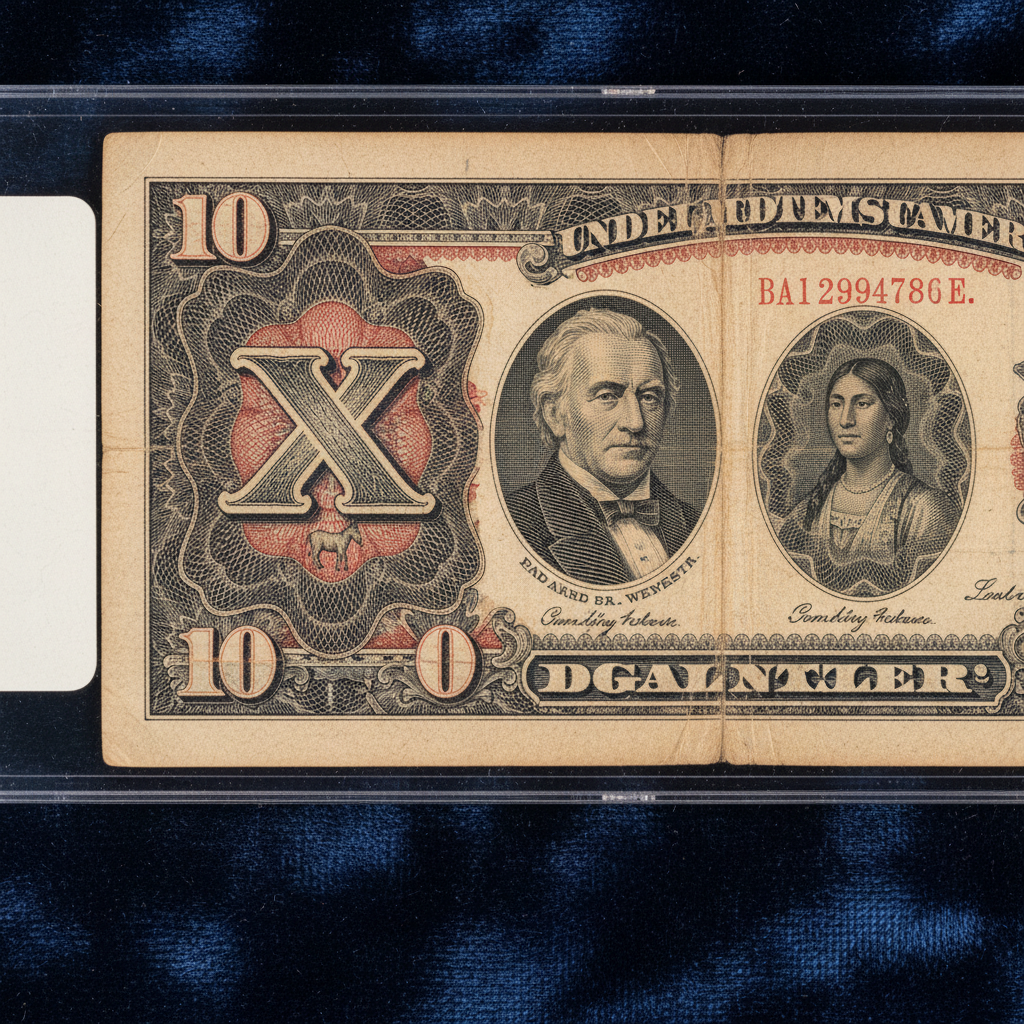
The upside-down eagle says everything. On the 1869 $10 Legal Tender Note — cataloged as Fr. 96 and Whitman W-1275 — the central vignette of an eagle, when the note is held sideways, resolves into the unmistakable profile of a jackass. It's one of the great optical accidents in American currency design, and it gave this note a nickname that has outlasted every official designation by about 150 years.
But the nickname is almost a distraction. The real story of the 1869 $10 is its visual ambition — a chromatic and engraving achievement that stands apart from virtually everything the Bureau of Engraving and Printing produced in the nineteenth century.
The Rainbow That Earned the Name
The Series of 1869 Legal Tender notes are collectively known as the Rainbow Notes, and the $10 denomination is the crown jewel of the series. The face features a portrait of Daniel Webster on the left, rendered with the fine-line precision that defined the era's master engravers, while the back explodes in a wash of green, red, and gold ink that was extraordinary for federal currency of the period. Most Civil War-era and Reconstruction-era notes were comparatively austere. The 1869 series was a deliberate aesthetic statement — a government signaling stability and permanence through sheer visual authority.
The color palette wasn't decorative whimsy. Multicolor printing was a direct counterfeit deterrent. Replicating layered ink runs with the photographic and printing technology available in 1869 was genuinely difficult, which made the Rainbow Notes both beautiful and functional. That dual purpose is part of what makes them so compelling to serious currency collectors today.
The eagle vignette at the center of the note — the one that becomes a jackass when rotated — was engraved by the American Bank Note Company before Treasury production moved in-house. The optical illusion appears to have been unintentional, which somehow makes it better. Nobody planned for the $10 note of the United States government to double as a barnyard joke, and yet here we are.
Where These Notes Trade and What They're Worth
Surviving examples of Fr. 96 span an enormous condition range, and price follows grade with unusual severity in large-size currency. A heavily circulated example — think Fine 12 or Very Fine 20 — can be acquired for roughly $800 to $2,500, depending on margins and eye appeal. That's accessible territory for a note this historically significant.
Move up the grade ladder and the math changes fast. PMG-graded examples in Extremely Fine 40 have traded in the $4,000 to $7,000 range at major auction houses including Heritage Auctions and Stack's Bowers. Gem examples — PMG 65 EPQ or better — are genuinely rare. Large-size Legal Tender notes from this era saw heavy circulation; most survivors were spent, not saved. A PMG 66 EPQ example of Fr. 96 would be a condition rarity in any meaningful sense, and would likely draw competitive bidding well into five figures from the handful of advanced currency collectors who chase this material.
The population of high-grade survivors is thin enough that individual auction results carry outsized weight. Unlike the sports card market, where PSA population reports run into the thousands for key issues, top-pop large-size currency often means two or three known examples. That scarcity dynamic rewards patient collectors who track auction archives carefully.
For context: the broader Series of 1869 Rainbow set — spanning $1 through $100 denominations — is a recognized collecting pursuit, and the $10 Jackass Note is consistently the most recognized piece in that set. Completing a full Rainbow set in consistent mid-grade condition is a decade-long project for most collectors. The $10 note is rarely the bottleneck, but it is always the centerpiece.
Design Legacy and Why Collectors Keep Coming Back
American large-size currency collecting is a discipline that rewards deep research. The Friedberg catalog remains the standard reference, and the Whitman numbering system has added a second layer of precision for specialists. Fr. 96 sits within a broader Legal Tender type run that spans decades and dozens of varieties — but the 1869 issue is the one that non-specialists recognize on sight.
That crossover recognition matters in the market. Notes that have a story — a nickname, a visual hook, a moment of historical drama — tend to hold value better through soft markets than technically rarer but visually anonymous pieces. The Jackass Note has all three. It's visually arresting, historically grounded in the Reconstruction-era Treasury, and carries a nickname that makes it immediately memorable to anyone who encounters it.
Collectors entering large-size currency for the first time often land on this note not because a dealer steered them there, but because they saw one and couldn't look away. That's a durable foundation for long-term demand — and for a 155-year-old piece of paper money, durability is exactly the point.