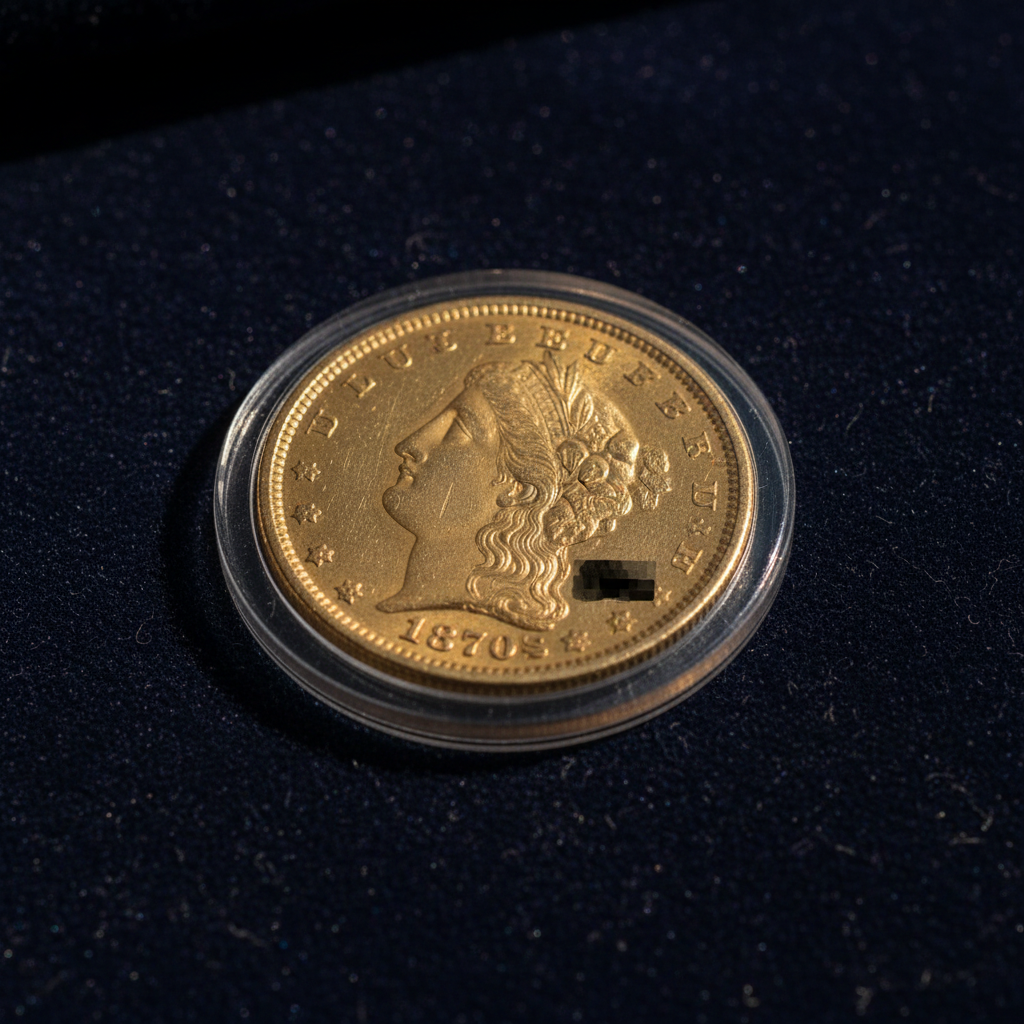
Only one example of the 1870-S Three Dollar Gold piece is confirmed to exist — and its origin story is stranger than most collectors realize. Struck at the San Francisco Mint during a year when the facility was laying its own cornerstone, the coin was almost certainly never intended for circulation. It may have been embedded in that cornerstone itself. What survived is a numismatic ghost: a coin that technically shouldn't be in private hands, yet commands a place among the most coveted rarities in American coinage.
That paradox is precisely what makes the 1870-S Three Dollar Gold the obsession it is. Mystery, provenance, and historical weight converge in a single small coin — just 20.6mm across, weighing 5.015 grams — that has defined the upper echelon of U.S. gold collecting for over a century.
The Cornerstone Theory and What It Means for Provenance
The prevailing historical account holds that the 1870-S Three Dollar Gold was struck specifically as a presentation piece for inclusion in the cornerstone of the new San Francisco Mint building. That ceremony took place on May 25, 1870. Mint employees and officials commonly struck one-of-a-kind or extremely low-mintage examples of current coinage for such occasions — it was tradition, not accident.
The problem: a coin that was sealed in a building's foundation shouldn't exist in a collector's cabinet. Yet it does. The most logical explanation — and the one numismatic historians have largely settled on — is that a second example was struck, either as a backup or a personal keepsake for a Mint official. No documentation survives to confirm this. The paper trail, if it ever existed, is gone.
That ambiguity is not a flaw in the coin's story. It's the story.
The known specimen has passed through some of the most important collections in American numismatic history. It appeared in the Eliasberg Collection, arguably the greatest assemblage of U.S. coins ever formed, and later surfaced at major auction. Heritage Auctions has handled significant transactions involving top-tier U.S. gold rarities in this tier, where realized prices for singular specimens routinely exceed $1 million and can push well past $3 million depending on market conditions and bidder depth.
Grading a Ghost: What the Numbers Actually Tell You
With a population of one confirmed specimen, conventional population report analysis doesn't apply here. There is no PSA 10 vs. PSA 9 spread to evaluate. No BGS 9.5 subgrades to parse. The 1870-S Three Dollar Gold exists outside the normal framework of supply-and-demand grading economics.
What grading does provide, in this case, is authentication and condition documentation. The known example has been certified and examined by leading third-party services. Its grade reflects genuine wear consistent with a coin that was handled — not circulated in commerce, but passed between hands, examined, perhaps displayed. That wear pattern itself supports the theory of a presentation or keepsake origin rather than a coin that ever saw a cashier's drawer.
The broader Three Dollar Gold series ran from 1854 to 1889, a peculiar denomination that never found commercial footing and was discontinued after 35 years of halfhearted production. Most dates are collectible but accessible. A 1854 Three Dollar Gold in MS-63 trades in the $3,000–$6,000 range at major auction houses including Stack's Bowers and Heritage. Branch-mint issues from New Orleans and Dahlonega carry premiums. The 1870-S sits so far above the rest of the series that comparing it to other dates is almost a category error.
- Series: Indian Princess Head, Three Dollar Gold
- Mintage (1870-S): 1 known specimen (Mint records suggest a handful struck)
- Designer: James B. Longacre
- Composition: 90% gold, 10% copper
- Weight: 5.015 grams
- Diameter: 20.6mm
- Mint: San Francisco (S mintmark)
What This Coin Means for the Market — and for Collectors Who Will Never Own It
The 1870-S Three Dollar Gold is not a coin you budget for. It's a coin you read about, research, and use as a benchmark for understanding what American numismatics can produce when history, scarcity, and mystery align perfectly.
For serious collectors working the Three Dollar Gold series, the practical play is assembling a high-grade, date-and-mintmark complete set with the 1870-S acknowledged as a placeholder — the one gap that will never close. Dealers at major shows treat this approach with genuine respect. A complete Three Dollar Gold set, minus the 1870-S, in consistent MS-62 to MS-64 grades represents a serious six-figure investment with real long-term upside, particularly as pre-1933 U.S. gold continues to attract both numismatic and alternative-asset buyers.
The 1870-S itself, should it ever appear at public auction again, would almost certainly shatter previous records. The market for true American numismatic rarities — coins with singular provenance, documented history, and zero substitutes — has never been stronger. Bidder competition for coins like the 1933 Double Eagle and the 1804 Silver Dollar has demonstrated that the ceiling for this category is functionally limitless.
One coin. One cornerstone. One hundred and fifty years of unanswered questions. The 1870-S Three Dollar Gold doesn't need a marketing campaign — it just needs to exist, and it does its own work from there.