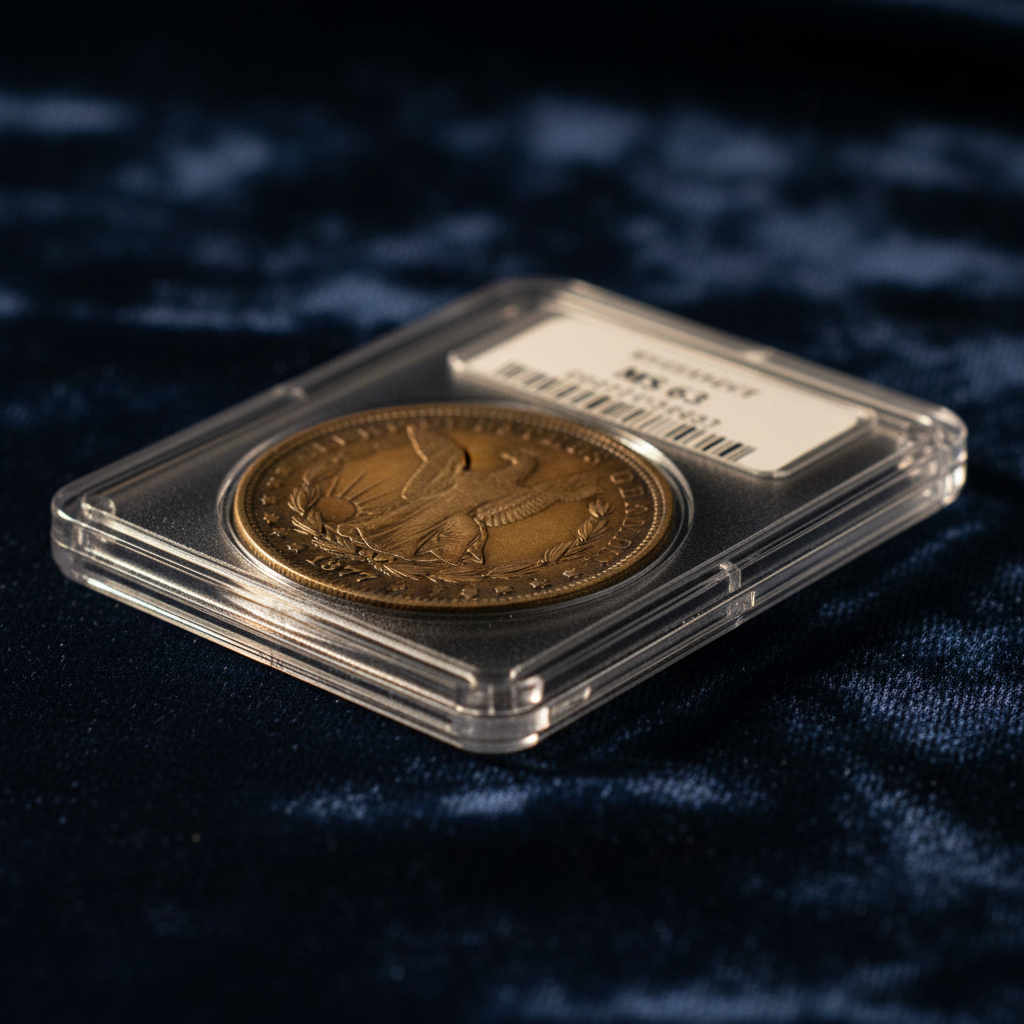
Carson City struck it from Nevada silver, then shipped it across the Pacific to be spent in Chinese ports. The 1877-CC Trade Dollar is one of American numismatics' great paradoxes — a coin minted in the American West that was never intended to circulate in the American West. And that contradiction is precisely what makes it one of the most compelling 19th-century silver issues a collector can chase today.
A Coin Without a Country
The Trade Dollar series was born from a commercial problem. In the early 1870s, American merchants competing in Asian markets — primarily China — needed a silver coin that could hold its own against the Mexican peso, the dominant trade currency across Pacific commerce. Congress authorized the Trade Dollar in 1873, specifying a slightly heavier weight than the standard Morgan-era dollar: 420 grains versus 412.5. The extra silver was a deliberate signal of value to Chinese merchants who weighed coins rather than taking face value on faith.
San Francisco handled the bulk of Trade Dollar production, given its direct commercial ties to Pacific shipping lanes. Carson City was a secondary mint, and its output for the series was modest by comparison. The 1877-CC had a mintage of just 534,000 coins — significant enough to avoid true rarity in the broadest sense, but low enough that high-grade survivors are genuinely scarce. Most of these coins entered commerce immediately, traveling through San Francisco trading houses before reaching Chinese ports, where they circulated hard. Chopmarks — the stamped verification marks applied by Chinese merchants and money changers — are common on Trade Dollar survivors, and they tell the story of a coin that actually did its job.
The irony is that while the coin was circulating freely in Guangdong and Shanghai, it was being stripped of legal tender status at home. Congress revoked the Trade Dollar's domestic legal tender status in 1876, leaving American holders of the coins in an awkward position. A coin made from Nevada silver, bearing the motto of the United States, was worth less in Nevada than it was in China.
What Survivors Look Like — and What They're Worth
Finding a problem-free 1877-CC is harder than the mintage figure suggests. Chopmarked examples are plentiful and trade at a fraction of unchopped coins. Among PCGS-graded specimens, the population thins dramatically above MS-62. Coins grading MS-63 and above are legitimately rare — PCGS has certified fewer than 30 examples at MS-63 or better across the entire grade range, and the population at MS-65 is effectively in the single digits.
At circulated grades, the 1877-CC is accessible. A solid VF-30 example without chopmarks typically trades in the $300–$500 range at retail, with auction results from Heritage and Stack's Bowers confirming that range over the past 18 months. Move into EF-45 territory and prices climb toward $700–$1,200 depending on strike quality and surface preservation. The Carson City coins are known for occasionally weak strikes on the eagle's breast feathers and Liberty's head, so strike sharpness commands a premium even within the same numeric grade.
The real money is in mint state. An MS-62 example brought $4,800 at a Heritage auction in 2023. A PCGS MS-63 — one of only a handful certified — has the kind of population scarcity that puts it in a different conversation entirely. Comparable auction results for MS-63 Trade Dollars from Carson City have cleared $15,000 in recent years, with the finest known examples commanding multiples of that when they surface.
The Collector Case for 1877-CC
Trade Dollars as a series have quietly outperformed many 19th-century silver issues over the past decade, driven partly by a growing collector base that appreciates the historical narrative — the Pacific trade era, the silver politics of the Gilded Age, the chopmark subculture — and partly by the simple math of low surviving populations in collectible grades.
The 1877-CC sits in a sweet spot within that series. It is not the key date — that distinction belongs to the 1878-CC and the proof-only issues — but it is scarce enough in high grade to present a genuine challenge. For a type collector, a well-preserved EF or About Uncirculated example delivers the full historical weight of the series at a reasonable price point. For a date collector working through the CC mint issues, the 1877 is a necessary stop, and finding a premium example without chopmarks requires patience.
There is something fitting about a coin that was rejected at home eventually finding its most devoted audience among American collectors. The 1877-CC Trade Dollar spent decades being undervalued in its own backyard. The market has spent the last thirty years correcting that mistake.