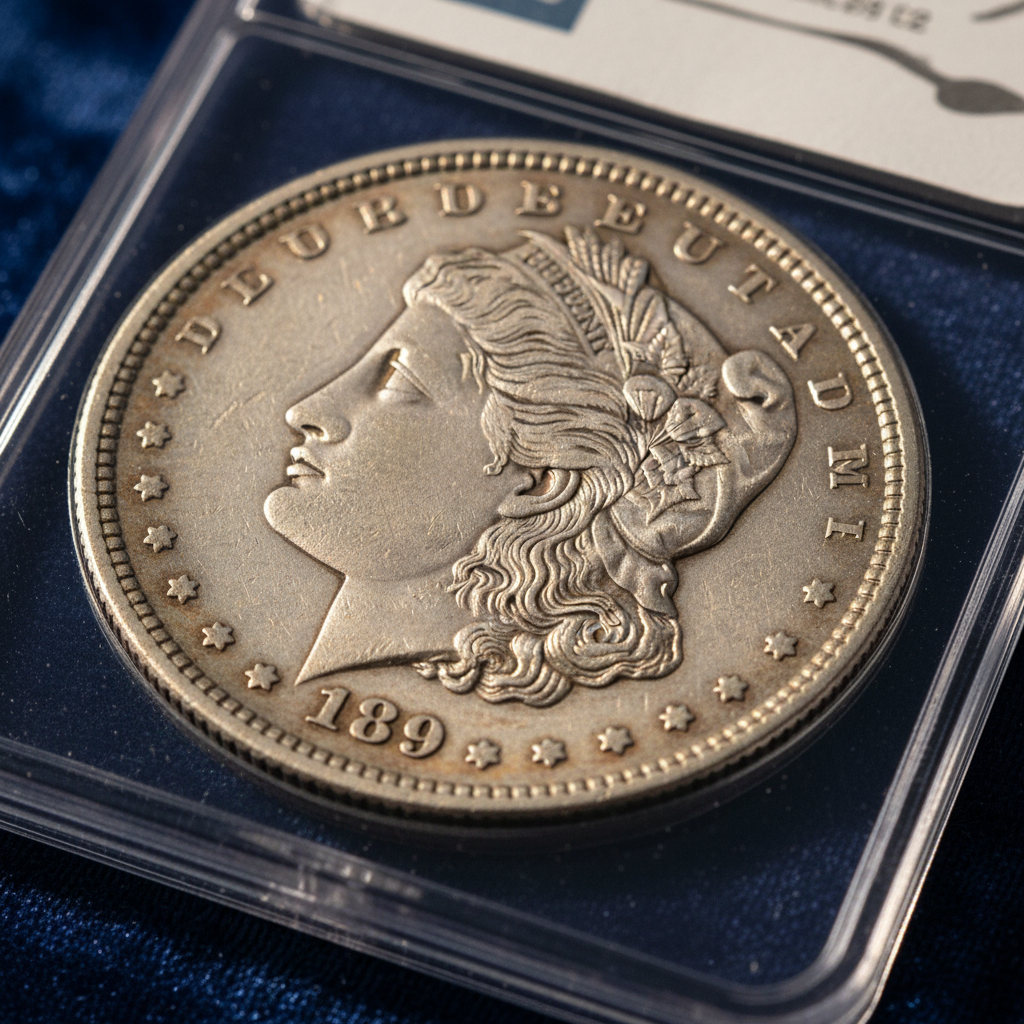
The Carson City Mint was already living on borrowed time when it struck its first Morgan dollars in 1878. By 1879, Washington was actively looking for an exit — costs were high, logistics were brutal, and Mint Director Horatio Burchard made no secret of his desire to shutter the Nevada branch as quickly as practicably possible. The silver pouring out of the Comstock Lode was supposed to be the CC Mint's reason for existing. Instead, it became a bureaucratic headache. That institutional ambivalence is baked into every 1879-CC Morgan dollar ever struck — and it's a large part of why serious collectors still chase them today.
The mint produced just 756,000 business strike examples in 1879, a figure that looks modest even by Carson City standards. Compare that to the Philadelphia Mint's output of over 14 million Morgans that same year and you start to understand the scarcity equation. Low mintage alone doesn't make a coin valuable — survival rates, strike quality, and collector demand all factor in — but with the 1879-CC, every variable points in the same direction.
Strike Quality and the Grading Gauntlet
Carson City Morgans have a reputation for weak strikes, and the 1879 issue does nothing to dispel it. The high points — Liberty's hair above the ear, the eagle's breast feathers — frequently show softness even on coins that saw minimal circulation. This creates a grading paradox that trips up newer collectors: a coin can look nearly uncirculated to the naked eye but still land at MS-62 or MS-63 due to strike weakness and contact marks that the grading room catches and the casual observer misses.
PSA, PCGS, and NGC all handle this date, though PCGS population data tells the clearest story on where the grade distribution clusters. The overwhelming majority of certified 1879-CC Morgans fall between VF-20 and MS-62. Coins grading MS-64 and above are genuinely scarce, and MS-65 examples are the kind of thing that shows up at Heritage or Stack's Bowers with pre-sale estimates that make non-collectors do a double take. An MS-65 1879-CC last offered at major auction carried a hammer price north of $50,000 — and that number has only moved in one direction over the past decade.
The Mint State population drops off sharply at the gem threshold, which is exactly where the serious money concentrates. Collectors who buy problem-free MS-63 examples in the $1,500–$3,500 range are playing a different game than those targeting gem survivors, but both groups understand the same fundamental truth: finding a well-struck, original-surface 1879-CC in any Mint State grade is harder than the mintage figure alone suggests.
What the Market Has Been Telling Us
Carson City Morgans as a category have held up remarkably well through the broader rare coin market's cyclical swings. The series benefits from a collector base that is both deep and emotionally committed — CC coins carry a frontier romanticism that date collectors and type collectors alike respond to. The 1879-CC sits in an interesting middle position within that series: it's not the rarest CC Morgan (that distinction belongs to the 1889-CC and 1893-CC), but it's scarce enough in higher grades to command serious premiums while remaining attainable in circulated grades for collectors working up the ladder.
Recent auction results from Heritage and Goldin show consistent demand for problem-free circulated examples. An EF-45 example in original, original skin — no cleaning, no artificial toning — typically brings $400–$700 depending on eye appeal. Move into the AU grades and you're looking at $800–$1,800 for strong examples. The spread between a cleaned coin and an original-surface coin in the same technical grade can be 40–60%, which underscores how aggressively the current market penalizes problems.
Silver's underlying price movement adds another layer. When spot silver ran hard in 2023, generic Morgan dollars got a lift across the board, but key-date and semi-key issues like the 1879-CC benefited disproportionately — collector demand insulated them from the volatility that hit common-date coins harder on the downside.
Building a Position in This Date
For collectors approaching the 1879-CC strategically, the calculus is straightforward: buy the best original example your budget allows, and do not compromise on surface integrity. A cleaned AU-55 is a consolation prize. An original VF-35 with honest wear and no problems is a coin worth owning.
PCGS and NGC holders both add liquidity — dealers and auction consignors move certified coins faster and at tighter spreads than raw examples, particularly at the MS-63 level and above where authentication anxiety is real. For anything grading MS-64 or better, third-party certification isn't optional; it's the price of admission to the serious bidder pool at Heritage, Stack's Bowers, or PWCC.
The Carson City Mint never did get shuttered on Burchard's preferred timeline — it limped along until 1893, producing some of the most coveted American coins in the process. The 1879-CC isn't the most dramatic chapter in that story, but it's an essential one. And in a market where essential coins with honest scarcity keep finding new buyers, that's not a bad place to be.