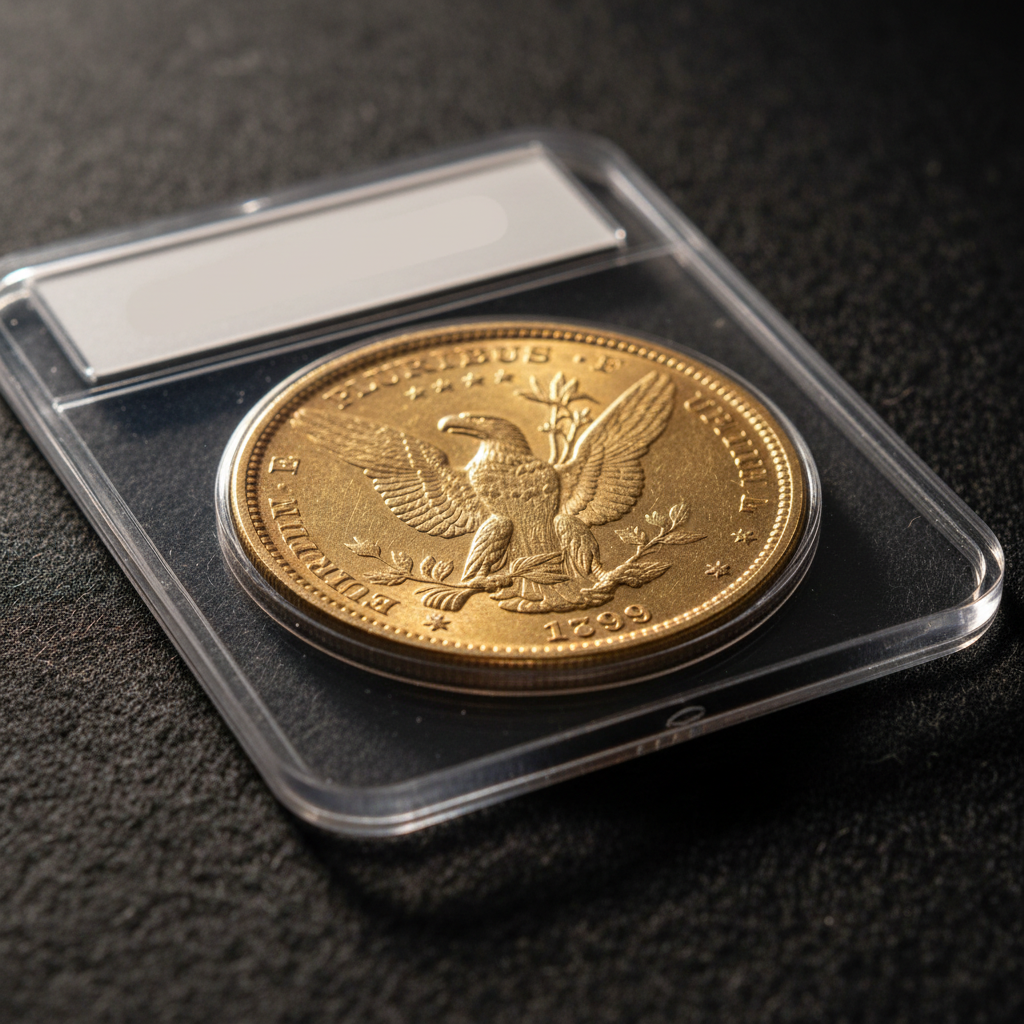
Only 2,325 examples of the 1879-O Liberty Head Double Eagle were ever struck — and not a single Type III $20 gold coin left the New Orleans Mint before or after that year. One coin, one year, one mint. The numismatic universe doesn't hand out distinctions like that often.
The 1879-O sits at a peculiar intersection of rarity and historical accident. New Orleans was a prolific gold-coining facility through much of the 19th century, yet the Type III Liberty Head Double Eagle — the design introduced in 1877 with the motto IN GOD WE TRUST repositioned on the reverse and the denomination spelled out as TWENTY DOLLARS — was struck there exactly once, in a single production run that yielded fewer pieces than many modern proof sets.
Understanding the Type III Distinction
The Liberty Head Double Eagle, designed by James Barton Longacre, went through three distinct design phases. The Type III iteration, which ran from 1877 through 1907, is the most commonly encountered in circulation — Philadelphia, Carson City, and San Francisco all struck millions across those three decades. New Orleans contributed exactly one year's worth to that total.
That singularity matters to specialists. A complete Type III Double Eagle collection by mint mark requires the 1879-O. There's no substitute, no alternative date from the Crescent City to fill that slot. For type collectors, it's an interesting rarity. For date-and-mint completionists, it's a mandatory acquisition.
The mintage of 2,325 pieces places it firmly among the scarcest business-strike Double Eagles in the entire series. For context, the notoriously rare 1870-CC Double Eagle had a mintage of just 3,789 — and that coin commands premiums that regularly push into six figures at major auction houses like Heritage and Stack's Bowers. The 1879-O's production run is smaller still.
Survival Rates and the Grading Reality
Mintage figures for 19th-century gold are a starting point, not the whole story. Large-denomination gold coins faced constant threats: melting, export, and the economic upheavals that followed the Civil War and the debates over bimetallism in the 1870s and 1880s. Many simply didn't survive.
Among the examples that did make it through, most saw heavy circulation. Finding a specimen above EF-40 is a genuine challenge. NGC and PCGS combined populations in the AU grades are thin — we're talking about a coin where a single example crossing an auction block in AU-55 or better is a catalogued event worth tracking. Gems are effectively nonexistent in any meaningful market sense.
That grading reality shapes the collector calculus considerably. Unlike some scarce coins where patience and budget can eventually land a high-grade example, the 1879-O demands that serious buyers recalibrate expectations. A problem-free VF-30 or EF-40 example is, for most collectors, a legitimate trophy. Chasing a Mint State example isn't just expensive — it may be a mission without a destination.
When examples do surface at auction, the results reflect that scarcity premium. Heritage Auctions and Stack's Bowers have both handled the coin in recent years, with mid-grade circulated examples routinely attracting competitive bidding from advanced gold specialists. The auction record for the finest known examples sits well into five figures, and the trajectory has been upward as collector interest in 19th-century branch-mint gold has intensified over the past decade.
New Orleans Gold and the Broader Market
Branch-mint gold from New Orleans has earned serious collector attention in its own right. The O mint mark carries a regional prestige — coins produced for a city that was, at the time, one of the most economically significant ports in the Western Hemisphere. New Orleans gold circulated through cotton markets, shipping lanes, and banking houses across the Gulf South.
That historical texture is part of what drives demand. Collectors aren't just buying metal and a grade — they're acquiring a tangible artifact from a specific moment in American monetary history. The 1879-O Double Eagle encapsulates that appeal with unusual precision: it's the only coin of its type from that facility, struck in a year when the post-Reconstruction South was still rebuilding its financial infrastructure.
The broader market for pre-1933 U.S. gold has remained resilient even as other collectible categories have experienced volatility. Coins with genuine rarity — not manufactured scarcity, but historical production limits — have held value and, in many cases, appreciated meaningfully. The 1879-O checks every box that serious gold specialists look for: low mintage, single-year type status, branch-mint provenance, and a survivor population that keeps the supply side perpetually constrained.
There are roughly 2,325 reasons this coin exists. The number of collectors who would genuinely want one almost certainly exceeds the number that will ever own one. That imbalance, more than any single auction result, is the real story here.