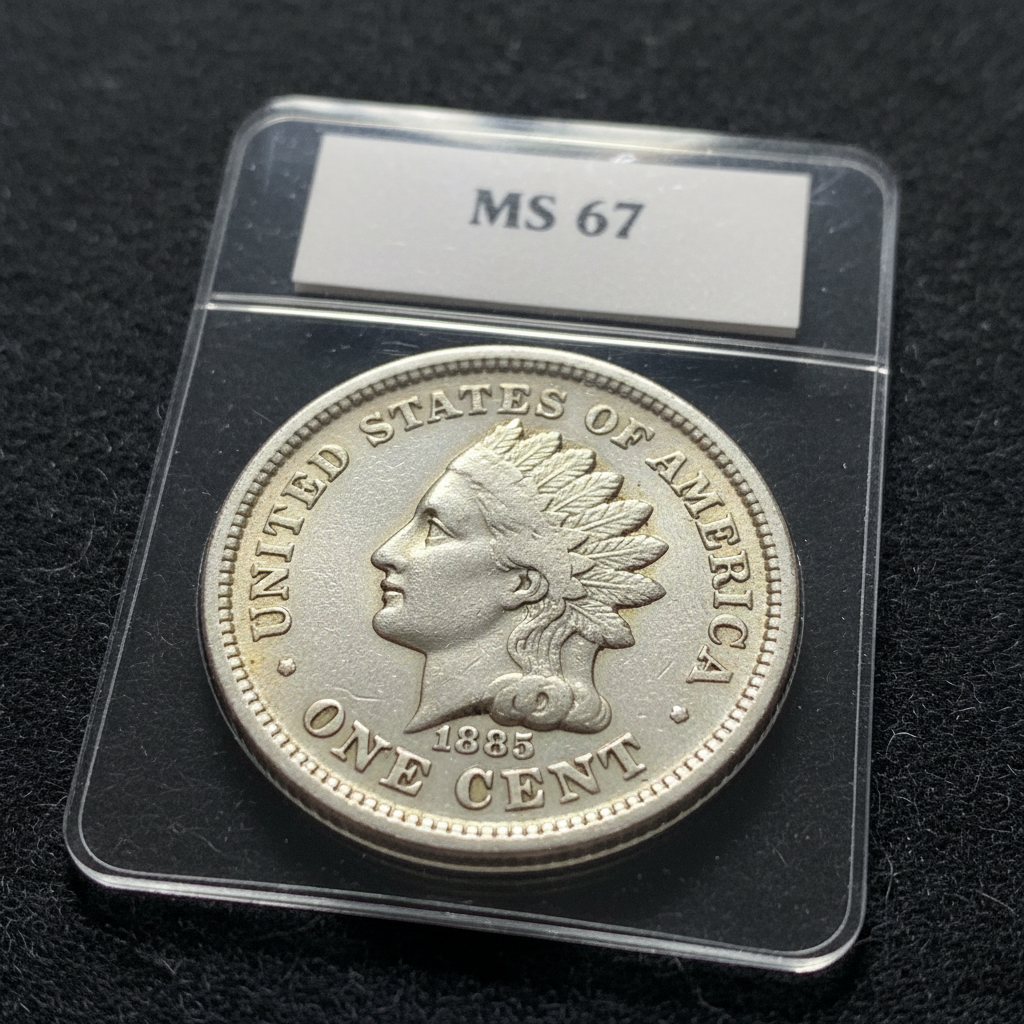
Before aluminum was cheap enough to wrap a sandwich, it was precious enough to cap the Washington Monument. The 1885 aluminum Indian Head cent exists at that exact inflection point — a coin struck during the brief, strange window when the metal was simultaneously a scientific marvel and a viable coinage experiment. It is one of the more quietly remarkable numismatic artifacts of the 19th century, and the market has been slow to fully appreciate it.
James B. Longacre's Indian Head design appears on the obverse, the familiar shield reverse on the other side. From a distance, it reads like any other cent of the era. Get closer — or hold one — and the illusion collapses. The weight is wrong. The color is wrong. The entire material proposition is wrong, in the best possible way.
Why Aluminum Was Radical in 1885
The context here is essential. Aluminum wasn't commercially mass-produced until the Hall-Héroult electrolytic process was patented in 1886 — one year after this coin was struck. In 1885, the metal was still being produced through a costly chemical reduction method that kept prices elevated and supply limited. Napoleon III famously reserved aluminum cutlery for his most honored guests, seating lesser dignitaries with gold and silver flatware. The Washington Monument's apex, installed in 1884, used aluminum precisely because it was considered a prestige material.
The U.S. Mint's pattern coin program operated in this environment. Mint officials and outside entrepreneurs regularly proposed alternative compositions for circulating coinage — some practical, some speculative, some driven by metal industry lobbying. Aluminum cents were struck as patterns in multiple years throughout the 1860s–1880s, but the 1885 issue lands at a historically loaded moment: the last gasp of aluminum as a luxury commodity, just before industrial chemistry democratized it entirely.
Within two years of this coin's striking, aluminum would be cheap. Within a decade, it would be mundane. The 1885 aluminum cent is, in a very literal sense, a snapshot of a material at peak cultural status.
What the Market Looks Like Today
Pattern coins occupy a specialized corner of numismatics that rewards patient, knowledgeable buyers. The standard reference is United States Pattern Coins by J. Hewitt Judd, and the 1885 aluminum cent is catalogued as Judd-1741 (and related varieties), with surviving examples numbering in the dozens rather than the hundreds. Population data from PCGS and NGC combined shows fewer than 50 certified examples across all grades for the major aluminum pattern varieties of this date — a supply constraint that should, in theory, create pricing discipline.
In practice, pattern coin prices are volatile and auction-dependent. Recent Heritage Auctions results for mid-grade aluminum Indian Head patterns from the 1880s have ranged from $2,400 to $14,000 depending on grade, variety, and provenance — a spread that reflects both genuine collector demand and the thin, irregular market that makes comps difficult to apply cleanly. A PCGS PR-64 example of a related 1881 aluminum pattern brought $8,400 at a 2022 Stack's Bowers sale, which serves as a reasonable ceiling anchor for mid-grade 1885 material.
The grading dynamics here matter. Aluminum is a soft metal, and 140-year-old specimens show it. Surface hairlines, contact marks, and handling wear accumulate readily, which is why eye-clean examples in PR-64 or better command significant premiums over their PR-62 counterparts. The jump from a 63 to a 65 on these pieces can represent a 200–300% price differential — steeper than you'd see on a comparable bronze pattern of the same era.
The Collector Case
Pattern coins as a category have seen renewed institutional interest over the past five years, driven partly by the broader numismatic bull market and partly by a generation of collectors who came up on type coins and are now hunting for something with more story. The 1885 aluminum cent has story in abundance.
It is not the rarest pattern coin in American numismatics. It is not the most expensive. But it may be the most conceptually interesting cent ever struck by the U.S. Mint — a one-cent piece made from a metal that, at the moment of striking, cost more per ounce than silver. The historical irony is almost too clean: a coin of the lowest denomination, built from one of the era's most prestigious materials, produced in tiny quantities as a what-if exercise that never became policy.
Collectors who specialize in the Indian Head series often overlook patterns entirely, treating them as a separate discipline. That's a reasonable position — but it means the 1885 aluminum cent occasionally surfaces at prices that undervalue its historical weight relative to its numismatic rarity. For a collector willing to do the Judd research and sit on Heritage's or Stack's Bowers' bidder lists, the gap between what this coin is and what it sometimes sells for represents a genuine opportunity.
Aluminum became ordinary almost overnight. This coin is proof it wasn't always.