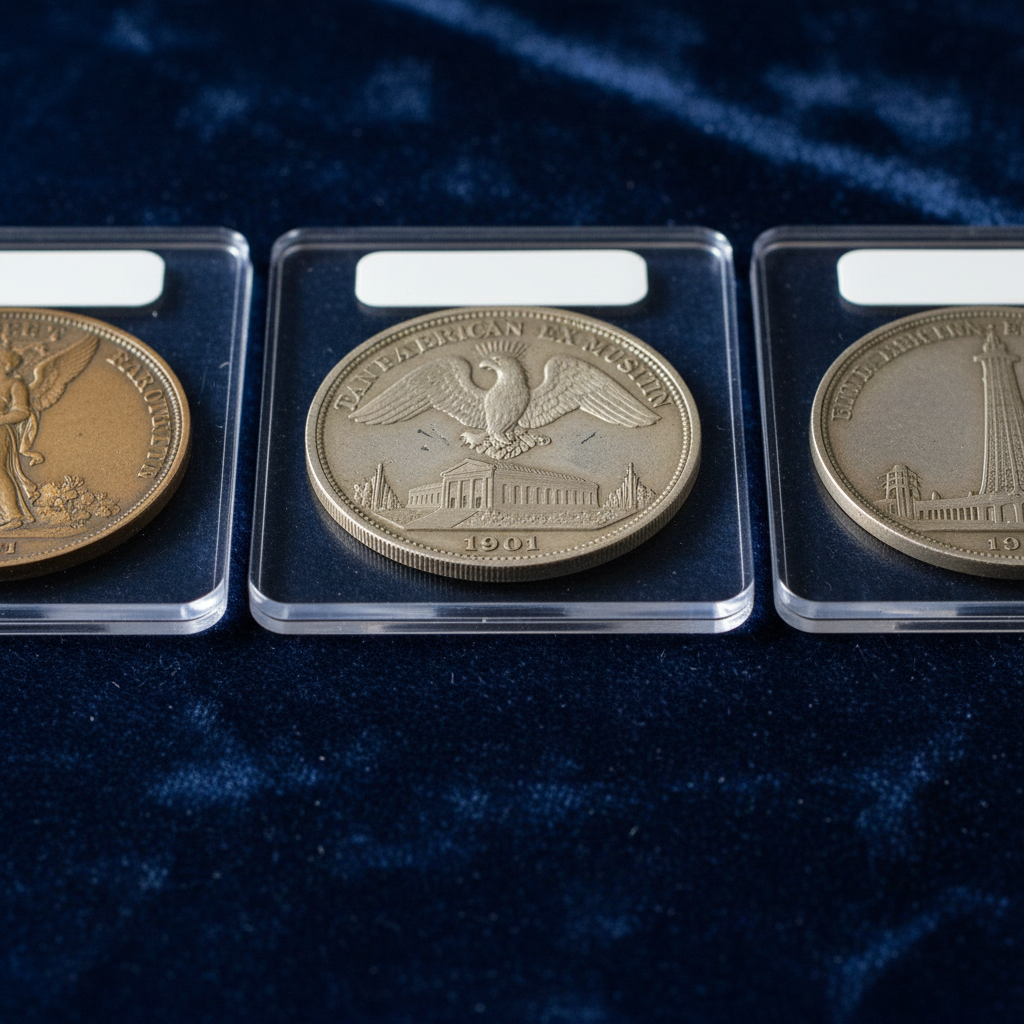
Buffalo, New York, 1901. The Pan-American Exposition drew eight million visitors, introduced the American public to electricity on a grand scale, and ended with President William McKinley taking two bullets from an anarchist's gun on the exposition grounds. That last detail — the assassination that elevated Theodore Roosevelt to the presidency — casts a long shadow over every medal struck for the event, and it's a major reason serious numismatists pay close attention to this short, tragic chapter in World's Fair coinage.
The U.S. Mint produced only three Pan-American medals and So-Called Dollars tied to the 1901 exposition. Three. That scarcity alone would make them worth tracking. Add the historical weight of McKinley's death, and you have a set that punches well above its population numbers in terms of collector demand.
What the Mint Actually Struck
World's Fair medal programs from the 1876–1926 era varied wildly in scope. Philadelphia's 1876 Centennial Exposition generated dozens of official and semi-official pieces. The 1893 Columbian Exposition in Chicago produced so many So-Called Dollars that the HK (Hibler-Kappen) reference catalog runs to multiple pages. By contrast, Buffalo 1901 is a tight set — and that's precisely what makes it tractable for collectors who want completeness without a six-figure budget.
The three pieces from the exposition fall under the So-Called Dollar umbrella, a category defined not by denomination but by approximate silver-dollar size. PCGS recognizes these within its So-Called Dollar registry, and population data reflects their relative obscurity: combined certified examples across all three types in PCGS MS-63 and above remain in the low double digits for most issues. That's not a misprint. These are genuinely scarce pieces in Mint State.
The designs lean heavily on exposition iconography — electric towers, the goddess Niagara, hemispheric symbolism consistent with the Pan-American theme — but the McKinley connection elevates them beyond decorative curiosities. McKinley attended the exposition. He was shot there, in the Temple of Music, on September 6, 1901. He died eight days later. Any medal struck for that event now carries a secondary layer of American political history that no amount of design revision could replicate.
Market Position and the So-Called Dollar Premium
The So-Called Dollar market has been quietly resilient over the past decade, benefiting from a collector base that skews older, knowledgeable, and patient. These aren't pieces that spike on social media hype cycles. They move when the right buyer meets the right auction catalog — typically through Heritage Auctions or Stack's Bowers, both of which regularly feature World's Fair material in their major sales.
Recent Heritage auction results for high-grade Pan-American exposition pieces in the HK-300 series range have shown realized prices between $400 and $1,800 depending on grade, strike quality, and whether the piece carries original luster. An MS-64 example with full cartwheel luster will command a meaningful premium over a problem-free MS-62 — the grade differential matters more in this niche than in many others because the population drop-off between 63 and 65 is steep.
For context, compare this to the 1893 Columbian half dollar market, where certified populations run into the thousands and price appreciation has been modest. Pan-American pieces from 1901 are structurally better positioned for appreciation simply because the supply ceiling is real. You cannot find more of them. The Mint struck what it struck, and attrition over 120-plus years has done its work.
- HK-type So-Called Dollars from 1901 Buffalo: three recognized pieces
- Typical PCGS MS-63 population per type: fewer than 15 examples in most cases
- Auction venue of choice: Heritage and Stack's Bowers major U.S. coin sales
- Key grading consideration: strike sharpness on the electric tower reverse devices
- Historical premium driver: direct McKinley assassination connection
Building the Set in 2024
For a collector working through Vic Bozarth's ongoing PCGS series on World's Fair medals — which spans the 1876 Philadelphia Centennial through the 1926 Sesquicentennial — the 1901 Pan-American set is one of the more achievable completions. Three pieces is a manageable target. The challenge is condition, not availability at some grade level.
Budget-conscious collectors can assemble a complete set in PCGS EF-45 to MS-62 for well under $2,000 total. That's a complete World's Fair medal set tied to one of the most consequential moments in American presidential history, certified and registry-eligible, for less than a single raw Morgan dollar in comparable condition. The value proposition is hard to argue with.
Push into MS-64 territory across all three pieces and you're looking at a multi-year search and a budget closer to $6,000–$8,000 — but you'd also own one of the finest known complete sets of 1901 Pan-American exposition medals in existence. In a niche this small, that means something.
McKinley never made it out of Buffalo. The medals struck to celebrate his exposition did, and 123 years later, they're still telling the story.