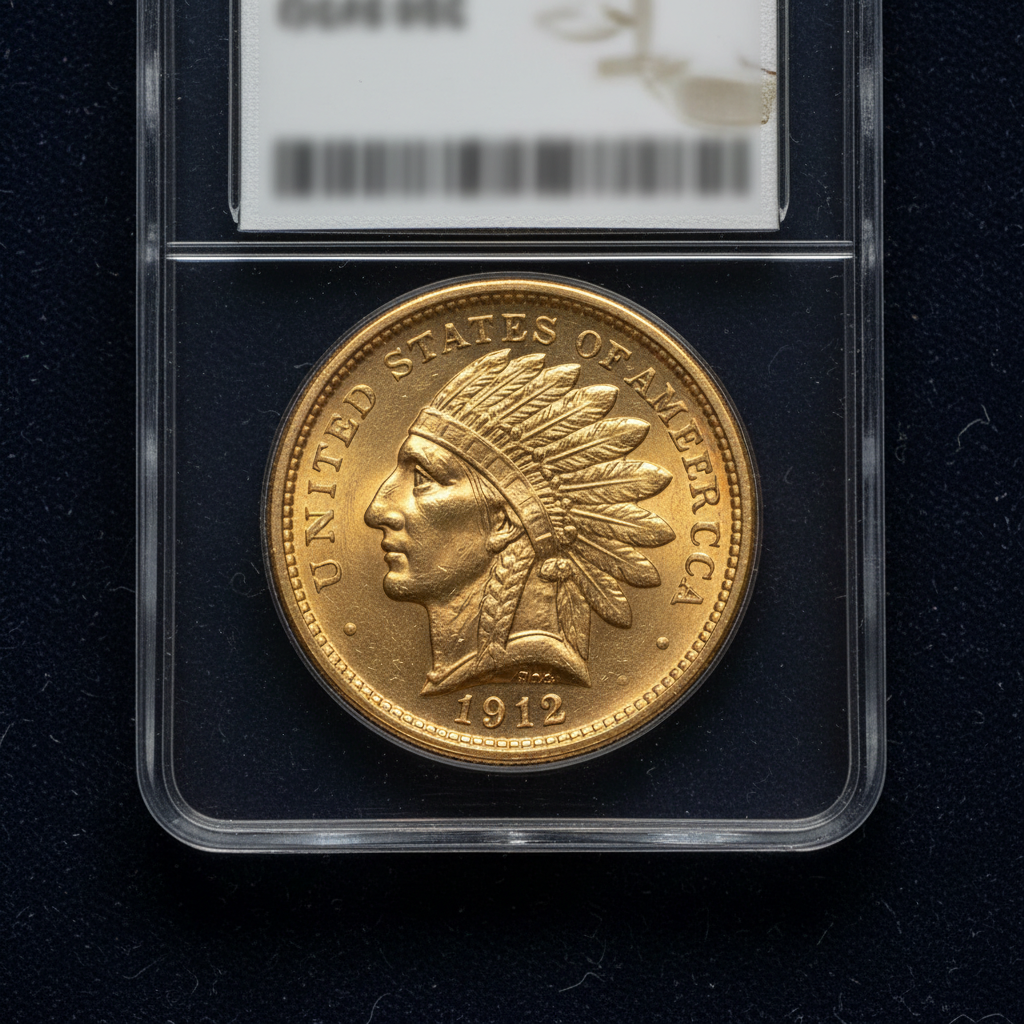
On March 18, 1912, the Philadelphia Mint struck every single one of the 197 Indian Head Quarter Eagle Proofs produced that year — all from a single die pair, all in a single session. That kind of production discipline is almost unheard of in U.S. Mint history, and it's a large part of why this coin commands serious attention from gold type collectors over a century later.
The $2.50 Indian Head series, designed by Bela Lyon Pratt, is already one of the more polarizing designs in American numismatics. The incuse relief — where the design sits recessed into the coin's surface rather than raised above it — was controversial when it debuted in 1908 and remains a point of fascination today. For the 1912 Proof issue, that incuse geometry takes on an entirely different character under the sandblast finish the Mint applied to all its gold Proofs that year.
The Sandblast Finish and Why It Matters Here
The U.S. Mint used a fine sandblast process on its gold Proof coinage during this era, producing a matte, granular surface texture that reads completely differently than the mirror-deep cameo fields collectors associate with modern Proofs. Under magnification, the finish reveals a fine, almost velvety grain — subtle but unmistakable to anyone who has handled one.
This matters more for the Indian Head quarter eagle than for most Proof issues of the period. On a conventional raised-relief design, the sandblast finish primarily affects the fields. On an incuse design, it saturates everything — the recessed portrait of Liberty, the eagle's feathers, the lettering — creating a visual uniformity that's either deeply elegant or visually flat depending on your aesthetic sensibility. Collectors who love it, love it completely.
The practical consequence is that originality is paramount. Any cleaning, wiping, or improper storage that disturbs the sandblast surface is essentially irreversible. The population of survivors in problem-free, original condition is considerably smaller than the raw mintage of 197 suggests.
Population, Grades, and What the Market Reflects
With a total production of 197 pieces, the 1912 Indian Head Quarter Eagle Proof sits in rarefied company even within the Proof gold series. For context, that's a smaller original mintage than most key-date Saints or Eagles from the same era. Attrition over 112 years — through spends, melts, improper cleaning, and simple loss — has thinned the survivor population considerably.
PCGS and NGC together have certified examples across a grade range that skews heavily toward the PR63 to PR65 band, which is typical for sandblast gold of this period. The surface sensitivity of the finish means that even light contact marks — the kind a coin might accumulate just from being carefully handled — can suppress a grade. Gems are genuinely rare. Anything at PR66 or above represents a coin that has essentially survived the last century untouched, and the auction record at those levels reflects that scarcity.
At Heritage and Stack's Bowers, certified examples in the PR63-PR64 range have traded in the $8,000–$15,000 corridor in recent years, with PR65 specimens pushing into the $20,000–$35,000 range depending on eye appeal and the strength of the sale. The market for this date is thin — transactions don't come up constantly — which means individual auction results can swing the perceived value meaningfully in either direction. Collectors pursuing this coin need to track realized prices carefully rather than relying on any single comp.
One additional layer of complexity: the Indian Head quarter eagle Proof series runs from 1908 through 1915, with no Proofs struck in 1911. Collectors building a complete Proof set of the series will find the 1912 to be one of the more accessible dates — the 1909 and 1910 issues, with mintages of 139 and 682 respectively, present different challenges at opposite ends of the scarcity spectrum. The 1912 occupies a middle ground that makes it a logical entry point for the series.
Buying Strategy for Serious Collectors
Given the surface sensitivity of sandblast gold, buying raw is a significant risk. A PCGS or NGC holder is essentially mandatory for any transaction at this price level — not because the certification guarantees perfection, but because it at minimum confirms the coin hasn't been cleaned or artificially enhanced in ways that would destroy long-term value.
When evaluating certified examples, prioritize originality over grade. A PR63 with fully intact sandblast surfaces and strong, even color will outperform a technically higher-graded coin that shows uneven toning or evidence of old cleaning that somehow slipped through. The photographs in major auction house archives — Heritage's, in particular — provide useful visual benchmarks for what original surfaces should look like on this date.
The 1912 Indian Head Quarter Eagle Proof is not a coin that announces itself loudly. Its appeal is quieter than that — a product of precision, rarity, and a surface treatment that rewards patience and a good loupe. For collectors who understand what they're looking at, that's exactly the point.