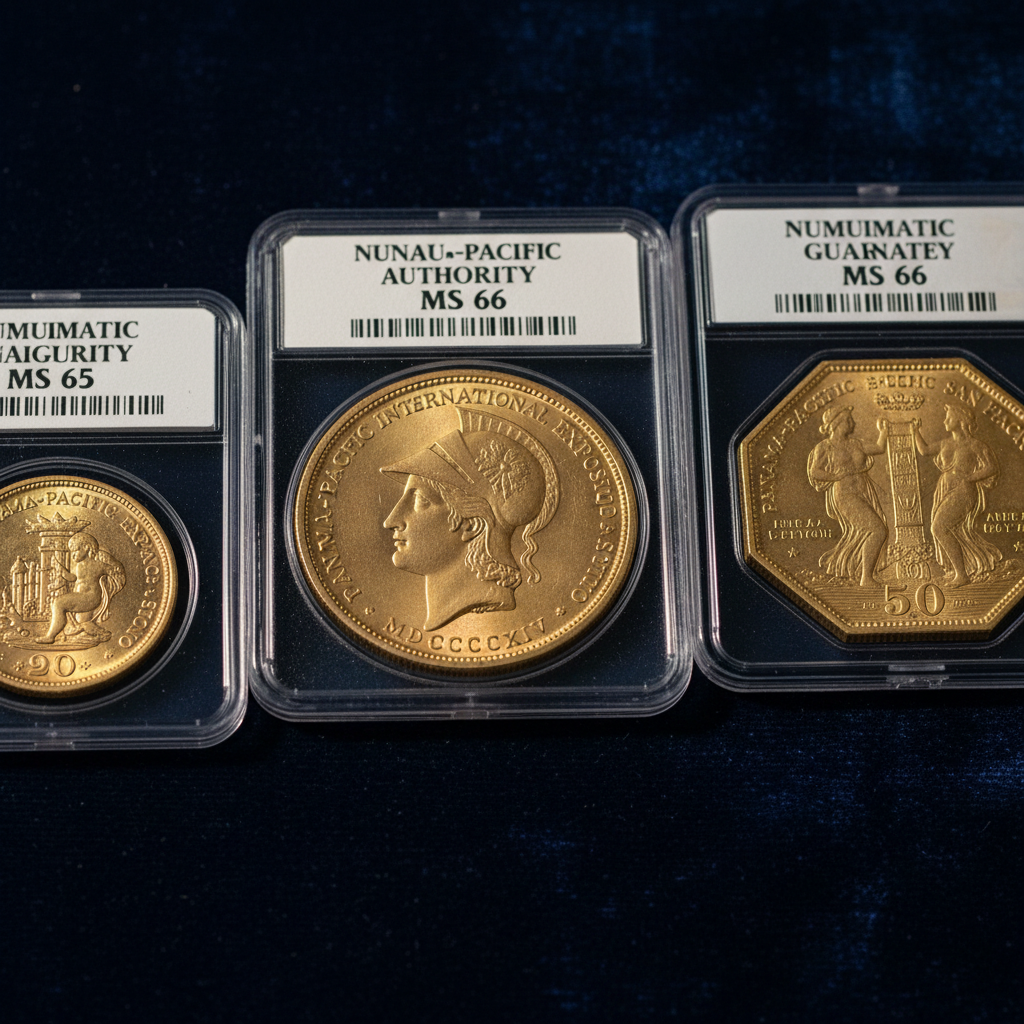
A century before registry set competition drove commemorative coin prices into the stratosphere, the U.S. Mint produced one of the most ambitious — and historically loaded — coin programs in American history. The 1915 Panama-Pacific International Exposition coinage remains a benchmark series for serious numismatists, combining genuine historical weight with genuine rarity, and the market for top-graded examples has never been more competitive.
San Francisco hosted the exposition from February through December of 1915, drawing an estimated 18.9 million visitors across its ten-month run. The event celebrated the completion of the Panama Canal and the city's own resurrection from the catastrophic 1906 earthquake. No world's fair of that scale had ever been staged west of St. Louis — a fact that made the accompanying commemorative coin program feel like a declaration, not just a souvenir.
What the Mint Actually Produced
Congress authorized a five-coin commemorative set for the exposition: a gold $50 round, a gold $50 octagonal, a gold $2.50 quarter eagle, a gold $1, and a silver half dollar. The twin $50 gold pieces — one round, one octagonal — were the showstoppers. At the time, they were the largest denomination coins the U.S. Mint had ever struck for circulation-adjacent purposes, and the octagonal format was a direct nod to California's pioneer gold coinage tradition from the 1850s.
Mintages were deliberately constrained. The round $50 saw just 483 pieces struck for sale, with 645 melted after the exposition closed. The octagonal $50 fared slightly better with 645 sold, but the overall survival universe for high-grade examples is brutally thin. PCGS has certified fewer than 200 examples of the round $50 across all grades, with just a handful reaching MS-65 or above.
The $2.50 gold quarter eagle and $1 gold piece were more accessible at the time — priced for middle-class exposition visitors rather than wealthy collectors — but even those saw modest mintages by modern standards. The half dollar, with roughly 27,134 pieces distributed, is the entry point for collectors today and still commands serious premiums in gem condition.
Where the Market Stands Now
Heritage Auctions has been the dominant venue for major Panama-Pacific transactions over the past decade. A PCGS MS-66 example of the octagonal $50 brought $282,000 at Heritage in a recent major auction — a figure that underscores just how aggressively advanced collectors pursue the top of the population. The round $50 in comparable grades has traded in similar territory, with strong bidding from both registry set builders and pure condition collectors.
Even the silver half dollar tells an interesting market story. In MS-65, PCGS-certified examples regularly clear $1,500 to $2,500 at auction. Push into MS-66 territory and the price jumps sharply — the population drops off fast above that threshold, and demand from type collectors and set builders converges on the same scarce coins.
The gold dollar, often overlooked in favor of the dramatic $50 pieces, may actually represent the most interesting value proposition in the series right now. It's genuinely scarce in gem, visually striking, and priced well below the stratospheric levels of its larger siblings. For collectors building a complete set on a disciplined budget, it deserves more attention than it typically gets.
The Medals and the Broader Picture
Beyond the coins, the U.S. Mint also produced official exposition medals — bronze and silver award medals distributed to exhibitors and participants throughout the fair. These medals are underappreciated by the broader numismatic market, which tends to fixate on the coins. But they're historically inseparable from the same program, struck at the same facility, and documented in official Mint records with the same care.
Collector interest in the medals has grown steadily as the exposition's centennial anniversaries passed, and NGC-certified examples have appeared with increasing frequency at Stack's Bowers and smaller specialist sales. They're not cheap in top condition, but they're not competing with the $50 gold pieces for attention either.
The Panama-Pacific series occupies a specific and irreplaceable position in American numismatic history. These weren't coins struck because Congress needed to honor a president or mark a war anniversary. They were produced because a city that had been leveled nine years earlier wanted to announce itself to the world — and the Mint gave that announcement physical form in gold and silver. That story doesn't get old, and the coins that carry it aren't getting any more common.