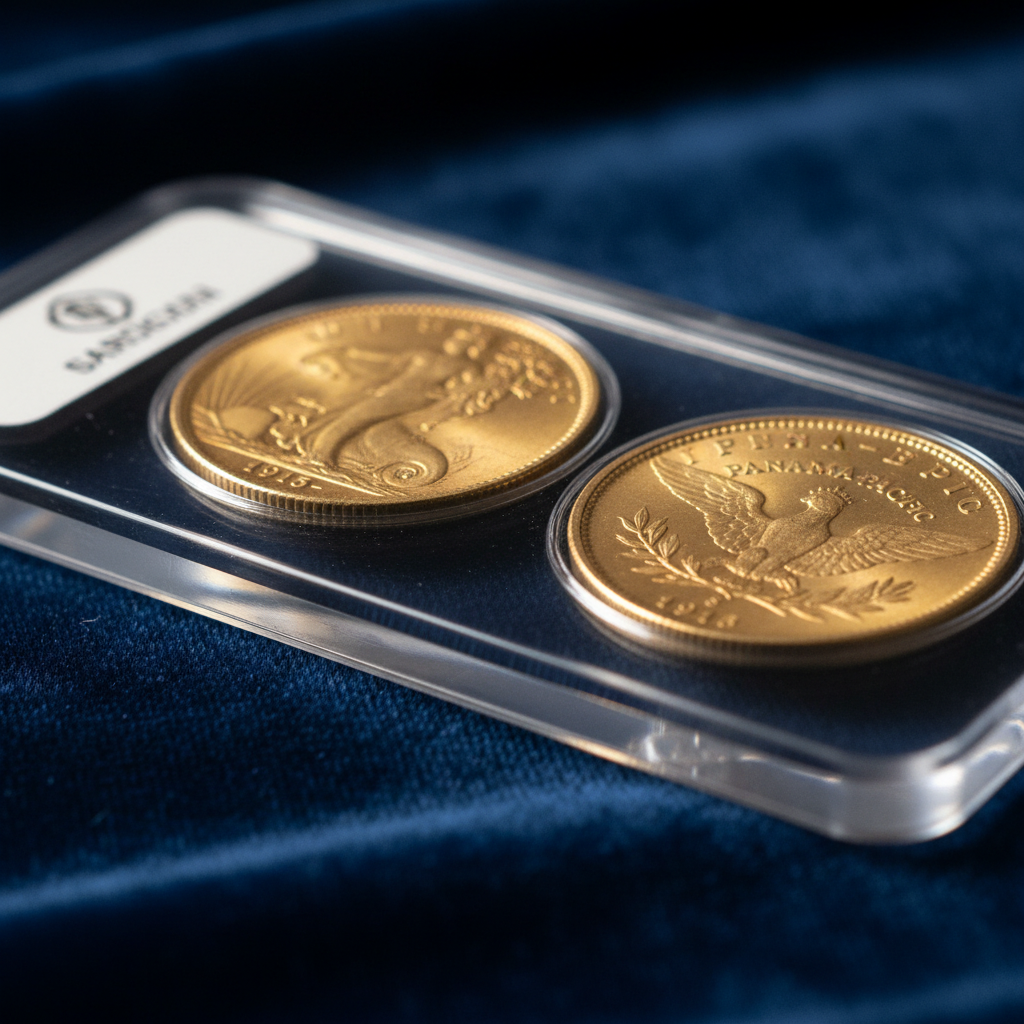
Before the United States Mint ever struck another gold commemorative, there was this coin. The 1915-S Panama-Pacific Exposition Quarter Eagle — a $2.50 gold piece issued to celebrate the opening of the Panama Canal — stands alone in American numismatic history as the first commemorative coin of its denomination ever produced by the federal government. More than a century later, it remains one of the most historically loaded issues in the entire U.S. commemorative series.
The timing was everything. The Panama Canal had opened in August 1914, a feat of engineering so audacious that the world needed a year to fully process it. San Francisco's Panama-Pacific International Exposition of 1915 was the celebration — a world's fair that drew millions of visitors and served as America's declaration that it had arrived as a global power. The Mint issued five commemorative coins for the event: two silver pieces, two gold coins, and a $50 gold octagonal piece that remains one of the most spectacular U.S. coins ever struck. The Quarter Eagle was the most accessible of the gold issues, and it carried the weight of the moment on both faces.
The Design and Its Makers
The obverse features a helmeted figure of Columbia astride a hippocampus — a mythological sea-horse — with the Golden Gate in the background. The reverse carries a spread eagle. The design was executed by Charles Keck, a sculptor whose work on this issue is often underappreciated given the star power of other Panama-Pacific designers like Robert Aitken, who handled the $50 gold pieces.
Keck's composition is restrained but purposeful. Columbia riding a sea creature through the Golden Gate is not subtle symbolism — it announces the Pacific era of American commerce with the confidence of a nation that had just connected two oceans. The coin is small, physically small at 18mm and just under 4.2 grams, but the iconography punches well above its weight class.
All examples carry the S mintmark, struck at the San Francisco Mint — the only facility that made sense for a coin honoring a West Coast exposition.
Mintage, Survivors, and the Grade Curve
The Mint struck 6,749 examples for circulation and sale at the exposition. That's a small number by any standard, but the survival rate is reasonably healthy because most buyers understood from the outset that these were collectibles, not pocket change. Many were sold in original holders or as part of complete Panama-Pacific sets.
In circulated grades, examples are accessible — MS-62 and MS-63 specimens regularly trade in the $1,500 to $2,500 range at major auction houses including Heritage Auctions and Stack's Bowers. The price curve steepens sharply as you move up the grading ladder. NGC MS-65 examples have hammered above $6,000, and gems graded MS-66 by either NGC or PCGS can push well past $10,000 depending on eye appeal and auction competition.
Population data tells the story of scarcity at the top end. PCGS has graded relatively few examples above MS-65, and the combination of original luster, strike quality, and the coin's small size — which makes contact marks more visible — means true gem survivors are genuinely rare. Buyers chasing a PCGS MS-66 or better should expect to wait for the right coin, not just the right price.
The complete five-coin Panama-Pacific set commands a meaningful premium over individual purchases. When a matched set appears at Heritage or Stack's Bowers, it routinely draws strong competition from advanced type collectors and registry set builders simultaneously — two buyer pools competing for one lot. That dynamic has kept set prices firm even in softer markets for classic U.S. gold.
Where It Sits in the Market Today
Classic U.S. commemorative gold has had a complicated decade. The broader rare coin market saw significant appreciation through 2021 and into 2022, followed by a normalization that hit some series harder than others. Panama-Pacific issues held up better than most, buoyed by their historical narrative and the fact that serious collectors treat the five-coin set as a single acquisition goal rather than cherry-picking individual pieces.
The Quarter Eagle specifically benefits from being the entry point to Panama-Pacific gold. Collectors who can't stretch to the $2,500 gold piece — which runs considerably higher in comparable grades — often start here. That demand floor has kept lower-grade MS examples liquid and relatively price-stable.
For investors tracking the commemorative gold segment, the Panama-Pacific Quarter Eagle functions less like a speculative play and more like a blue chip with a fixed supply. The mintage won't change. The history won't change. And the number of collectors who want a piece of the moment America connected two oceans isn't shrinking.
A century on, the coin that celebrated the impossible still commands the room.