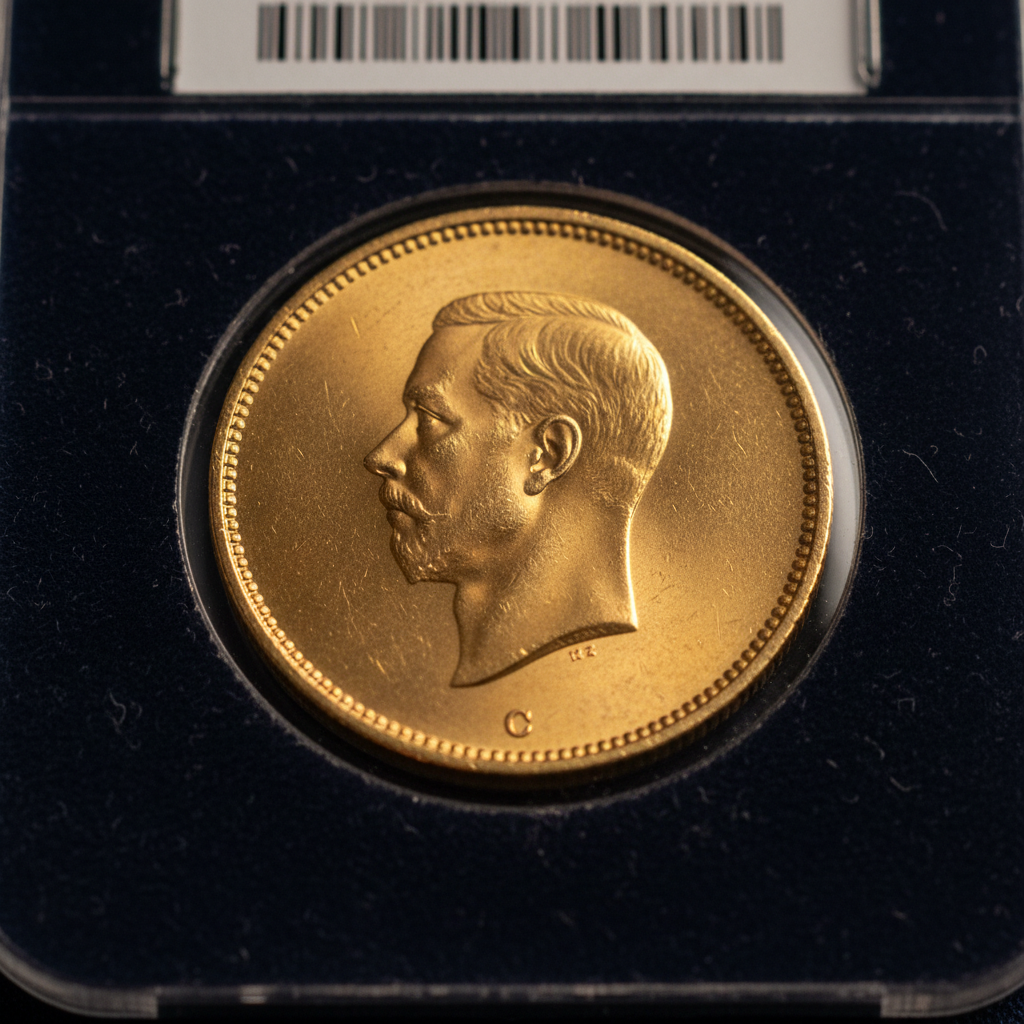
Only 6,111 examples of the 1916-C George V Gold Sovereign left the Ottawa Mint. Fewer than a handful are confirmed to survive today. That gap — between mintage and known survivors — is what makes this coin one of the most compelling mysteries in Canadian numismatics, and one of the most consequential keys in British Commonwealth gold coinage.
Struck in Crisis, Lost to History
By 1916, the war had consumed everything. Britain was hemorrhaging gold to finance the conflict, and the Royal Mint's branch facilities in Ottawa, Melbourne, Perth, Sydney, and Bombay were all pressed into service striking sovereigns to meet imperial demand. Ottawa's contribution that year was modest by any standard — 6,111 pieces, compared to the millions produced at Sydney and Perth during the same period.
What happened next is where the story gets complicated. Prevailing numismatic theory holds that the vast majority of the 1916-C issue was melted — either recalled by the British government as part of wartime gold repatriation efforts, or absorbed into the broader sovereign melt programs that swept through the 1920s and 1930s as nations abandoned the gold standard. Canada itself suspended gold coinage after 1919, and the Ottawa Mint's sovereign output was always more symbolic than operational. The coins were never widely circulated domestically.
The result is a survival rate that borders on statistical noise. Most estimates place the number of confirmed extant examples in the low single digits — some researchers cite as few as three to five specimens in institutional and private hands combined. That's not scarcity. That's near-extinction.
What Survivors Actually Look Like at Auction
When a 1916-C sovereign does surface, the market responds accordingly. Heritage Auctions and Stack's Bowers have both handled examples over the past two decades, and realized prices reflect just how thin the collector pool is for coins at this rarity tier. Graded examples in NGC AU-55 or better have traded well into the five-figure range — a remarkable premium over the coin's nominal gold content of roughly 0.2354 troy ounces.
For context, a common-date George V sovereign from the Sydney or Perth mint in comparable grade might bring $400–$700 at auction depending on eye appeal and current gold prices. The 1916-C, in any grade, operates in an entirely different market. The rarity premium here isn't a multiplier — it's a different conversation entirely.
NGC and PCGS population reports for this date are essentially anecdotal. When a coin has fewer confirmed survivors than most collectors have fingers, population data tells you almost nothing about pricing. What matters is provenance, documentation, and whether the bidders in the room that day have been chasing the coin for years.
The Ottawa Mint's Brief, Underappreciated Legacy
The C mintmark — struck below the bust on the obverse — identifies Ottawa as the issuing facility, and it appears on sovereigns from 1908 through 1919. The branch was established partly to service Canada's gold fields and partly to reinforce the imperial monetary network. In practice, Ottawa never achieved the output volumes of its Australian counterparts, and its sovereign series is defined by low-mintage dates across the board.
The 1916-C is the undisputed key date, but collectors building a complete Ottawa sovereign set will find the 1909-C and 1916-C are the two dates that define whether a collection is serious or decorative. The other dates — 1908, 1910, 1911, 1913, 1914, and 1917 through 1919 — are obtainable with patience and budget. Those two are not.
There's also a broader argument to be made about Canadian gold coinage being systematically undervalued relative to its American and British counterparts. A coin with comparable rarity in the U.S. series — say, a 1927-D Saint-Gaudens Double Eagle, with its own wartime-adjacent melt story and similarly tiny survivor population — commands prices that dwarf what Ottawa sovereigns typically realize. Whether that gap closes over the next decade is one of the more interesting questions in Commonwealth numismatics.
The 1916-C doesn't need hype. Six thousand coins made. Almost none left. The math does the talking.