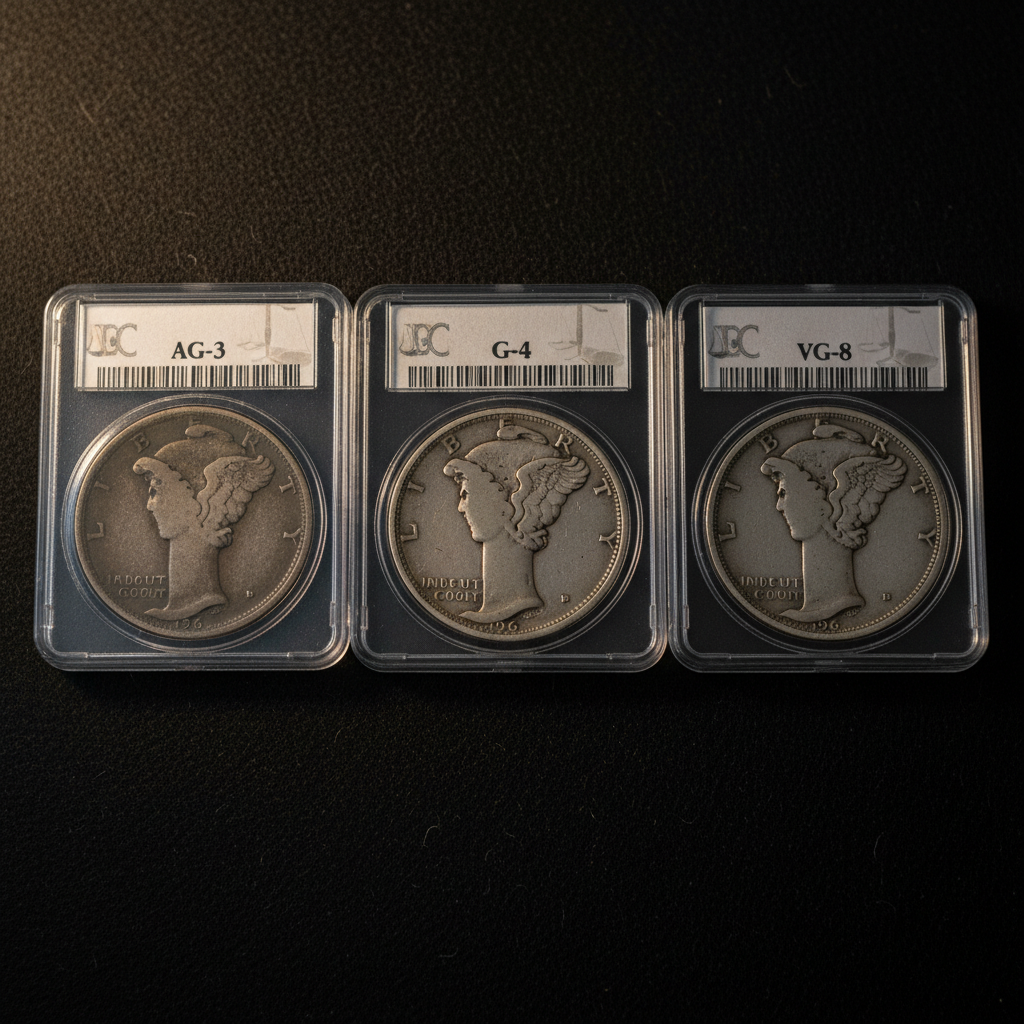
At 264,000 coins struck, the 1916-D Mercury Dime holds one of the most unforgiving mintages in all of American coinage — and the market prices every single grade accordingly. This isn't a coin where condition is an afterthought. From the most brutalized AG3 survivor to a crisp VG8 with readable legends, the spread between grades can mean thousands of dollars. Understanding exactly what separates them isn't academic. It's money.
The Denver Mint produced these dimes late in 1916, transitioning away from the Barber design after cranking out more than 6.5 million Barber dimes earlier that year. Every last one of the 264,000 Mercury Dimes entered circulation immediately — no mint sets, no collector reserves, no hoarding at the source. The coin was born into the pocket change economy and spent accordingly. That origin story is precisely why low-grade examples dominate the population data today, and why even a heavily worn specimen commands serious collector attention.
Reading the Grade: What Survives at Each Level
At AG3 (About Good), you're working with a coin that has been nearly consumed by circulation. The date and mintmark — that critical D — must be identifiable, but the devices are little more than outlines pressed into a worn field. The rim is typically merged with the lettering. For a 1916-D, this is still a legitimate entry point, and PCGS prices an AG3 in the range of $700–$900 depending on eye appeal and market timing. That floor is a statement about just how scarce this issue is.
Moving to G4 and G6, the design begins to assert itself. Liberty's portrait shows separation from the field. The fasces on the reverse — the bundle of rods that gives the coin its unofficial name — starts to read as a distinct device rather than a flat smear. The mintmark at G4 should be clear, not guessed at. Collectors should be cautious here: a 1916-D with a weak or damaged mintmark is the single most dangerous attribution trap in Mercury Dime collecting. Altered 1916 Philadelphia dimes with added D mintmarks have circulated in the market for decades. Buying raw at this grade is a risk that professional grading eliminates.
At VG8, the coin is genuinely presentable. The major design elements are clear, the date is sharp, and LIBERTY reads fully across the headband. This is the grade where many serious type collectors and key-date specialists anchor their 1916-D holdings — enough detail to appreciate the design, low enough on the scale to remain accessible. PCGS values a VG8 at approximately $2,500–$3,000, and Heritage auction results from the past 18 months bear that out consistently.
Population Reality and the Counterfeit Problem
PCGS has certified thousands of 1916-D Mercury Dimes across all grades, but the distribution is heavily weighted toward the lower end of the scale. The overwhelming majority of certified examples sit between AG3 and Fine-12. That's not surprising given the coin's history — it circulated hard through the late teens and twenties before collectors began pulling examples from change. By the time the numismatic community fully grasped the 1916-D's significance, most survivors were already well-worn.
The counterfeit and alteration risk cannot be overstated. The 1916 Philadelphia dime — struck in the millions — is virtually worthless by comparison. Adding a D mintmark to a worn Philadelphia example is a fraud with a long history, and it remains a threat in the raw coin market. Never buy a raw 1916-D Mercury Dime without a compelling reason to trust the source completely. A PCGS or NGC holder doesn't just verify grade — it verifies authenticity, and for this particular coin, that's the more valuable service.
The grading guide framework from AG3 to VG8 matters because this is where most 1916-D transactions actually happen. The coin exists in Mint State — PCGS has certified a handful of MS examples, and a single MS65 sold at Heritage for over $300,000 — but those are trophies for a different tier of collector. For the serious numismatist working within a realistic budget, the low-grade 1916-D is the market. Knowing precisely what you're buying, and what the grade actually means on this specific issue, is the difference between a smart acquisition and an expensive mistake.
The 1916-D Mercury Dime doesn't reward guesswork at any grade level. It rewards knowledge.