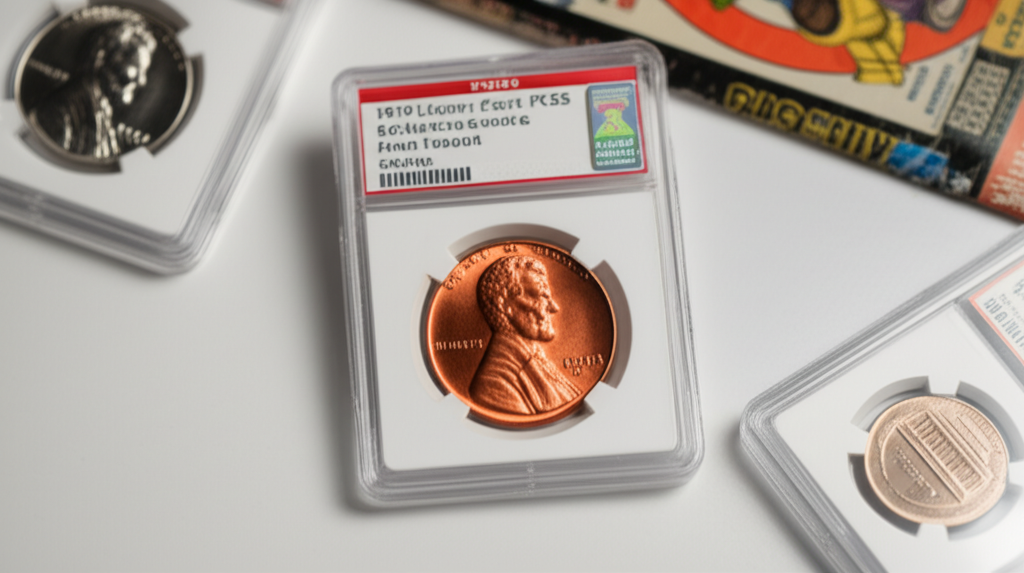
There is exactly one business-strike Lincoln Wheat cent on the planet certified PCGS MS-69 RD. It's a 1919 Philadelphia issue, it carries a CAC green sticker, and it's heading to the block at GreatCollections on March 22, 2026. That's the whole story — and it's a remarkable one.
MS-69 is a grade that barely exists in the context of 20th-century business-strike coinage. On PCGS's 70-point Sheldon scale, a 69 demands virtually perfect surfaces, full original luster, and an absence of any meaningful contact marks or distracting blemishes. For a coin struck in 1919 — on high-speed industrial presses, bagged with thousands of others, and circulated through a monetary system with zero concern for preservation — surviving over a century at that level is less a matter of luck than it is a statistical impossibility that somehow materialized anyway.
What MS-69 Actually Means for a Wheat Cent
To understand the significance here, consider the population context. PCGS has graded countless millions of Lincoln cents across all dates and mintmarks. The vast majority of Mint State survivors top out in the MS-63 to MS-65 range. Gem examples at MS-66 and MS-67 command serious premiums. MS-68 coins are legitimately rare across nearly every Wheat cent date. MS-69 is essentially theoretical.
The 1919 Lincoln cent had a mintage of roughly 392 million coins — an enormous number by early 20th-century standards. High mintage often correlates with higher survival rates in top grades, since more coins entered the pipeline and statistically more ended up in rolls or collections untouched. But even with nearly 400 million starting points, the population of certified MS-68 RD examples across all Lincoln Wheat cent dates remains thin. A 69? This appears to be a singular achievement in the series.
The CAC endorsement adds a meaningful layer of validation. Numismatic Guaranty's Certified Acceptance Corporation sticker system is designed to identify coins that meet or exceed the standard for their assigned grade — essentially a second opinion from one of the most respected quality-control operations in the hobby. On a coin already sitting at the absolute pinnacle of its series, the CAC green sticker signals that the grade isn't a borderline call. This coin earned its number.
The Auction and What to Expect
GreatCollections, the Irvine, California-based auction platform founded by Ian Russell, has built a reputation for handling significant certified coins with competitive buyer's premiums and broad collector reach. Bringing this particular coin through their platform rather than a traditional major-house sale like Heritage or Stack's Bowers is notable — it suggests confidence that the collector base for a coin of this caliber extends well beyond the floor of a major convention auction.
Pricing comps for a coin in this position are almost nonexistent by definition. The closest reference points would be the finest-known examples of other early Lincoln cent dates in MS-68 RD, which have traded in the low-to-mid five figures depending on date and eye appeal. A coin that clears that grade by a full point — in a series where MS-68 is already a ceiling for nearly every date — enters genuinely uncharted pricing territory.
For context: a 1909 VDB Lincoln cent in PCGS MS-67 RD has sold north of $25,000 at major auction. Common-date Wheat cents in MS-68 RD regularly bring $10,000 to $30,000 depending on the specific date and population. The 1919 MS-69 RD isn't competing in those categories. It's competing with itself — which is the definition of a true rarity.
A Benchmark Coin for the Entire Series
The Lincoln cent series has produced its share of landmark auction moments. The 1909-S VDB carries the most famous name. The 1914-D commands the highest prices among common-circulation dates. The 1955 Doubled Die is the most recognizable error coin in American numismatics. But benchmark coins aren't always about rarity of mintage or error variety. Sometimes they're about condition — and this 1919 MS-69 RD is the condition benchmark for the entire Wheat cent era.
A coin like this doesn't come up twice in a generation. The March 22 sale date is circled on more than a few serious collectors' calendars right now.