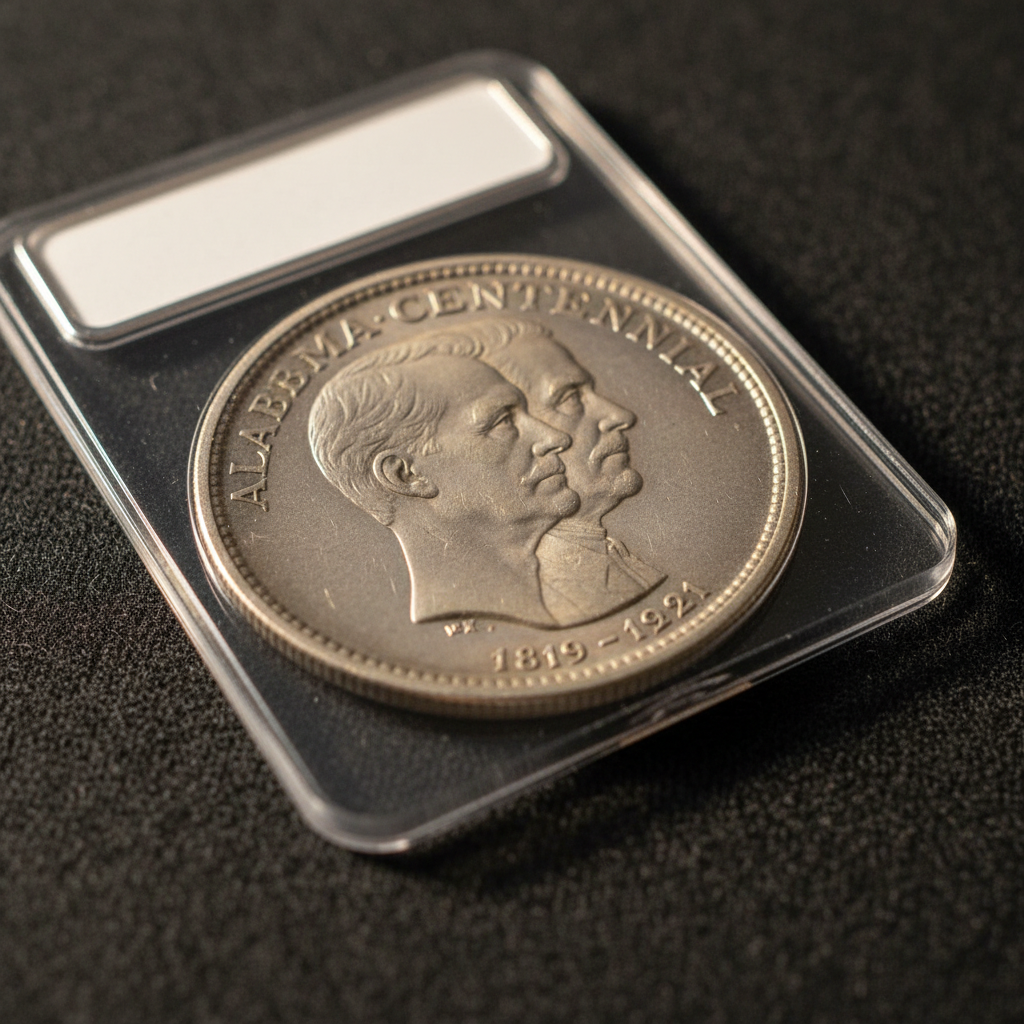
A century of statehood. Two governors on one coin. And a mintage so small it still commands serious money at auction. The 1921 Alabama Centennial Half Dollar is one of the most historically layered pieces in the entire classic U.S. commemorative series — and it remains chronically underappreciated by collectors who haven't taken the time to understand what they're actually looking at.
Alabama was admitted to the Union on December 14, 1819, making it the 22nd state. The centennial fell in 1919, but Congress moved slowly — as it tends to — and authorization didn't come until 1921. By then, the commemoration was already two years late. That delay is a footnote, but it matters: the coin was struck during a single year, with no subsequent issues, which concentrates the collector base around a tight, defined supply.
The Design That Changed the Rules
What makes the Alabama Half Dollar genuinely significant in numismatic history isn't the anniversary it commemorates — it's what appears on the obverse. The coin features dual portraits: William Wyatt Bibb, Alabama's first governor, alongside Thomas Kilby, the sitting governor at the time of issue. Placing a living person on a U.S. coin was, at that point, essentially unprecedented in modern American coinage. It was controversial then and remains a conversation piece now.
The design was executed by Laura Gardin Fraser, one of the most accomplished sculptors working in American numismatics during the early 20th century. Fraser also worked on the Oregon Trail Memorial Half Dollar and brought the same classical sensibility to the Alabama piece. The reverse features a bald eagle — standard commemorative iconography — but the obverse dual-portrait composition gives the coin a distinctly different visual weight than its contemporaries.
There's also a variant that collectors specifically hunt: the 2×2 variety, which carries the numerals "2×2" incused in the field of the obverse, referencing Alabama's status as the 22nd state. This wasn't applied to every coin in the issue. The plain version and the 2×2 variety were both struck in 1921 at the Philadelphia Mint, and distinguishing between them is the first thing any serious buyer needs to verify before committing to a purchase.
Mintage, Population, and What the Market Says
The numbers here are stark. Total mintage for the plain Alabama Half Dollar came in at 59,038 pieces, while the 2×2 variety was struck in a much smaller quantity of just 6,006 coins. In the context of classic commemoratives, the plain issue is moderately scarce; the 2×2 is genuinely rare.
PSA and NGC both handle classic U.S. commemorative coins, with NGC being the dominant grading service in this space. In circulated grades — AU-55 through AU-58 — plain Alabama Halves regularly trade in the $150–$300 range depending on eye appeal and surface quality. Push into Mint State territory and the price curve steepens quickly. An NGC MS-65 example can bring $800 to $1,200 at major auction, with gem-quality coins graded MS-66 or above crossing $2,500 to $4,000+ when they appear at Heritage or Stack's Bowers.
The 2×2 variety commands a meaningful premium at every grade level. An MS-642×2 typically opens bidding well above its plain counterpart — expect $600–$900 in that grade — and a certified MS-65 2×2 in original, untoned surfaces is the kind of coin that generates real competition in a Heritage Signature Sale. Population reports from NGC show relatively few survivors in the upper Mint State grades for either variety, which keeps ceiling prices elevated even as the broader commemorative market experiences the occasional soft patch.
One market dynamic worth tracking: classic U.S. commemoratives as a category have quietly outperformed expectations over the past several years, driven partly by type collectors building 20th-century sets and partly by a renewed appreciation for coins with genuine historical narratives. The Alabama Half benefits from both currents. It's a type coin, a variety coin, and a piece of documented American political history — three collector motivations bundled into one silver half dollar.
Condition Considerations for Buyers
Like most classic commemoratives, Alabama Halves were originally sold to the public through local committees and often stored in less-than-ideal conditions — cardboard holders, tissue paper, dresser drawers. Bag marks, carbon spots, and cleaning are endemic to the series. Buyers should prioritize original surfaces over numerical grade whenever possible.
Luster quality on this issue tends toward satiny rather than frosty, which means contact marks show more readily than on some other commemoratives. A coin graded MS-64 with clean cheeks on both portraits and undisturbed luster will outperform an MS-65 with questionable originality every time — at least among the collectors who know what they're doing.
For the 2×2 variety specifically, verify that the incused numerals are sharp and unambiguous. Worn examples can make the designation harder to confirm, and some early holders from legacy grading services didn't always specify the variety on the label. When in doubt, resubmission to NGC or PCGS with a variety attribution request is worth the cost.
The Alabama Centennial Half Dollar was born from bureaucratic delay and political vanity — and it ended up being one of the most interesting coins the U.S. Mint struck in the entire interwar period. That's not a bad legacy for a coin most people walk past in dealer cases without a second glance.