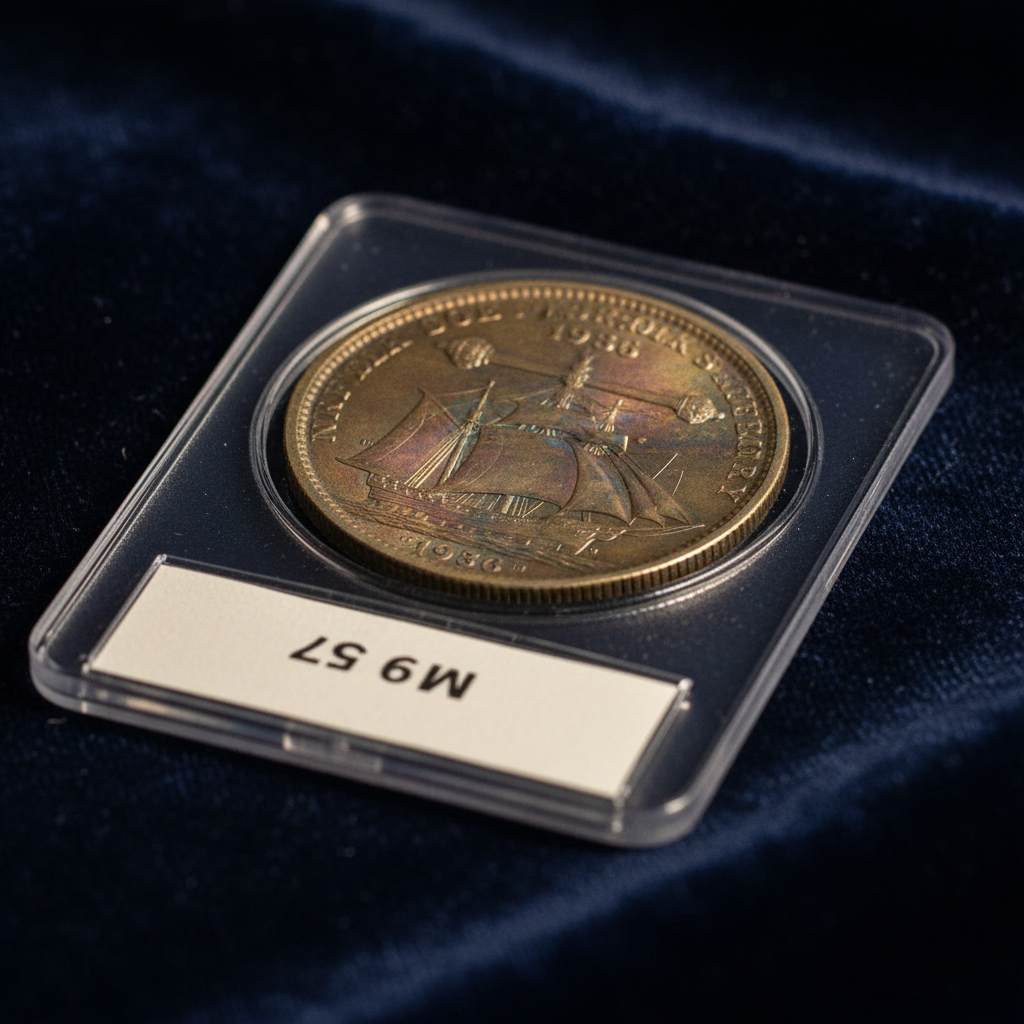
No U.S. coin talks more and says less about when it was made. The 1936 Norfolk, Virginia Bicentennial half dollar crams five separate dates onto its surfaces — yet omits the one piece of information collectors reflexively reach for first: the year of striking. It is, by any measure, the most text-dense coin the United States Mint ever produced, and the story behind it is messier than its crowded fields suggest.
The coin commemorates the 300th anniversary of the granting of Norfolk's land patent in 1636, the city's formal incorporation in 1736, its designation as a royal borough in 1736, and the sesquicentennial of American independence — with 1776 and 1926 also appearing on the design. Five dates. Not one of them is 1936, the year the coins were actually struck at the Philadelphia Mint. The irony is almost theatrical.
A Commission, a Crown, and a Political Brawl
The design itself generated genuine controversy before a single coin left the press. The reverse features the Royal Mace of Norfolk — a ceremonial crown-topped symbol of British colonial authority — which struck more than a few observers as an odd choice for a coin celebrating American civic history. The Fine Arts Commission, which reviewed commemorative designs, pushed back hard. The argument wasn't merely aesthetic. Placing a British royal emblem on a U.S. coin honoring a city's American identity carried symbolic weight that critics found tone-deaf at best.
The commission lost. The mace stayed. Norfolk's local boosters, who had lobbied aggressively for the commemorative program, weren't about to let a federal arts panel strip their coin of its most distinctive local symbol. The episode is a useful reminder that the commemorative coin programs of the 1930s were as much political products as numismatic ones — driven by municipal pride, congressional horse-trading, and the financial interests of local coin committees who sold the pieces at a premium above face value.
That premium matters for understanding the market. The Norfolk half was sold directly to collectors at $1.65 per coin — a significant markup over the 50-cent face value — through the Norfolk Advertising Board. Total mintage came in at 25,015 pieces, with 15 coins held back as assay pieces, leaving a net distribution of 25,000. By the standards of the 1930s commemorative era, that's a relatively modest number, though not rare enough to generate the kind of scarcity premium that drives the top-tier classic commemoratives.
Where the Market Sits Today
The Norfolk half occupies a specific and stable niche in the classic commemorative market. In MS-65, PCGS and NGC certified examples have traded in the $400–$600 range at major auction venues including Heritage and Stack's Bowers over the past several years. Push into MS-66 territory and prices climb meaningfully — strong examples have crossed $1,000 at auction, with the finest certified pieces at MS-67 commanding multiples of that figure given the thin population at that grade level.
PCGS has certified relatively few Norfolk halves at the gem and supergem levels. The coin's high-relief design elements — particularly the mace on the reverse — are prone to contact marks and weak strikes, which suppresses the population of truly pristine survivors. That technical challenge is part of what gives the Norfolk half its collector appeal beyond the historical novelty: finding a sharply struck, mark-free example is genuinely difficult.
For type collectors building a classic commemorative set, the Norfolk is a required piece — one of 48 distinct designs in the standard classic commemorative series. For specialists focused on the 1936 commemorative issues specifically, it's one of the most visually complex coins in what was already a crowded year for the Mint. Nineteen thirty-six saw more commemorative half dollar varieties released than any other single year in U.S. history, which has created its own collecting sub-genre around date-and-mintmark sets from that calendar year alone.
The five-date design quirk, the mace controversy, the missing strike year — none of it was accidental. The Norfolk half is exactly what 1930s commemorative coinage was: a local political project dressed up in numismatic clothing. That it also happens to be genuinely interesting to look at is almost beside the point. Almost.