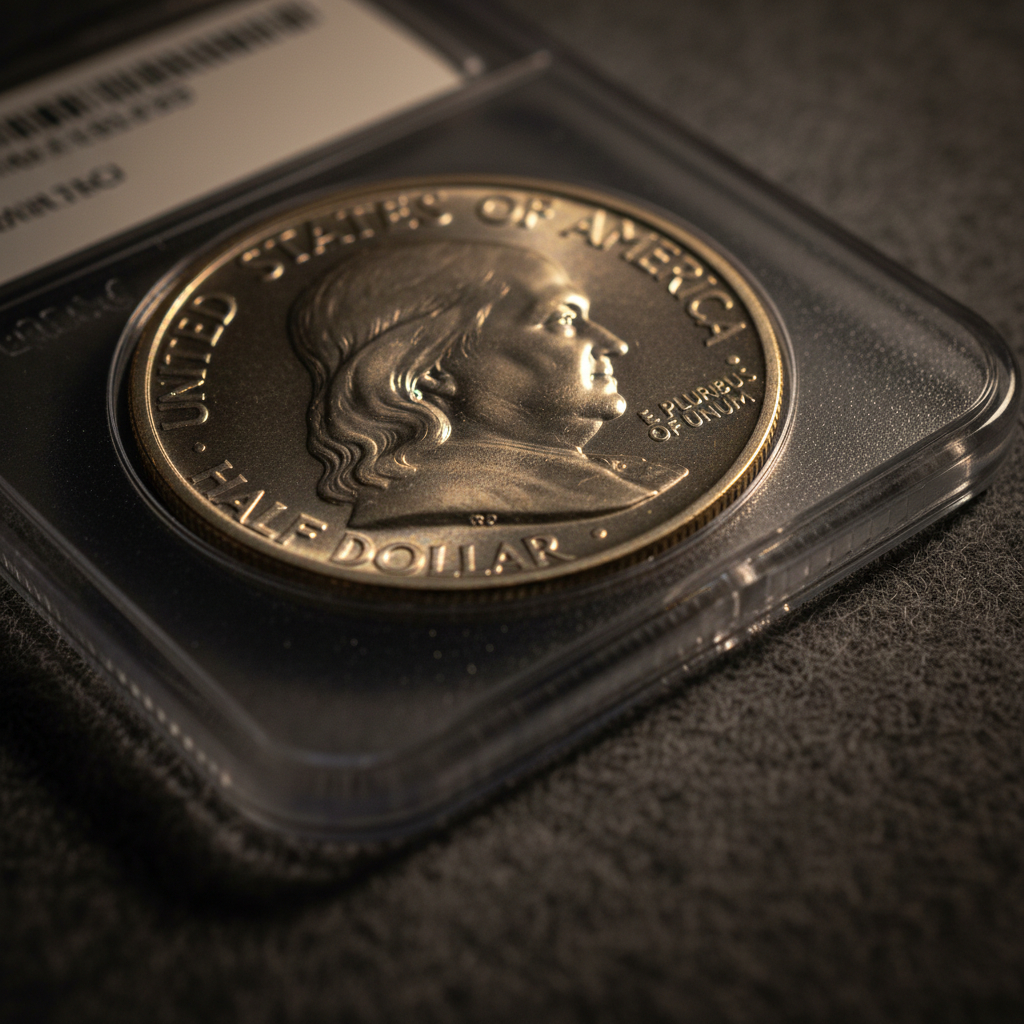
There are proof varieties, and then there are the proof varieties — the ones that define a series. The 1961 Proof Doubled Die Reverse Franklin half dollar is firmly in the second category. Among the entire Franklin half dollar run from 1948 to 1963, no proof variety commands more respect from specialists, and the auction record backs that up.
PCGS has designated this as one of the most dramatic proof varieties in the entire Franklin series — a distinction that carries real weight when you consider the competition. The Franklin series has no shortage of fan favorites. The so-called Bugs Bunny variety, produced when clashing dies left Lincoln's beard superimposed on Franklin's, has built a loyal following on the strength of its nickname alone. But novelty and genuine rarity are different things, and the 1961 Proof DDR sits in a different tier entirely.
What Makes the Doubling So Significant
Doubled die varieties occur during the hubbing process, when a working die receives multiple impressions from the hub at slightly different angles or positions. On the 1961 Proof DDR, the doubling is concentrated on the reverse — most visibly on the lettering of UNITED STATES OF AMERICA and HALF DOLLAR, as well as on elements of the Liberty Bell design itself. This isn't the kind of microscopic shift that requires a loupe and patience to appreciate. The doubling is bold and accessible, which is exactly why it resonates with both variety specialists and generalist collectors.
Proof coinage adds another layer of significance. Proof coins are struck with specially prepared dies on polished planchets, typically multiple times, to produce a sharp, mirror-like finish. When a doubled die appears in a proof context, the high-contrast fields amplify the visual effect of the doubling in ways that a business strike simply cannot replicate. The cameo contrast between frosted devices and mirrored fields makes the doubling jump.
The 1961 proof set had a mintage of 3,028,244 — substantial by modern standards, but that raw number is deeply misleading when you're hunting for the DDR variety. The doubled die reverse represents a small fraction of that production, and examples in high grades with strong cameo designation are genuinely scarce. PCGS population data reflects this: PR67 Deep Cameo examples are rare enough that when one surfaces at Heritage Auctions or Stack's Bowers, the result tends to surprise even seasoned bidders.
The Market for High-Grade Examples
Pricing on the 1961 Proof DDR scales sharply with grade and cameo designation. A problem-free example in PR65 without cameo is accessible — typically in the low hundreds — but the market compresses fast once you move into PR67 Cameo territory, and it becomes a different conversation entirely at PR67 Deep Cameo or above.
That grade-sensitivity is not unique to this coin, but the DDR premium layered on top of the cameo premium creates a multiplier effect that few Franklin varieties can match. Collectors who've tracked this series over the past decade have watched strong examples appreciate meaningfully, particularly as the overall Franklin half dollar market has attracted a younger generation of numismatists who appreciate the series' relatively compressed timeline — just 15 years of production — and the depth of its variety landscape.
For context, a PR67 Deep Cameo example of the standard 1961 proof Franklin without DDR might bring $300–$500 at major auction. Add the doubled die reverse, and you're in a different market segment. Documented auction results for top-pop DDR examples have cleared well into four figures, with the finest known specimens representing genuine condition rarities.
Where It Stands in the Series Hierarchy
The Franklin half dollar series rewards specialists. There's enough variety depth — from the 1955 Bugs Bunny to the various Full Bell Lines designations — to keep a collector occupied for years. But the 1961 Proof DDR occupies a specific and arguably unchallenged position: it is the proof variety against which all others in the series are measured.
Part of that status comes from the visual drama of the doubling itself. Part comes from the legitimacy conferred by PCGS recognition. And part comes from the simple market reality that collectors who've spent time with the series tend to circle back to this coin when they want to make a statement piece of their collection.
The Franklin series ended in 1963, replaced by the Kennedy half dollar in 1964 following the assassination. That abrupt close gave the series a natural boundary that makes it completable — a quality serious collectors prize. Within that finite universe, the 1961 Proof Doubled Die Reverse is the coin that doesn't get traded away when collectors thin their holdings. It gets held.