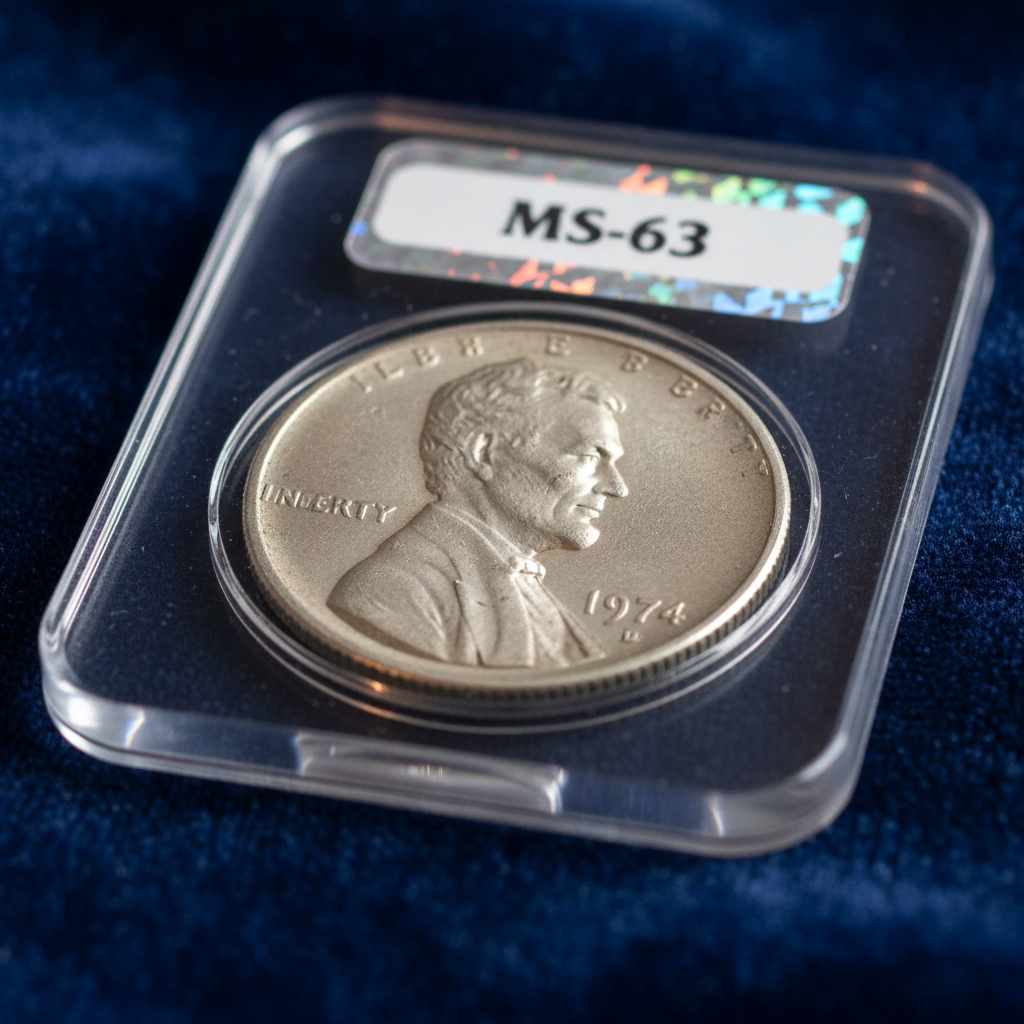
Fifty years ago, the U.S. Mint struck roughly 1.5 million aluminum cents and came within a congressional vote of putting them into circulation. Today, the coins are federally prohibited from private ownership — and the legal skirmish over the last known specimen in collector hands remains one of the most unsettling precedents in American numismatics.
This is not a story about a coin that failed. It's a story about a coin that worked exactly as designed, then got buried by the politics surrounding it.
Why the Mint Went to Aluminum in the First Place
By the early 1970s, copper prices had climbed to the point where the metal content of a one-cent piece was approaching face value. The Mint was facing the same economic trap that would eventually force the composition change to copper-plated zinc in 1982 — and it was scrambling for alternatives years before that solution landed.
Aluminum was the leading candidate. It was cheap, abundant, and lightweight. The Mint produced test strikes in 1973 and 1974, settling on a composition of 96% aluminum and 4% trace metals. The obverse retained the Lincoln portrait; the reverse kept the Lincoln Memorial design that had been standard since 1959. Visually, the coins looked like cents. Functionally, they were a different animal entirely.
The problems emerged fast. Vending machine operators — a powerful lobbying bloc at the time — warned that their equipment couldn't distinguish aluminum cents from slugs. The medical community raised alarms about the coins being swallowed by children, arguing that aluminum was radiolucent and therefore invisible to X-rays, making ingested coins nearly impossible to locate. Whether that concern was scientifically rigorous or politically convenient is debatable. What isn't debatable is that it worked.
Congress killed the program in 1974. The Mint recalled and destroyed the entire production run — or thought it had.
The Specimens That Survived, and the Government's Response
Mint officials had distributed samples to members of Congress for examination during the legislative review process. When the program was cancelled, those coins were supposed to come back. Most did. A handful didn't.
For decades, the existence of surviving specimens was an open secret in numismatic circles. Collectors knew they were out there. The government knew collectors knew. The official position was that any aluminum cent in private hands was government property, illegally retained — full stop.
That position was tested directly in 2014, when a Smithsonian Institution conservator named Randy Lawrence came forward claiming to have inherited an aluminum cent from his father, a former Mint employee. Lawrence attempted to have the coin authenticated and, ultimately, sold. The Mint's response was swift: federal agents seized the coin. Lawrence pursued legal remedies. He lost. The coin went to the Smithsonian's National Numismatic Collection, where it resides today — the only aluminum cent with any kind of sanctioned public existence.
The legal outcome sent a clear message to anyone sitting on a similar piece: the government's claim doesn't expire, and it doesn't negotiate.
What This Means for the Market — and Why Collectors Should Pay Attention
From a pure numismatic standpoint, the 1974 aluminum cent occupies a category almost entirely its own. It cannot be legally bought, sold, or transferred in the United States. No major auction house — not Heritage Auctions, not Stack's Bowers, not Goldin — would touch one. No grading service, including PCGS or NGC, has encapsulated a specimen for public sale. The coin exists in a legal gray zone that makes even the most aggressive dealers step back.
That inaccessibility is precisely what makes the 1974 aluminum cent so fascinating as a numismatic artifact. It has no published auction record because no legitimate auction has ever occurred. It has no population report because no grading service has processed one for commerce. Its value, in any theoretical sense, is entirely academic — and yet the coin commands more sustained collector attention than most issues with six-figure realized prices.
The broader lesson here is one that serious collectors ignore at their peril. Government property claims on experimental and pattern coinage don't follow the same statute-of-limitations logic that governs most civil disputes. The Mint's position on the aluminum cent — that all surviving specimens belong to the federal government regardless of how they were obtained or how long they've been in private hands — has now been upheld in federal court. That's not a technicality. That's binding precedent.
For the collector who stumbles across an aluminum cent at an estate sale or buried in a deceased relative's collection: the romanticism of the find is real. The legal exposure is equally real. The government has demonstrated, clearly and recently, that it will act on its claim. The 1974 aluminum cent is the rarest kind of numismatic object — one that becomes more legally dangerous the more desirable it is.