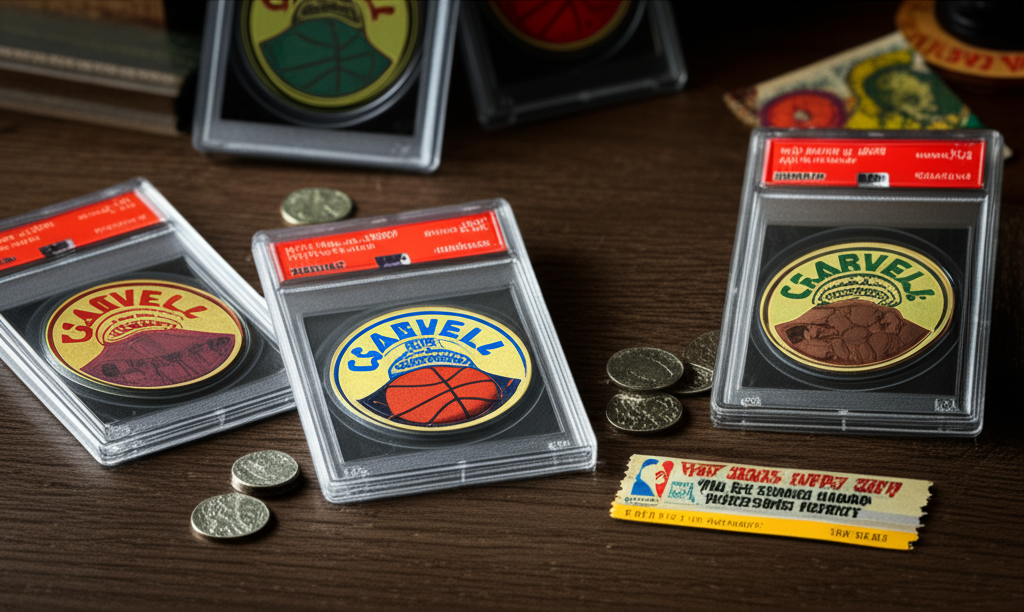
Food issues have always occupied a strange corner of the hobby — too niche for mainstream collectors, too interesting to ignore. The 1975 Carvel Ice Cream basketball disc set lands squarely in that territory, and it deserves more attention than it gets.
Issued as a regional promotion tied to the Carvel soft-serve chain, the set consists of round, disc-shaped cards featuring NBA players from the mid-1970s. Think of them as the hockey puck of the trading card world — literally circular, visually distinct, and almost entirely absent from the conversations that dominate basketball card collecting today. That absence is starting to look like an opportunity.
What You're Actually Getting
The checklist is where this set earns its legitimacy. The 1975 Carvel discs include recognizable names from one of the most talent-rich eras in NBA history — players who were either in their prime or approaching it during the mid-70s golden age of the league. The format itself is unusual: the discs measure roughly 3.75 inches in diameter, feature color player photos at center, and carry basic stats and team identification around the border. They were distributed with ice cream purchases, which means survival rates are predictably brutal. Kids ate the ice cream. The discs went in the trash.
That attrition matters enormously for today's market. Low-pop items from legitimate sets featuring Hall of Fame-caliber players are exactly the kind of thing that gets rediscovered when the broader vintage basketball market heats up — and that market has been running hot for the better part of four years.
PSA population data on individual discs from this set remains thin, with many key players showing single-digit graded examples across all grade levels. That's not a knock on the set's legitimacy — it's a reflection of how few survived in collectible condition and how few collectors have submitted what they own. Both factors compress supply in ways that can move prices sharply when demand arrives.
The Context That Makes This Interesting
NBA food and regional issues from the 1970s are genuinely underrepresented in the market relative to their baseball counterparts. Sets like the 1970-71 Topps basketball series get their due, but the regional and promotional issues that filled the gaps — Carvel, Dairy Queen, and similar food-tie promotions — have largely been left to specialists and team collectors.
That's changing. The broader vintage basketball card market has seen sustained price appreciation since roughly 2019, with pre-1980 material benefiting disproportionately from collector interest in players like Julius Erving, Kareem Abdul-Jabbar, and Pete Maravich — all names that intersect with the 1975 Carvel checklist's era. When collectors exhaust the obvious entry points in mainstream Topps issues, they start hunting for alternatives. Regional food issues become the logical next step.
The Carvel discs also benefit from a visual distinctiveness that's increasingly valued in a market saturated with rectangular cardboard. The circular format is immediately recognizable, photographs well, and displays cleanly in a collection. Aesthetics matter more than collectors sometimes admit.
From a grading standpoint, the disc format creates its own challenges. The rounded edges are prone to wear, the paper stock is thinner than standard Topps issues of the era, and centering — already a concern on rectangular cards — becomes a more complex evaluation on a circle. Finding a high-grade example of a key player from this set is genuinely difficult. A PSA 7 or better on a star disc should be treated as a meaningful find.
What Dealers and Collectors Should Watch
The honest assessment here is that the 1975 Carvel set sits at an interesting inflection point. It has the right ingredients: legitimate Hall of Fame-era players, extreme scarcity in high grade, a distinctive format that separates it from the noise, and a collecting community that has not yet fully priced in its rarity.
Raw examples occasionally surface at regional shows and on secondary platforms, often misidentified or undervalued by sellers who don't specialize in food issues. That's exactly the kind of inefficiency that rewards collectors willing to do the work. Submitting a raw disc to PSA or SGC — both of which grade non-standard formats — can crystallize value that a raw sale simply won't capture.
Heritage Auctions and Goldin have both handled obscure 1970s basketball material with increasing regularity as collector appetite for the era deepens. A well-graded Carvel disc featuring a marquee name hasn't had its moment yet at a major auction house. When it does, the comp it sets will reframe how the entire set is valued.
The ice cream is long gone. The cards, for those who kept them, may have aged considerably better.