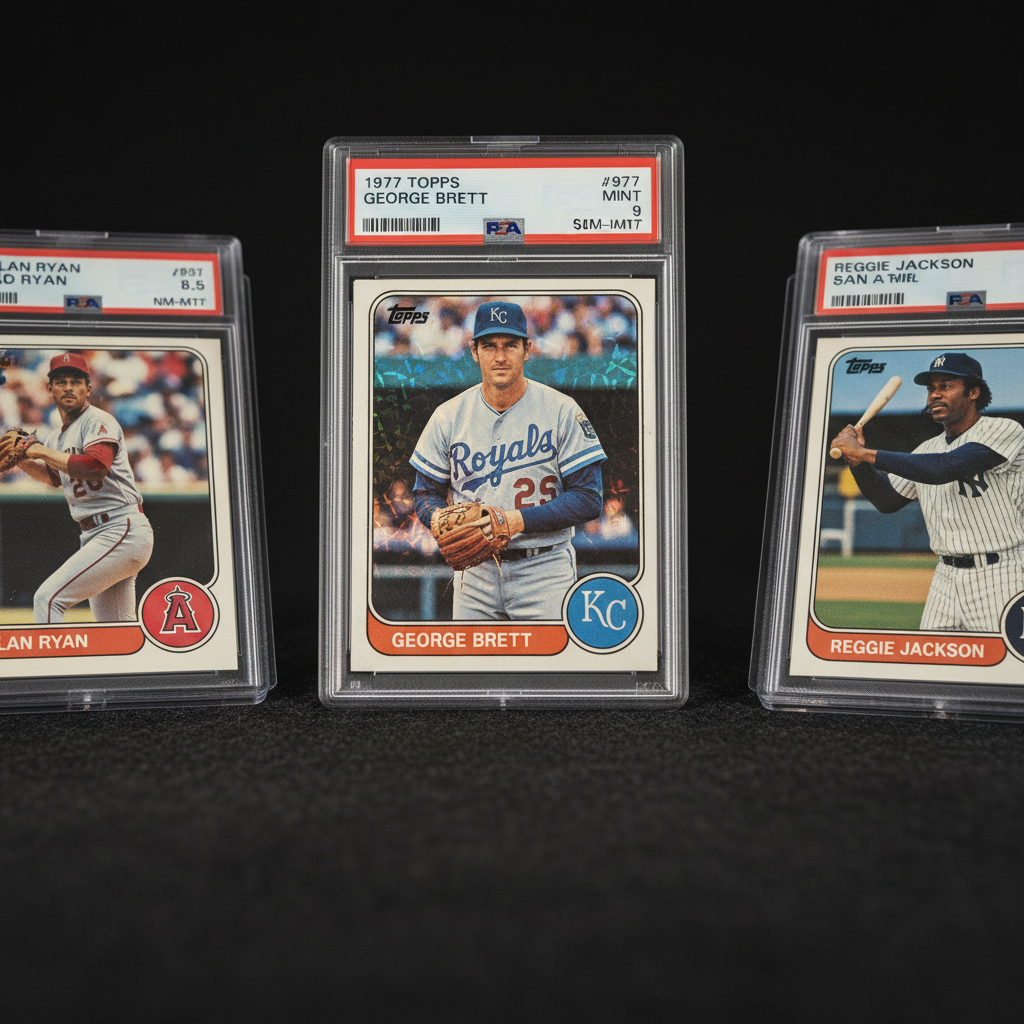
Nineteen seventy-seven was a transitional year for baseball — Reggie Jackson had just signed the richest free-agent deal in history, the Yankees were ascending again, and Topps was quietly producing one of the most underrated vintage sets of the decade. Nearly five decades later, the 1977 Topps Baseball set holds up as a legitimate collector's target: deep with star power, anchored by a handful of key rookies, and still accessible enough that building a high-grade run doesn't require liquidating a retirement account.
The set spans 660 cards and carries the visual hallmarks of mid-70s Topps — color-blocked player names, clean photography, and a design language that reads as authentically retro without being garish. Centering issues plague the run, which makes PSA 8s and above meaningfully scarce on the most desirable cards. That scarcity is where the real market story lives.
The Cards Driving Real Money
The undisputed anchor of the set is the Dale Murphy rookie card (#476). Murphy's card shares space with two other players in the classic Topps rookie format of the era, but it's his name that moves the needle. PSA has graded over 2,800 copies, with fewer than 90 earning a PSA 10 Gem Mint designation — a pop count that keeps prices firm at the top. A PSA 10 Murphy has traded in the $800–$1,400 range at Heritage and Goldin over the past 18 months, with condition-sensitive buyers willing to stretch for centered, sharp examples.
Then there's the Andre Dawson rookie (#473), another multi-player card that collectors have embraced as a legitimate Hall of Fame cornerstone piece. Dawson's PSA 10 population sits below 60 copies — tighter than Murphy's — and recent auction results reflect that constraint, with gem examples clearing $1,200 at Heritage in late 2023. Both Murphy and Dawson were inducted into Cooperstown, which gives the 1977 set a dual-HOF rookie narrative that few mid-70s Topps issues can match.
Beyond the rookies, the set's star cards carry real weight. The Reggie Jackson (#10) — issued right as Jackson was becoming the most talked-about player in the game — is a perennial PSA submission target. The Mike Schmidt (#140) and George Brett (#580) cards round out the upper tier, with Brett's card in particular benefiting from renewed collector interest following his sustained HOF legacy. A PSA 9 Brett has been moving in the $150–$300 range, while PSA 10 copies remain rare enough to command multiples of that.
Why Condition Is Everything Here
The 1977 Topps set was printed during an era when Topps wasn't exactly prioritizing collector-grade output. Cards came out of wax packs with soft corners, print defects, and centering that wandered. That manufacturing reality has a direct market consequence: the gap between a PSA 7 and a PSA 9 on key cards isn't incremental — it's exponential.
Take the Rod Carew (#120), a card that looks deceptively common in mid-grade. In PSA 7, it trades for pocket change. In PSA 9, it commands $80–$120. In PSA 10 — with fewer than 30 copies certified — it becomes a genuine trophy piece. This pattern repeats across the set's top 20 cards and explains why serious collectors pursuing 1977 Topps in high grade are playing a long game, hunting raw copies at shows and in collections rather than overpaying for already-graded mid-grade examples.
The Dave Parker (#270) and Gary Carter (#295) cards follow the same trajectory. Carter especially — a HOF catcher whose market has strengthened over the past three years as vintage catching cards have come into vogue — represents solid value in the PSA 8–9 range before the population drops off sharply at the top.
One card that often gets overlooked: the Thurman Munson (#170). Munson's tragic death in 1979 gave his cards a memorial significance that has only deepened with time, and his 1977 Topps issue in PSA 9 condition has been quietly appreciating. It's the kind of card that serious vintage collectors hold rather than flip.
The Set as a Whole
Collectors who approach 1977 Topps as a complete set project are working with a different calculus than single-card speculators. A mid-grade complete set — averaging PSA 6 to 7 across all 660 cards — can be assembled for $2,000–$4,000 with patience. A high-grade run pushing PSA 8 and above on every card is a multi-year project that will cost significantly more, particularly given the centering challenges on common cards that most dealers ignore until a set collector comes looking.
The 1977 Topps set doesn't generate the auction headlines that a 1952 Topps or 1986 Fleer Basketball does. It doesn't need to. It's a set with genuine Hall of Fame depth, a dual-rookie anchor, and a price point that rewards patient, knowledgeable collectors over momentum chasers. In a market that's been volatile since 2021, that kind of steady, fundamentals-driven value is increasingly hard to find.