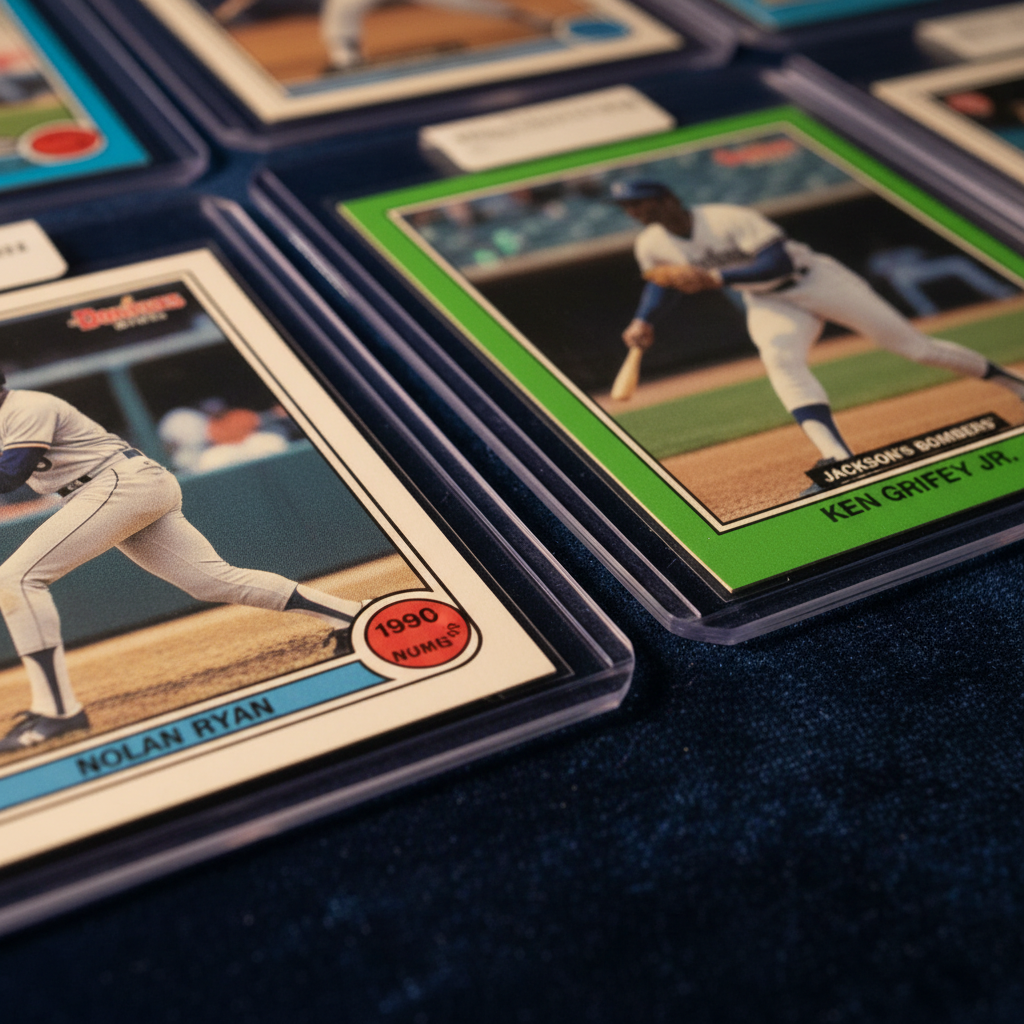
Thirty-five years after Donruss flooded the hobby with hundreds of millions of cards, the 1990 set still gets dismissed as wallpaper. That's a mistake — at least for a handful of specific cards that have quietly held collector interest while the rest of the checklist collects dust in dime boxes at card shows.
The 1990 Donruss release arrived at peak Junk Wax overproduction. Donruss, Topps, Fleer, and Score were all printing to theoretical demand — which is to say, they were printing without limit. The result was a market so oversupplied that most cards from this era will never carry meaningful secondary market value. But that sweeping dismissal causes collectors to overlook the cards that actually matter within the set.
The Rookie Cards That Still Move
The centerpiece of any 1990 Donruss conversation is the Juan Gonzalez rookie card (#33). Gonzalez went on to win two AL MVP awards and slug 434 career home runs, and his Donruss rookie — shared with Topps, Score, and Fleer that same year — remains the most searched card from this checklist. Raw copies trade for next to nothing, but PSA 10 examples have sold in the $30–$60 range depending on timing and comparable sales, which is respectable for a Junk Wax RC with population counts in the thousands.
The Sammy Sosa rookie (#489) is the other name that gets attention. Sosa's hobby legacy is complicated by the steroid era, but his raw power numbers — 609 career home runs, three seasons of 60-plus — still command a collector base. PSA 10 copies of his 1990 Donruss have sold in the $20–$45 range, modest but consistent. The Sosa rookie market tends to spike whenever vintage power-hitter cards cycle back into fashion.
Larry Walker's rookie card also appears in this set. Walker's 2020 Hall of Fame induction gave his early cardboard a noticeable lift, and the 1990 Donruss RC benefited alongside his more premium issues from the same year. It's not a high-dollar card, but Hall of Fame status provides a floor that most Junk Wax cards simply don't have.
The Established Stars Worth Grading
Beyond rookies, the 1990 Donruss checklist carries cards of Ken Griffey Jr., Nolan Ryan, Rickey Henderson, and Cal Ripken Jr. — names that need no introduction. The Griffey (#365) is the most pursued of the bunch. Griffey's 1989 Upper Deck rookie is the card that defined his cardboard legacy, but collectors building complete Griffey runs pull his 1990 Donruss as a matter of course. High-grade examples are easy to find given production volume, but a PSA 10 Griffey from any set has an audience.
The Ryan (#280) appeals to a different collector — the completist working through his massive career catalog. Ryan pitched until 1993 and appeared on cards well into his 40s, creating one of the longest single-player runs in the hobby. His 1990 Donruss isn't a market mover, but it belongs in any serious Ryan collection.
Henderson's card (#255) benefits from his 2009 Hall of Fame induction and his standing as the greatest leadoff hitter in baseball history. The stolen base record alone — 1,406 career steals — keeps his cards in circulation among stat-obsessed collectors who prioritize historical significance over raw dollar value.
Grading Realities for a High-Print Era
Here's where the 1990 Donruss story gets genuinely interesting from an investment standpoint: grading these cards is almost never economically rational at standard submission tiers. With PSA 10 population counts running into the thousands for most key cards, there's no scarcity premium to unlock. The Juan Gonzalez RC, for instance, has a PSA 10 population well above 2,000 copies — the kind of number that caps upside regardless of the player's legacy.
The calculus changes only at the extreme margins. A PSA 10 with a particularly clean centering and sharp corners can still find a buyer at a modest premium over raw, but nobody should be submitting 1990 Donruss cards expecting to flip for serious profit. The play here is personal collection value, not arbitrage.
That said, the set does have one structural advantage over many of its Junk Wax contemporaries: the design is genuinely good. The red-and-black border with the puzzle-piece back design has aged better than the 1990 Fleer's neon yellow or the 1990 Score's busy layout. Aesthetics don't drive markets, but they do drive the kind of low-level collector affection that keeps a set from disappearing entirely.
The honest verdict on 1990 Donruss: it's a set where the names matter and the numbers don't. Gonzalez, Sosa, Walker — those are real cards with real players behind them. The rest is nostalgia inventory. Know the difference, and the set becomes a perfectly reasonable corner of a broader vintage baseball collection rather than a cautionary tale about overproduction.