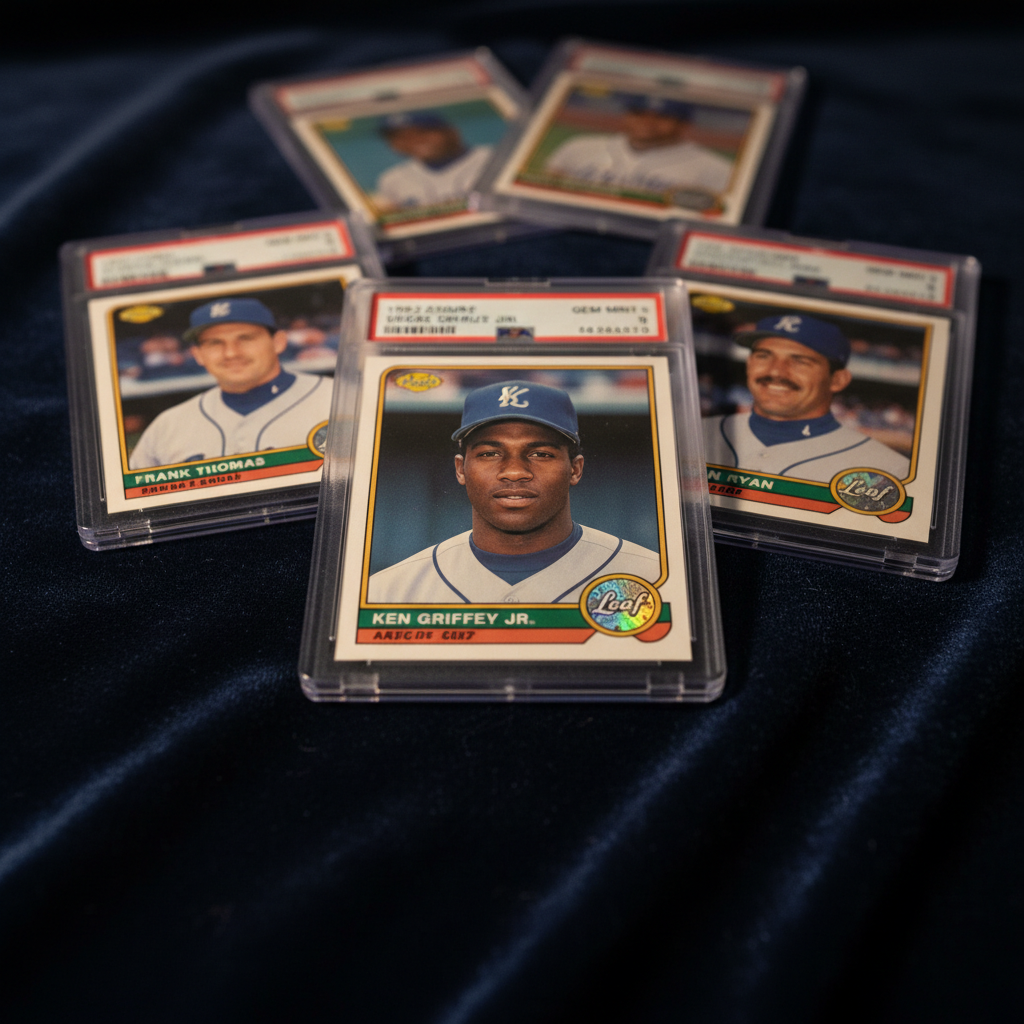
Thirty-six packs. No guaranteed hits. No superfractors, no autographs, no manufactured relics. Just cardboard, wax, and the quiet dignity of a product that understood exactly what it was. Beckett's Cheap Wax Wednesday series recently cracked a box of 1992 Leaf Series 2 Baseball, and the results serve as a useful reminder that some of the hobby's most compelling breaks don't require a four-figure box price to be worth your time.
The 1992 Leaf set doesn't get the reverence of its 1990 predecessor — the one that introduced the brand with a splash and gave collectors some of the cleanest photography of the junk wax era — but Series 2 holds its own. The checklist runs deep with Hall of Fame talent, and the card stock, by early-'90s standards, remains genuinely above average. Donruss, Leaf's parent company, positioned the line as a premium alternative to base Topps and Fleer, and the production quality showed it.
What's Actually in the Box
A standard 1992 Leaf Series 2 hobby box ships with 36 packs at roughly 15 cards per pack, putting the total card count near 540. At current secondary market prices — boxes trade in the $20–$40 range depending on condition and seller — the per-card cost is negligible. That's the entire appeal of the Cheap Wax format, and it's a legitimate one.
The Hall of Fame presence in Series 2 is real. The checklist includes cards of Cal Ripken Jr., Ken Griffey Jr., Nolan Ryan, Ryne Sandberg, and Frank Thomas, among others. None of these are short-printed. None carry meaningful scarcity. But that's almost beside the point — this is a set built for the pleasure of the pull, not the portfolio.
From a grading standpoint, 1992 Leaf cards present a mixed picture. The dark borders that define the set's aesthetic look sharp when centered and clean, but they're unforgiving to handle wear. A card that's been touched twice shows it. PSA population data reflects this: high-grade examples of the key players are attainable but not abundant, and a PSA 10 on a Griffey or Thomas from this set still commands a meaningful premium over raw copies. The Griffey Series 2 card in PSA 10 has sold in the $15–$30 range at recent auction, modest by modern standards but consistent with collector demand for the player across his deep checklist.
The Junk Wax Paradox
Here's the tension at the center of every Cheap Wax break: these cards were produced in enormous quantities during the hobby's peak overproduction years, which means raw copies are essentially worthless in bulk. But the same production era that killed secondary market values also created the conditions for a nostalgia trade that's been quietly appreciating for a decade.
Collectors who were kids in 1992 are now in their 40s with disposable income and a genuine emotional connection to this cardboard. That's not a new observation, but the market keeps validating it. Sealed 1992 Leaf hobby boxes have crept up in price over the past three years, driven partly by break culture and partly by the same nostalgia wave lifting all boats from the junk wax era. A box that sat in a dealer's back room at $15 in 2018 might move at $35–$45 today.
The graded market adds another layer. While raw 1992 Leaf cards are abundant, truly high-grade examples — the ones that survived three decades in top-loaders or original packaging — are scarcer than population reports suggest, because most collectors never bothered to submit them. There's a reasonable case that undergraded, condition-sensitive junk wax cards represent one of the hobby's last genuine value inefficiencies.
Breaking for the Right Reasons
Beckett's box break format serves a specific audience: collectors who want to watch the cards come out of the pack without buying the box themselves, and hobbyists who are curious whether a product is worth hunting down. For 1992 Leaf Series 2, the answer depends entirely on your expectations.
If you're chasing raw financial upside, look elsewhere. The print runs were massive, the stars are well-documented, and nobody is paying significant money for ungraded copies of common Hall of Famers from this era. But if you want 36 packs of clean, well-designed early-'90s baseball cards featuring legitimate legends of the game, delivered at a price point where the fun-per-dollar ratio is nearly unbeatable — this box makes a compelling argument for itself.
The 1992 Leaf set never needed to be rare to be good. It just needed to be exactly what it was: a well-made product from a transitional moment in hobby history, built when card companies still competed on quality rather than manufactured scarcity. That's a harder thing to find than it sounds, and thirty years later, it still shows.