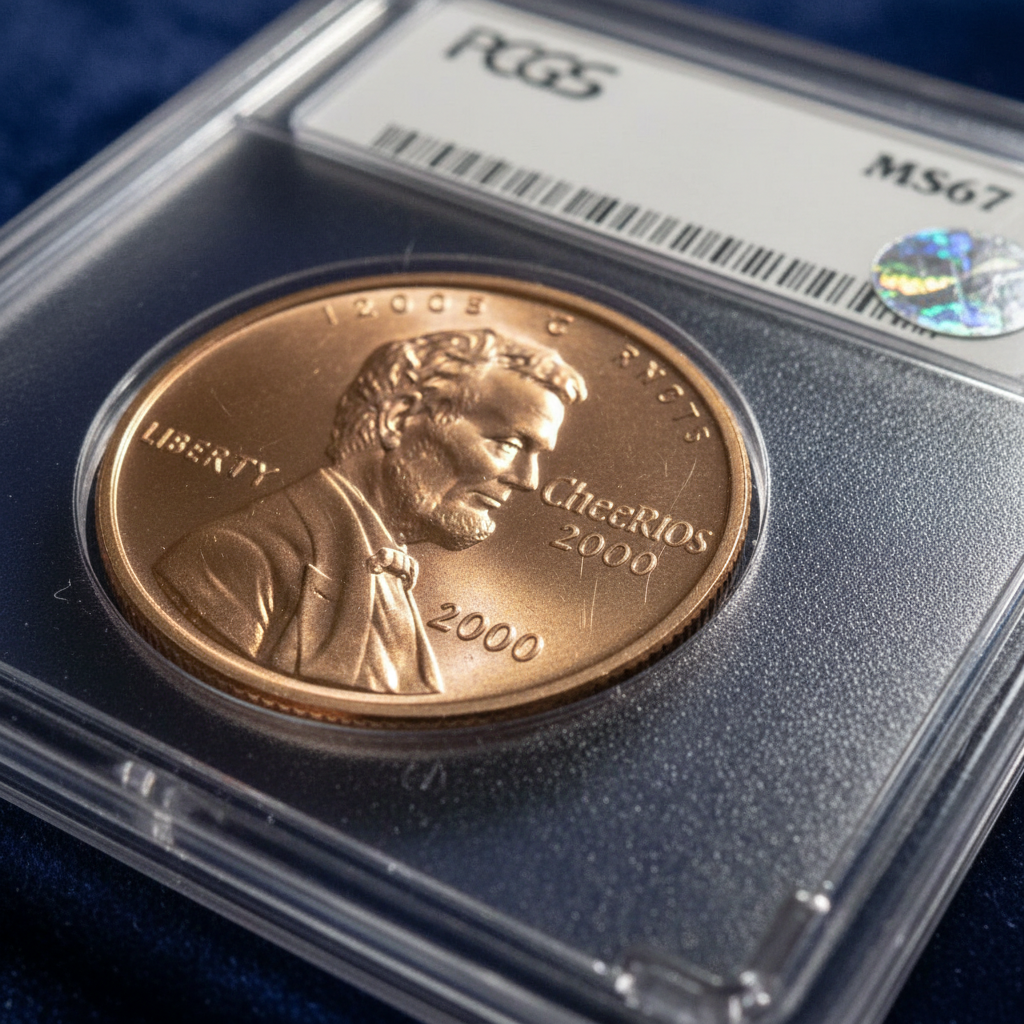
Ten million Lincoln cents shipped inside Cheerios boxes in early 2000. Most ended up in piggy banks, couch cushions, or the trash. A small fraction survived in pristine condition — and those coins are now commanding serious money from collectors who know exactly what they're looking at.
The 2000 Cheerios Cent is one of the more unusual promotional artifacts in U.S. Mint history, born from an unlikely partnership between the federal government and General Mills. The Mint needed a vehicle to introduce the new Sacagawea dollar to the American public. General Mills needed a reason for consumers to pick their cereal off a crowded shelf. The solution: stuff 10 million Lincoln cents and 5,500 Sacagawea golden dollars into specially marked Cheerios boxes nationwide.
The promotion launched in January 2000 to coincide with the millennium rollover and the official debut of the Sacagawea dollar program. For most families, the coin was a novelty — a fun little prize, like a Cracker Jack toy with legal tender status. Few understood, or had any reason to suspect, that these cents might carry any special significance.
What Makes the Cheerios Cent Different
Here's where the story gets interesting. Early research by numismatists revealed that at least some of the cents distributed in Cheerios boxes were struck from a different reverse die than the standard 2000 Lincoln cents entering circulation at the same time. The Cheerios cents appear to have been produced using an enhanced or prototype reverse hub — one that shows more pronounced detail in the memorial building's columns on the reverse. This is the same kind of die distinction that separates a common date from a major variety in any other series.
The distinction isn't visible to the naked eye at a glance. Side-by-side comparison under magnification tells the real story. That detail — the kind of thing that separates serious numismatists from casual coin handlers — is precisely why most of these cents were spent without a second thought.
Not every Cheerios cent exhibits the enhanced reverse. The population of confirmed variety specimens is a fraction of the original 10 million distributed, and the number that survived in collectible condition is smaller still. PSA and PCGS have both certified examples, with high-grade specimens — think MS-67 and above — representing the true scarcity tier within an already narrow population.
What the Market Says
Raw, ungraded Cheerios cents with original packaging — the sealed, unopened Cheerios box or the intact cellophane wrapper — trade at a meaningful premium over loose examples. A certified MS-66 example with confirmed enhanced reverse detail has sold in the $1,500 to $3,000 range at major auction. Push that grade to MS-67 or MS-68 with strong eye appeal, and realized prices have reached $5,000 to $6,000 or higher depending on the platform and the buyer pool on a given day.
Heritage Auctions and Stack's Bowers have both handled certified Cheerios cents, and the results track with what you'd expect from a coin that sits at the intersection of modern rarity, pop culture provenance, and die variety collecting. The Sacagawea dollars from the same promotion carry their own premium — particularly the Pattern Reverse Sacagawea variety, which is a genuinely significant rarity — but the Lincoln cent is arguably the more accessible entry point for collectors who want a piece of the story without paying four figures minimum.
Context matters here. The Lincoln Memorial cent series ran from 1959 through 2008. Across nearly five decades of production, the series is not known for dramatic rarities — it's a workhorse series, high-mintage, widely collected but rarely explosive at auction. The Cheerios cent punches well above its series weight precisely because it combines a documented die variety with a compelling origin story and a hard cap on surviving high-grade examples.
Provenance Is Everything
Original packaging transforms the collectible entirely. An unopened Cheerios box from 2000 with the coin still sealed inside is a time capsule — and the market treats it that way. These intact examples are genuinely rare. Most boxes were opened, most coins were removed, and most packaging was discarded within days of purchase. The ones that survived did so almost by accident: a collector who recognized the moment, a parent who saved it for a child, a hoarder with good instincts.
For dealers and collectors evaluating raw examples without original packaging, the enhanced reverse die detail is the authentication anchor. Without it, you have a common 2000 Lincoln cent worth face value. With it — confirmed by a major grading service — you have one of the more charming modern varieties in American numismatics.
Twenty-five years after they tumbled out of cereal boxes across America, the best Cheerios cents are still appreciating. The ones that got spent are gone forever. The ones that got saved are worth more every year. That's the whole story of coin collecting, compressed into a single box of breakfast cereal.