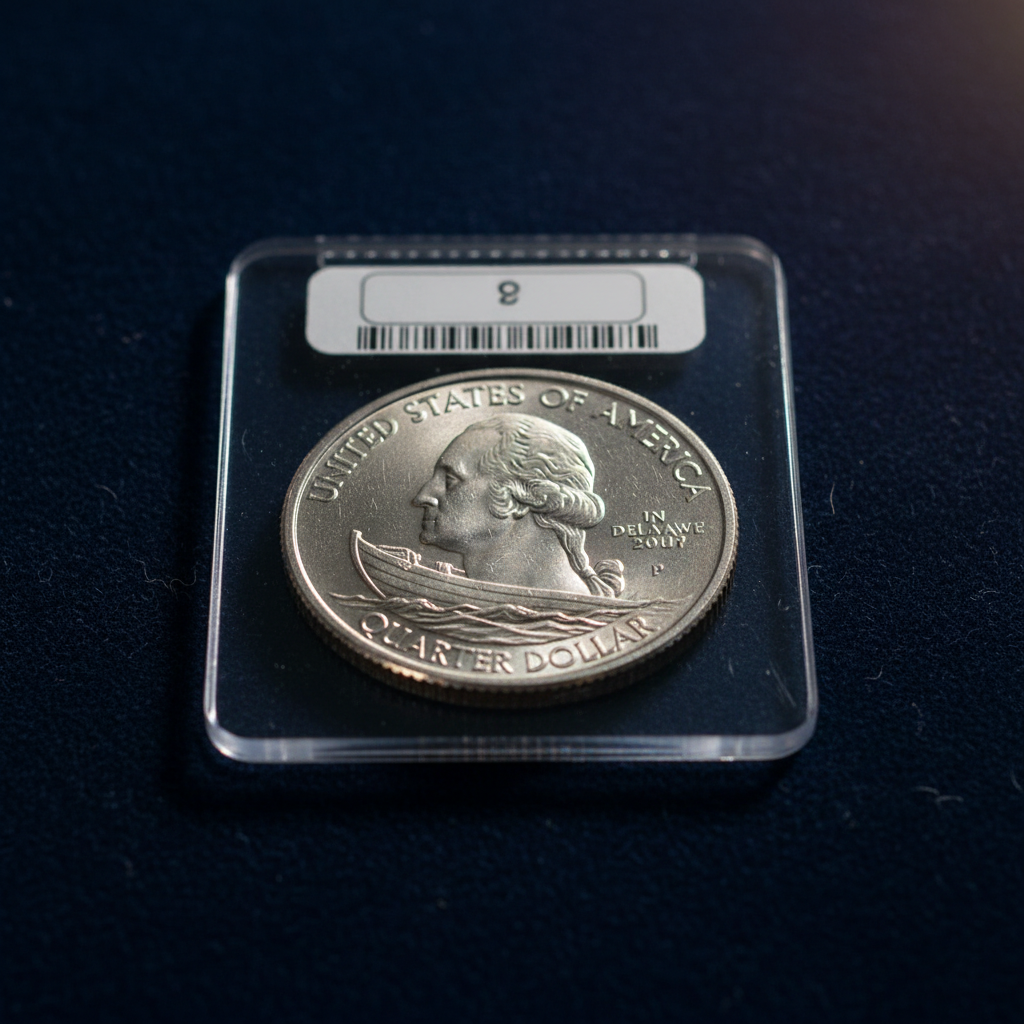
When the America the Beautiful Quarters Program closed out after 56 coins, Congress didn't leave collectors empty-handed. The 2021-P Washington Crossing the Delaware quarter stepped in as a one-year transitional type — a coin that exists precisely because legislative timing created a gap, and the U.S. Mint needed something to fill it. That backstory alone makes this issue more interesting than its face value suggests.
Struck at the Philadelphia Mint in 2021, this quarter carries the "P" mintmark and depicts Emanuel Leutze's iconic 1851 painting of Washington's crossing of the Delaware River on December 25, 1776 — one of the most reproduced images in American history. The design choice wasn't arbitrary. Congress specifically authorized the Washington Crossing theme as a bridge issue before the new American Women Quarters Program launched in 2022. One year. One design. That's it.
Mintage, Population, and the Grade That Matters
The Philadelphia Mint struck approximately 278.4 million of these quarters for circulation — a number large enough to keep raw examples common and cheap, but not so overwhelming that high-grade certified specimens are plentiful. This is where the story gets interesting for serious collectors.
In circulated grades, the coin is essentially a pocket-change find. Don't pay more than a dollar or two for anything below MS-64. The real action starts at MS-67 and above on the Sheldon scale, where population figures thin out considerably. PSA and PCGS both handle modern clad coinage, and the top-pop chase on this issue is very much alive. A PCGS MS-68 example — if you can find one — commands a meaningful premium over melt, with recent auction comparables suggesting prices in the $50–$150 range depending on eye appeal and surface quality.
The First Strike and Early Releases designations from PCGS and NGC respectively add another layer for registry collectors. These labels, applied to coins submitted within the first 30 days of release, carry modest premiums but matter to anyone building a complete modern type set with designation consistency.
Proof versions — struck at the San Francisco Mint — are a separate conversation entirely. The 2021-S proof in PR-70 Deep Cameo is the obvious target for type collectors who want the definitive example of this one-year issue. NGC and PCGS populations for PR-70 DCAM examples remain relatively tight, and prices have held steady in the $20–$40 range at venues like eBay and through Heritage Auctions' internet-only sessions.
Why a One-Year Type Coin Deserves More Respect
Modern U.S. coinage doesn't produce true one-year types very often. The Washington quarter design itself ran from 1932 through 1998 with only minor modifications. The State Quarters era launched in 1999 and ran for a decade. One-year transitional issues — coins that exist because of a specific legislative or programmatic gap — are genuinely uncommon in the modern series, and the market has historically rewarded them over the long term.
Consider the 1975-S proof Washington quarter, which carries no mintmark variety drama but commands collector attention simply because of its place in the series timeline. Or look at how transitional clad issues from the mid-1960s — the years when silver was phased out — have appreciated steadily as type collectors filled holes. The Washington Crossing quarter occupies a structurally similar position: it's the last coin before a new multi-year program began, and it's the only quarter ever to bear this specific reverse design.
That singularity has value. Not speculative, moonshot value — but the quiet, durable value of a coin that type set builders must own. Every serious modern type set needs one. There's no substitute, no variation that fills the slot.
The bulk of circulation strikes will never be worth more than a few dollars. But a registry-quality MS-68 or a flawless PR-70 DCAM proof represents the ceiling of what this design can be — and for a coin that will never be minted again, that ceiling is worth understanding before the market figures it out for you.