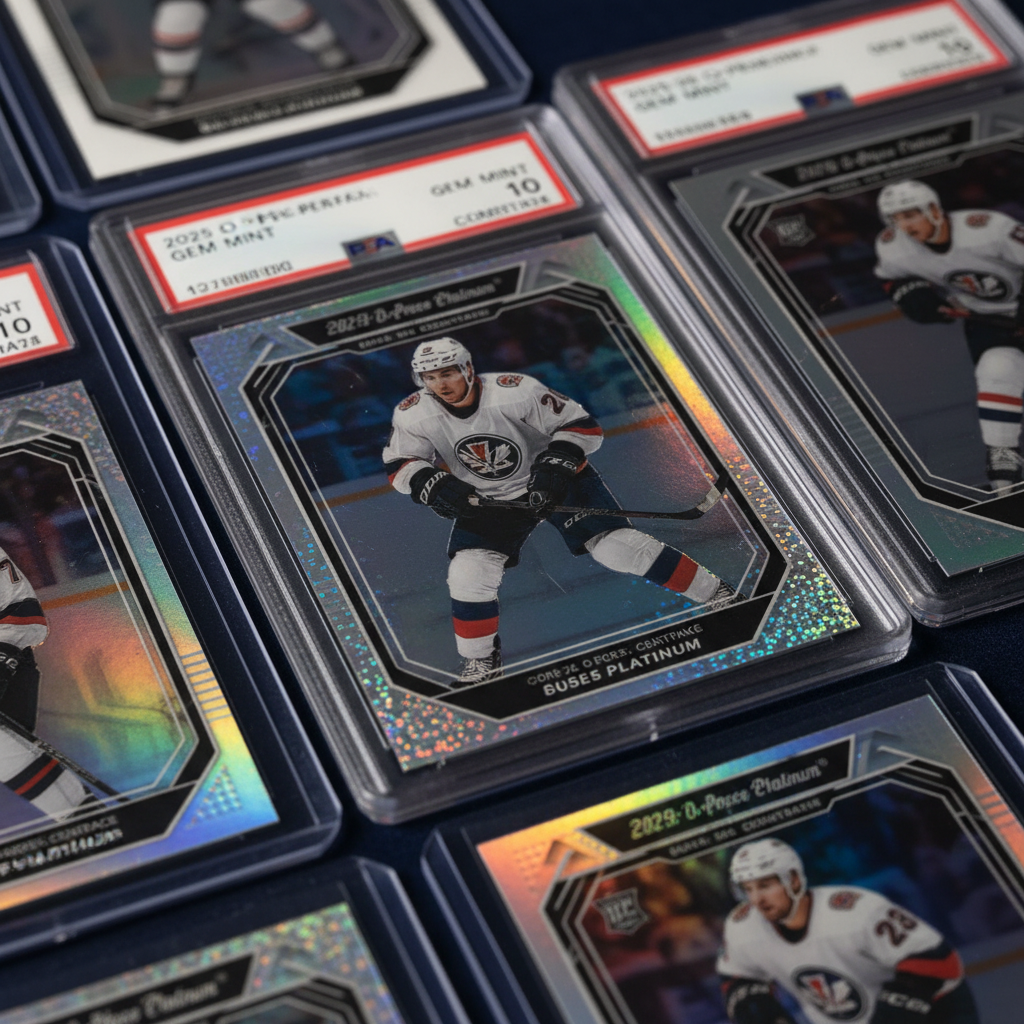
Upper Deck's 2025-26 O-Pee-Chee Platinum Hockey is locked in for release, and the checklist confirms what the hobby has come to expect from this product: a deep parallel rainbow, a robust autograph program, and enough insert variety to keep both box-breakers and set-builders engaged. For a mid-tier hockey release, OPC Platinum consistently punches above its price point — and the 2025-26 configuration looks to continue that tradition.
Hobby boxes and blaster boxes will both be in play at launch, giving this product reach across the full retail spectrum. Hobby configurations are where the serious pulls live, while blasters serve as the entry point for younger collectors and casual fans picking up product at Target or Walmart. Upper Deck has historically used OPC Platinum to thread that needle more effectively than most of its hockey competitors.
What's in the Checklist
The base set covers the full NHL roster landscape, with veteran stars, second-year breakouts, and true rookies all represented. Rookie cards are, as always, the engine of this product's secondary market. The 2024-25 rookie class — headlined by names like Matvei Michkov and Cayden Lindstrom — carried significant pull in last year's equivalent releases, and the 2025-26 class will be watched closely for the next wave of first-year NHL talent.
Parallels are where OPC Platinum earns its collector loyalty. The rainbow structure typically runs from base through Blue, Teal, Purple, Orange, Gold, and Black finishes, with the rarest tiers numbered as low as 1-of-1. Refractor-style finishes give the cards a visual pop that photographs well — a non-trivial consideration in an era where card aesthetics drive social media engagement and, by extension, market demand.
Autograph content spans several insert programs, including on-card signatures where available. The distinction matters: sticker autos, which Upper Deck has leaned on at various points across its product lines, draw consistent criticism from the collector community and suppress secondary market values compared to on-card equivalents. Whether 2025-26 OPC Platinum leans toward on-card or sticker will be a key detail to watch when hobby cases start arriving.
Market Position and Secondary Expectations
OPC Platinum has carved out a reliable niche in the hockey card market — not the prestige tier of The Cup or Ultimate Collection, but a step above base-level products like Series One and Two. That positioning means accessible box prices (hobby boxes typically land in the $80–$130 range at release) with upside concentrated in the parallel and auto pulls.
On the secondary market, the product's strongest performers have historically been PSA 10 rookie parallels of players who break out in their first full NHL season. A Michkov-equivalent from the 2025-26 class, pulled as a numbered Gold or Black parallel and graded gem mint, could realistically command $300–$800+ depending on the player's early-season performance. That's the OPC Platinum value proposition in a sentence: low barrier to entry, lottery-ticket upside on the right rookie.
Grading makes sense on the high-end parallels and autos. The OPC Platinum card stock — a chromium-style finish — is susceptible to surface scratches and edge wear, which means raw pulls from hobby boxes often grade out lower than collectors expect. A PSA 9 on a numbered parallel is common; a PSA 10 is genuinely scarce and commands a meaningful premium over its 9 counterpart.
- Release format: Hobby boxes and blaster boxes
- Base set: Full NHL roster coverage including rookies
- Parallel structure: Multi-tier rainbow with numbered finishes to 1/1
- Autographs: On-card and insert-based programs
- Inserts: Multiple themed insert sets across both hobby and retail configurations
- Grading consideration: Chromium stock warrants submission on numbered parallels and key rookies
Team Sets and Collector Strategy
Team set collectors — a segment of the hockey hobby that often gets overlooked in favor of player-focused speculation — will find OPC Platinum's depth useful. The checklist's broad roster coverage means most franchises get meaningful representation, and team-based parallel rainbows are a legitimate collecting goal for the patient, budget-conscious hobbyist.
For speculators, the calculus is straightforward: identify the two or three rookies most likely to make a significant impact in 2025-26, target their numbered parallels early in the release window before the market prices in performance, and hold through the first half of the season. It's a strategy that's worked in OPC Platinum before — and one that requires knowing the prospect landscape cold before boxes even hit shelves.
The full checklist, team sets, and box odds are the data points that separate informed breaks from blind gambling. When those details finalize closer to release, the secondary market will move fast. In OPC Platinum, the window between product announcement and price discovery closes quickly — and collectors who do their homework before launch day are the ones who come out ahead.