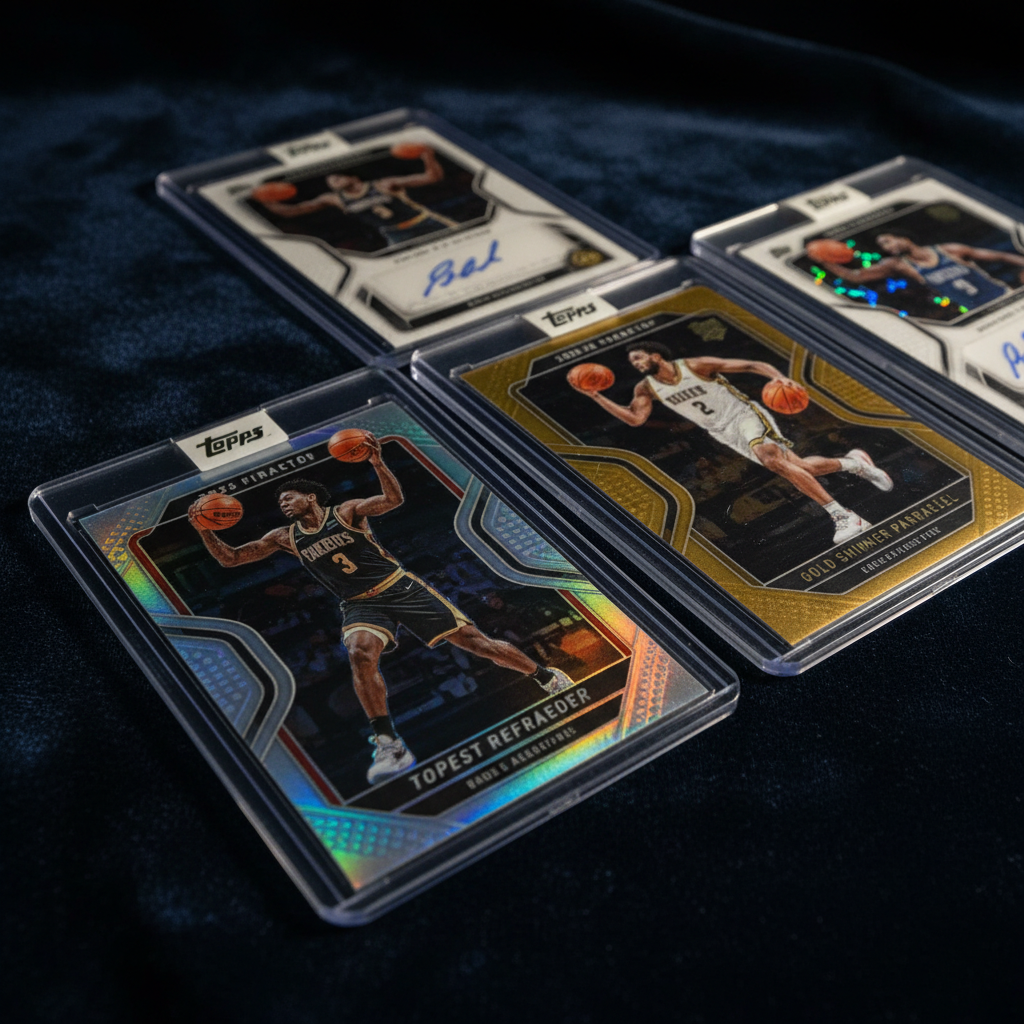
Topps Finest has always played the parallel game better than almost anyone in the basketball card space, and the 2025-26 edition is doubling down on that reputation. The set arrives with a tiered rainbow structure that ranges from widely accessible refractors to short-printed die-cuts that will have case breakers chasing for months — and given where Finest rookies have traded in recent years, the stakes are real.
For context: a 2021-22 Topps Finest Cade Cunningham Base Refractor PSA 10 was moving in the $40–$65 range at peak, while his Superfractor — one of one — cleared $8,000 at Goldin. The parallel structure is the engine that drives that spread, and understanding it is the difference between buying smart and buying blind.
The Parallel Ladder: How 2025-26 Finest Stacks Up
The 2025-26 Finest parallel architecture follows the brand's established chromium framework, but with refinements to the color-tier sequencing that collectors who've followed the line since its 2012 basketball revival will recognize immediately.
At the base of the rainbow sits the standard Base Refractor, unnumbered and the most attainable entry point. From there, the ladder climbs through a sequence of numbered parallels:
- Blue Refractor — numbered to /150
- Green Refractor — numbered to /99
- Gold Refractor — numbered to /50
- Orange Refractor — numbered to /25
- Red Refractor — numbered to /10 or /5 depending on subset
- Superfractor — 1/1, the top of every rainbow
Die-cut and special-finish variants — including the X-Fractor and Pulsar Refractor patterns that Finest has leaned into heavily since the 2020s — layer additional complexity onto that base structure. The Pulsar in particular photographs exceptionally well, which matters in a market where Instagram and eBay listings are often the first point of contact between a card and a potential buyer.
Rookie Class Exposure: Where the Real Money Lives
No parallel guide exists in a vacuum. The value of any Finest rainbow is almost entirely a function of who's in the rookie checklist, and the 2025-26 draft class — headlined by the top picks from the 2025 NBA Draft — gives this set legitimate upside potential.
Finest has historically been a strong venue for early-career chromium. The brand's 2003-04 run produced LeBron James refractors that now grade out at PSA 10 for $2,000–$4,500 depending on the specific parallel. The 2018-19 Finest Luka Dončić Base Refractor PSA 10 regularly trades in the $300–$500 corridor. Those comps set the ceiling for what a hit from this year's class could eventually become — assuming the right player breaks out.
The numbered parallels below /25 are where the speculative play concentrates. A Gold Refractor /50 of a consensus top-three pick is typically the sweet spot for the collector who wants meaningful scarcity without paying Superfractor premiums. At current hobby box prices — which have settled in the $180–$220 range for Finest basketball at most online retailers — a Gold Refractor pull of a franchise-caliber rookie represents a strong hit-to-cost ratio compared to competing premium chromium releases.
The Orange /25 tier is where things get genuinely interesting from an investment standpoint. Low enough to feel exclusive, high enough that multiple copies will surface on the secondary market and establish real price discovery. Watch those sales closely in the first 60 days after release — that window is when the market is most liquid and least manipulated by artificial scarcity.
Grading and Population Dynamics
Finest's chromium stock grades well. The card stock is consistent, corners are typically sharp out of pack, and the refractor coating doesn't show surface wear the way vintage cardboard does. PSA 10 population rates on modern Finest base refractors routinely run above 60–70% of submitted copies, which is both a selling point and a caution flag — high pop rates compress premiums on PSA 10s over time.
The numbered parallels tell a different story. Collectors submit them at lower rates, populations stay thin, and a PSA 10 on a /10 Red Refractor of a star rookie can command a 3x–5x multiple over a raw copy simply because so few graded examples exist for comparison. BGS 9.5 Black Labels on Finest parallels are legitimately rare given the set's typical print quality — if you pull a numbered card with pristine centering, it's worth the submission cost to find out.
The Superfractor, as always, is its own category. One of one means the market is whatever the two most motivated buyers decide it is on any given day. Heritage Auctions and Goldin have both moved Finest Superfractors of star rookies well into five figures when the timing and the player aligned. That ceiling hasn't changed.
Finest doesn't need to reinvent itself every year — the system works. What changes is the talent on the checklist, and in 2025-26, that's the only variable that actually matters.