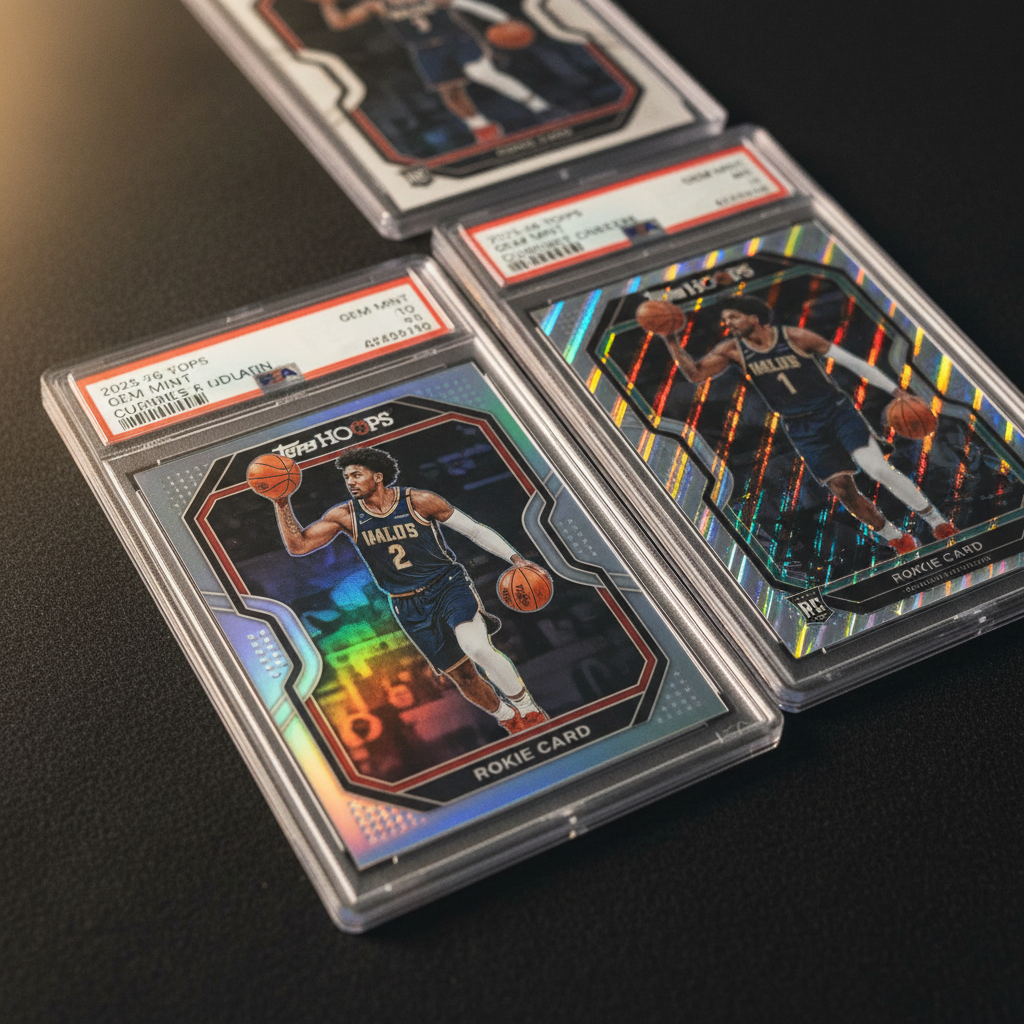
Topps is bringing NBA Hoops back for the 2025-26 season, and the product's checklist architecture suggests the brand is leaning harder into its value-tier identity while quietly expanding the autograph program that's driven its secondary market performance over the past two years.
Hoops has always been the entry point — the product you crack when you want volume, color, and a legitimate shot at something real without the per-box price tag of Prizm or Select. That positioning hasn't changed. What has changed is how Topps is structuring the insert and auto layers to give collectors more reasons to care about the base set again.
Box Configuration and Base Set Structure
Hobby boxes are configured at the familiar hobby format, with team sets covering all 30 NBA franchises and a base checklist that spans veterans, rookies, and the short-print tiers that Hoops collectors have learned to hunt. The 2025-26 rookie class — headlined by whatever the draft lottery produces — will be the commercial engine here, as it always is. Hoops rookie cards have historically been the first widely available licensed cards for incoming players, which gives the product a timing advantage that even premium competitors can't fully neutralize.
The base design for 2025-26 continues the clean, arena-photography approach that Topps has favored since reclaiming the NBA license. Nothing revolutionary, but Hoops was never supposed to be revolutionary. It's supposed to be accessible, and the design delivers on that brief.
Autographs, Inserts, and the Cards That Actually Move
The autograph checklist is where serious collectors need to focus. Hoops has carved out a reliable niche for on-card autos at a price point that makes player-collector accumulation genuinely viable. Recent Goldin and PWCC sales data shows that Hoops rookie autos from the 2023-24 and 2024-25 runs have held value better than their sticker price suggested — particularly for players who outperformed draft-slot expectations in their first seasons.
Insert programs include the returning fan-favorite parallel structures, with color-tiered parallels running from base holofoil up through numbered short prints. The rarest parallels — typically numbered to 10 or fewer — have consistently attracted grading submissions to PSA and BGS, where even a PSA 9 on a low-pop numbered parallel can carry meaningful premium over raw copies.
- Base set with full 30-team coverage and rookie cards
- Autograph cards spanning veterans and 2025 draft class
- Numbered parallel tiers, including short prints numbered to 10 and 1-of-1 variants
- Insert sets covering league leaders, historical tributes, and photo variation SPs
- Team set collector configurations available alongside hobby
The photo variation short prints deserve particular attention. Hoops has quietly built a collector community around SP hunting that rivals the energy around flagship Topps baseball SPs — and the secondary market has followed. On eBay and through PWCC's marketplace, confirmed SP variants from recent Hoops releases have sold at 3x to 8x the price of standard base copies, even in raw condition.
Market Context: Where Hoops Sits Right Now
The NBA card market spent most of 2023 and early 2024 in a correction cycle after the pandemic-era bubble deflated. Premium products like Flawless and National Treasures absorbed the sharpest price drops. Hoops, operating at the lower end of the price spectrum, proved more resilient — partly because floor products don't have as far to fall, and partly because the collector base for Hoops skews toward genuine fans rather than pure speculators.
That dynamic matters for 2025-26. If the incoming rookie class produces one or two players who immediately capture the broader sports conversation — the kind of debut seasons that move markets — Hoops will be the first product to feel it. The 2003-04 Hoops LeBron James rookie, while not the card the hobby obsesses over, was the first widely distributed licensed LeBron card on the market. First-mover timing still counts.
Release date details are still being finalized, but based on Topps's recent production calendar, a late 2025 or early 2026 retail and hobby drop is the working expectation. Collectors who've been sitting on the sidelines waiting for NBA product to stabilize may find Hoops 2025-26 is exactly the low-risk re-entry point the market has been building toward — assuming the rookie class delivers.