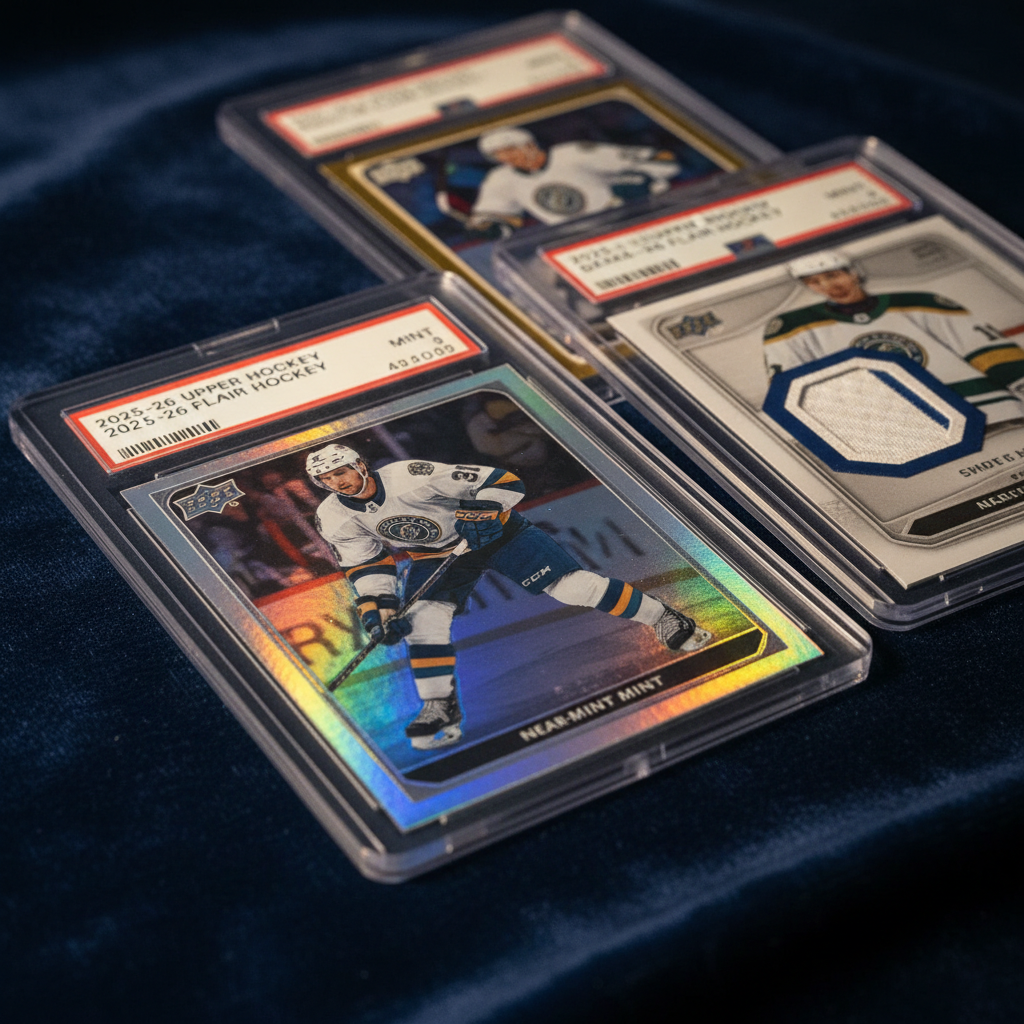
Upper Deck is bringing Flair Hockey back for 2025-26, and the checklist confirms this isn't a quiet reissue. The product is loaded with autographs, tiered parallels, and a hobby box configuration designed to appeal to both player collectors and set builders — with enough short-printed content to keep the secondary market active for months after release.
Box Configuration and What You're Pulling
Each hobby box delivers a structured hit count built around autographs and numbered parallels. Flair has historically positioned itself as a mid-to-premium tier release in Upper Deck's hockey calendar — not the flagship, but not a budget product either. Think of it as the sweet spot between Series One accessibility and The Cup exclusivity, which is exactly why it tends to move well at the case level with group breakers.
The insert and parallel structure follows a tiered rarity system, with the lowest-numbered variants sitting at print runs that make PSA population reports genuinely interesting. When a card has a print run of 10 or fewer copies, every graded example carries real scarcity weight — and Flair regularly includes those tiers in its autograph parallels.
Base set odds are structured to reward box buyers without making the checklist feel padded. The short-print rookies — always the engine of any hockey product's secondary market — are distributed across hobby configurations at rates that should keep raw prices volatile in the first 30 days post-release.
The Rookie and Autograph Landscape
The 2025-26 NHL rookie class is the real story here. Any product releasing in this window is essentially a vehicle for that class, and Flair's checklist reflects that priority. Rookie autographs, rookie parallels, and rookie-specific insert sets dominate the high-value tiers of the checklist.
For context, the 2024-25 season produced several high-profile rookies whose early autos have already established strong comp baselines at auction. Heritage Auctions and Goldin both moved graded rookie autos from that class in the $200–$800 range for BGS 9.5 examples of top-tier prospects, with outliers pushing well past that on short-printed parallels. Flair's numbered auto structure — particularly anything numbered to 25 or below — will slot directly into that pricing conversation.
Veterans aren't an afterthought either. Established stars anchor the autograph checklist in ways that give case buyers a floor. A signed parallel of a perennial Hart Trophy contender numbered to 49 or fewer has demonstrated consistent demand at PWCC and Stack's Bowers, regardless of the product it originates from. Flair's design language — which has always leaned into bold aesthetics over the understated look of something like SP Authentic — tends to photograph well, which matters more than collectors sometimes admit when cards hit eBay listings.
Team Sets and Collector Strategy
Flair publishes team set lists alongside the master checklist, which is genuinely useful for player collectors who want to know their target count before committing to boxes versus singles. Teams with deep autograph representation in the checklist — historically the Original Six franchises and current playoff contenders — tend to see their team sets command premiums in the completed set market on eBay and through COMC.
A few structural notes on the checklist worth flagging:
- Parallel tiers run from base through numbered variants, with the deepest cuts sitting at 1-of-1 printing plate and superfractor-style equivalents
- Insert sets carry their own parallel structures, meaning the total universe of collectible cards per player can run deep for star players
- Rookie Short Prints are embedded in the base set, not separated into a distinct subset — which affects how collectors approach set completion
- Autograph parallels are numbered independently of the base parallel structure, so a player can have multiple distinct numbered autos within the same product
The team set lists also reveal roster decisions that matter for player collectors — specifically, which current players Upper Deck secured autograph agreements with versus which appear only in base or insert form. That distinction drives real price differentials on the secondary market, and it's worth cross-referencing the checklist against your player collection targets before the release date arrives.
Flair has earned a loyal following precisely because it doesn't try to be everything. It's a focused product with a clear identity, and the 2025-26 edition looks built to reinforce that reputation rather than chase trends it doesn't need to chase. For hockey collectors, that kind of consistency is increasingly rare — and increasingly valuable.