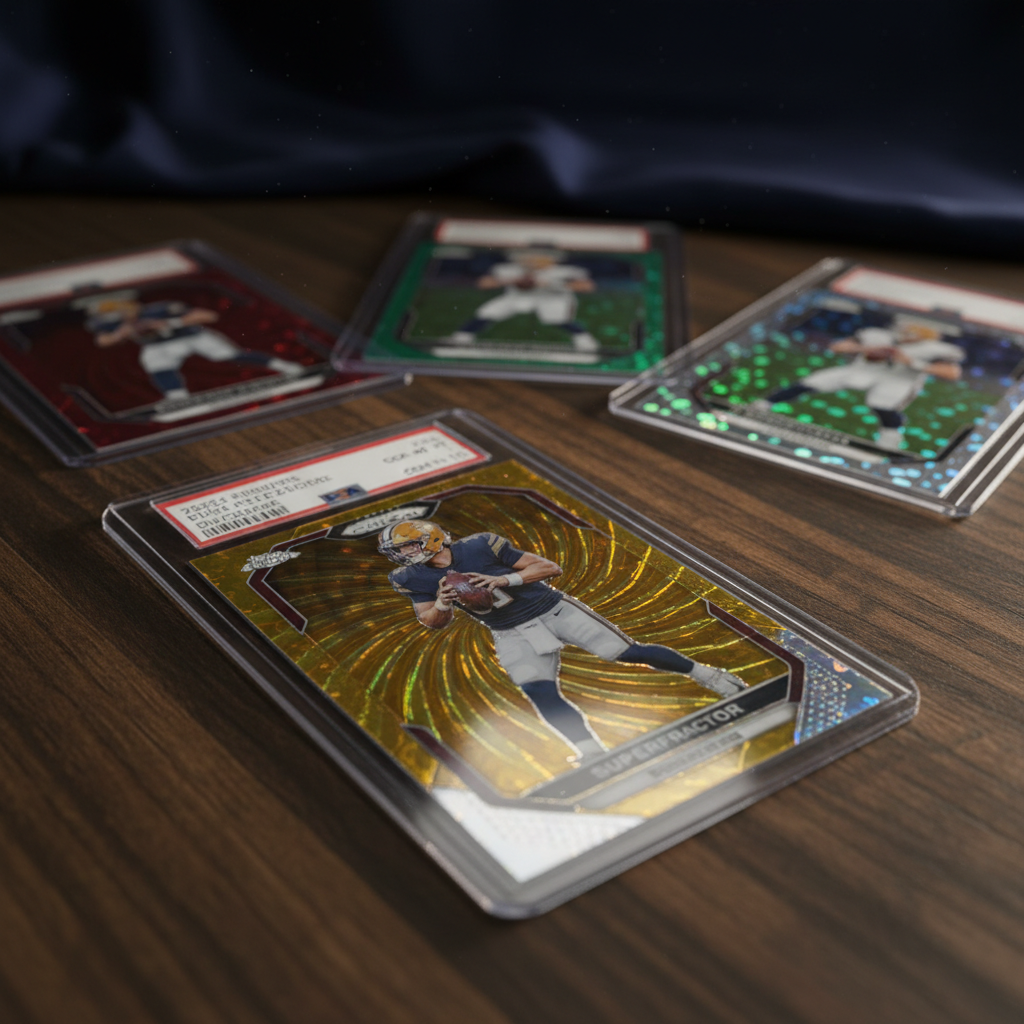
Topps Chrome Football has always lived and died by its parallel structure — and the 2025 edition doubles down on that tradition with one of the more layered rainbow chases the brand has produced in recent memory. Whether you're busting hobby boxes at roughly $180–$220 per box or hunting singles on the secondary market, knowing what you're looking at — and what it's worth relative to the base — is the difference between a smart pull and a missed opportunity.
Here's the complete breakdown of what the 2025 Topps Chrome Football parallel ecosystem looks like, and why the structure matters for both collectors and investors tracking this product's early market behavior.
The Parallel Ladder: From Refractors to 1-of-1s
Chrome's core appeal has always been the refractor rainbow, and 2025 maintains the tiered architecture that long-time collectors know well — while adding enough new wrinkles to keep the chase fresh. The base Refractor sits at the foundation, unnumbered and widely distributed, serving as the entry point for most parallel hunters. From there, the numbering gets tight fast.
- Base Refractor — Unnumbered
- Green Refractor — Numbered to /199
- Blue Refractor — Numbered to /150
- Purple Refractor — Numbered to /125
- Gold Refractor — Numbered to /50
- Orange Refractor — Numbered to /25
- Red Refractor — Numbered to /10
- SuperFractor — 1-of-1
The color-to-number mapping is largely consistent with recent Chrome Football releases, which matters for collectors building sets or tracking comps. A Gold Refractor /50 of a rookie like a top-five draft pick has historically commanded 3x to 8x the price of an unnumbered base Refractor in comparable grade, depending on the player's trajectory through their first NFL season. The SuperFractor, as always, is its own market entirely — a one-of-one of a breakout rookie can realistically reach five figures at auction if the timing is right.
Prizm comparisons are inevitable, and for good reason. Panini Prizm Football has dominated the NFL card market for over a decade, but Chrome's Refractor technology — that distinct, light-refracting finish — remains genuinely different from Prizm's Silver. They're not interchangeable aesthetically, and the collector base knows it. Chrome tends to skew toward a slightly older, more traditional collector demographic, while Prizm pulls younger buyers. Both are legitimate. Neither is going away.
Retail vs. Hobby: Where the Parallels Diverge
One area where 2025 Chrome Football adds complexity — and value differentiation — is the retail-exclusive parallel track. Retail configurations, including hanger boxes and blaster boxes at $25–$35, carry their own parallel variants that don't appear in hobby configurations. This isn't new to Chrome, but it's a dynamic that trips up newer collectors constantly.
Retail-exclusive parallels in 2025 include the Pink Refractor (hanger-exclusive) and the Yellow Refractor (blaster-exclusive). Both are unnumbered, which creates an interesting secondary market dynamic: scarcity is implied by the retail format's lower volume relative to hobby, but there's no print run stamp to anchor pricing. That ambiguity cuts both ways — it can suppress value because buyers can't verify rarity, or inflate it because sellers lean on perceived scarcity.
The Hobby-exclusive Atomic Refractor is the counterpart on the premium side — a visually distinct parallel with a busier, more geometric refractor pattern that commands a meaningful premium over standard Refractors of the same player. In recent Chrome Football releases, Atomic Refractors of star rookies in PSA 10 have sold in the $40–$150 range depending on player tier, compared to $15–$60 for standard Refractors in the same grade. The spread widens considerably for elite prospects.
Grading Considerations for Chrome Parallels
Chrome cards present specific grading challenges that affect which parallels are worth submitting. The refractor coating is unforgiving — surface scratches that might not register on a matte card become visible under light on a Chrome parallel. PSA and BGS both see elevated rejection rates on Chrome stock relative to traditional cardboard, and population reports reflect it.
For numbered parallels at /25 or tighter, grading submission almost always makes economic sense for star players — the combination of low print run and a PSA 10 or BGS 9.5 Black Label creates a multiplier effect on value that can be dramatic. A Red Refractor /10 of a first-round rookie quarterback in PSA 10 is a genuinely rare object. The population on those cards, even years after release, often sits in the single digits.
For unnumbered base Refractors and even Green /199s of non-star players, the grading math rarely works — submission fees eat into margin fast, and the secondary market for mid-tier Chrome parallels is thinner than the hobby press releases suggest.
The 2025 Chrome Football parallel structure is well-designed, familiar enough to be accessible, and deep enough to sustain a serious rainbow chase. Whether it produces the kind of landmark rookie cards that define a product's legacy depends entirely on the NFL class of 2025 — and that verdict won't come from a parallel guide. It'll come from the field.