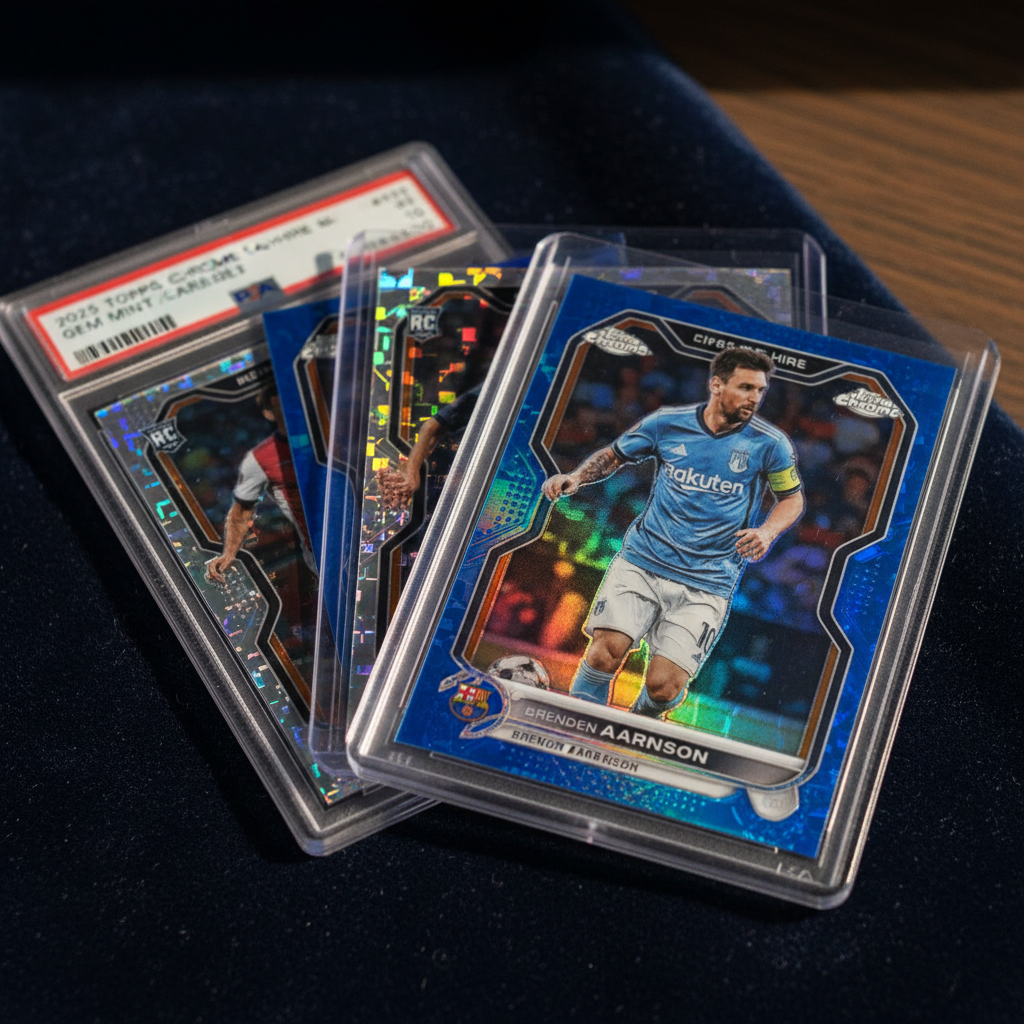
Topps is bringing its Chrome Sapphire treatment to MLS soccer again in 2025, and the configuration details are now locked in. For collectors who've watched Sapphire editions appreciate sharply across baseball and basketball — the 2020 Topps Chrome Sapphire Lionel Messi rookie reprint regularly clears four figures in PSA 10 — this release deserves serious attention before it hits the market.
What's in the Box
Each hobby box delivers a focused, premium hit count consistent with the Sapphire model: collectors can expect autographs alongside the signature blue refractor stock that defines the product line. The Sapphire finish — a deeper, more saturated blue chromium compared to standard Chrome — has historically driven a meaningful premium over base Chrome parallels at the same grade level.
The checklist spans active MLS rosters with an emphasis on the league's marquee names. Given MLS's growing international footprint and the influx of high-profile signings over the past two seasons, the autograph checklist will be the primary value driver here. Short-printed parallels and numbered refractors round out the insert structure, following the tiered rarity system Topps has used across its Sapphire universe.
- Base Sapphire parallels on blue chromium stock
- Numbered refractor parallels at multiple tiers
- Autograph cards, including Sapphire-stock signed versions
- Insert sets with odds structured around hobby box configuration
Print runs on Sapphire products are traditionally tighter than standard Chrome releases, which is precisely why the secondary market responds the way it does. When supply is constrained and a player breaks out — think Lorenzo Insigne or Cucho Hernandez gaining broader recognition — the ceiling on a low-pop Sapphire auto can move fast.
The MLS Sapphire Market in Context
MLS cards have had a complicated few years. The league's expansion, the arrival of global stars, and the 2026 World Cup narrative building in the background have all created genuine collector interest — but the market remains thinner than comparable MLB or NBA Sapphire releases. That's a double-edged reality.
On one hand, liquidity is lower. You won't flip a mid-tier MLS Sapphire auto in 48 hours the way you might a baseball counterpart. On the other hand, the upside on the right player is disproportionate. When an MLS player earns a national team call-up or transfers to a European club, domestic card prices can spike 300–500% almost overnight — and a Sapphire parallel, with its inherently low print run, amplifies that move considerably.
The 2026 World Cup factor is real and worth pricing into your strategy now. The United States, Canada, and Mexico are all co-hosting, and MLS-based players from all three nations will get a massive visibility boost. Collectors who identified key Sapphire autos from the 2023 and 2024 MLS Chrome releases ahead of that cycle are already sitting on meaningful gains.
From a grading standpoint, Chrome Sapphire cards are notoriously unforgiving. The high-gloss, dark-tinted surface shows handling marks and print defects at a rate that pushes PSA 10 pop counts lower than you'd expect relative to print run. That scarcity within scarcity is a feature, not a bug, for long-term holders — but it means buying raw Sapphire cards carries real risk. Grade before you price, or buy already-graded copies if the comp data supports it.
Timing and Positioning
The 2025 release arrives at a moment when soccer cards broadly are recalibrating after the speculative peak of 2021–2022. Panini's exclusive NFL and NBA deals have pushed some collector capital toward soccer as an alternative, but the category hasn't fully recovered its froth-era highs. That's not a warning — it's an entry point.
Sapphire MLS, specifically, has never been a volume play. It's a precision product: you're buying it for the right player, the right parallel, and the right grade. Boxes are worth cracking if you have conviction on specific names in the checklist. Otherwise, the smarter move for most collectors is to wait for the post-release secondary market to settle, identify the two or three autos that the market is undervaluing relative to the player's trajectory, and buy graded.
The 2026 World Cup clock is ticking. Eighteen months from now, the players on this checklist will be among the most-watched athletes on the planet. A PSA 10 Sapphire auto of the right name, bought at today's MLS market prices, could look very cheap in retrospect.