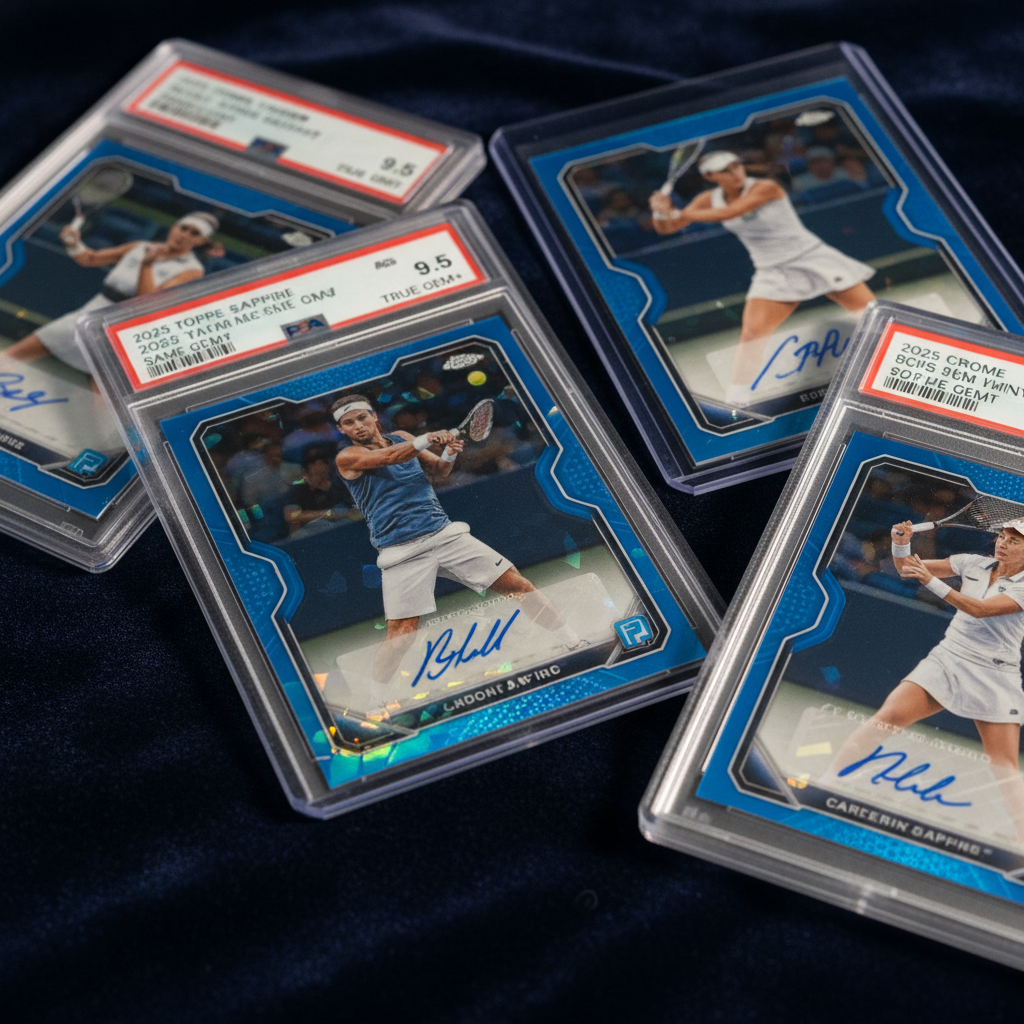
Topps is bringing its Chrome Sapphire treatment to the tennis world in 2025, and the product specs make a compelling case that this isn't just a cash-grab extension of a baseball brand. The 2025 Topps Chrome Sapphire Tennis set arrives with the same blue-refractor aesthetic that turned the baseball version into a modern hobby staple — and for a sport that has been chronically underserved by the trading card market, the timing couldn't be more deliberate.
Tennis cards have historically occupied a niche corner of the hobby, with most serious collector demand concentrated around a handful of vintage Steffi Graf and Pete Sampras issues, or the occasional Roger Federer autograph surfacing through Panini's limited tennis releases. The secondary market for modern tennis cards has been thin but directionally positive — Jannik Sinner and Carlos Alcaraz rookie-era cards in particular have seen consistent upward pressure as both players have traded Grand Slam titles back and forth. Topps is reading the room correctly here.
Box Configuration and What You're Pulling
Each hobby box is configured to deliver a focused, premium-feel experience rather than the bloated pack counts of a base-tier product. The checklist centers on active tour players across both the ATP and WTA circuits, with autograph content anchoring the box's value proposition.
Parallels follow the Chrome Sapphire hierarchy collectors already know from the baseball product:
- Sapphire (base) — the blue refractor that defines the set's identity
- Gold Sapphire — numbered parallels with tighter print runs
- Red Sapphire — further restricted, typically to 5 or fewer copies
- SuperFractor — 1-of-1, the set's top pull
Autograph parallels mirror this structure, meaning a Coco Gauff or Carlos Alcaraz auto SuperFractor from this set would immediately enter conversation as one of the most significant modern tennis cards in existence. That's not hyperbole — it's just how the 1/1 market works when the player has a legitimate global profile.
Why the Sapphire Brand Carries Weight Here
The Chrome Sapphire name has real equity. When Topps launched the baseball version as a Walmart exclusive in 2019, the market initially shrugged. Within two years, Sapphire parallels of top prospects were routinely outpacing their base Chrome counterparts by 3x to 5x at auction. The aesthetic — deep blue refractive stock, clean design — proved more durable than expected, and graded copies in PSA 10 became the standard presentation for the format's top pulls.
Applying that brand architecture to tennis is a logical expansion, but it carries execution risk. Tennis card demand is real but concentrated. The Alcaraz effect has been measurable — his cards saw a significant spike following his 2022 US Open win and again after his 2024 Wimbledon title defense. Sinner's Australian Open run in early 2024 produced similar, if slightly more modest, secondary market movement. The question isn't whether demand exists. It's whether Topps can convert casual tennis fans into repeat hobby buyers, which requires the product to deliver on both the checklist and the pull rates.
If the autograph checklist skews toward bankable names — Alcaraz, Sinner, Gauff, Aryna Sabalenka — this product has a legitimate shot at establishing a secondary market floor that holds. If it leans too heavily on journeymen or mid-tier players to fill boxes, the value will concentrate in a handful of SKUs and the rest will sit.
Release Date and Where to Watch
The 2025 Topps Chrome Sapphire Tennis set is slated for release through hobby channels, consistent with how Topps has handled other Sapphire-branded products. Specific box pricing hasn't been widely published at announcement, but comparable Sapphire tennis and soccer products from recent cycles have landed in the $80–$130 per box range at hobby retail, with secondary market prices moving quickly once allocation sells through.
For collectors building a position in modern tennis cards, the calculus is straightforward: autograph parallels of the top four or five names on the checklist are the only cards worth grading and holding. Everything else trades on aesthetics and set completion demand — which is real, but thinner. Watch PSA and BGS population reports in the first 60 days post-release; early pop data on the SuperFractor and 1/1 autos will tell you more about this product's ceiling than any box break video will.
Tennis has been waiting for a card product that takes it seriously. Whether this is the one that finally sticks is a question the secondary market will answer by summer.