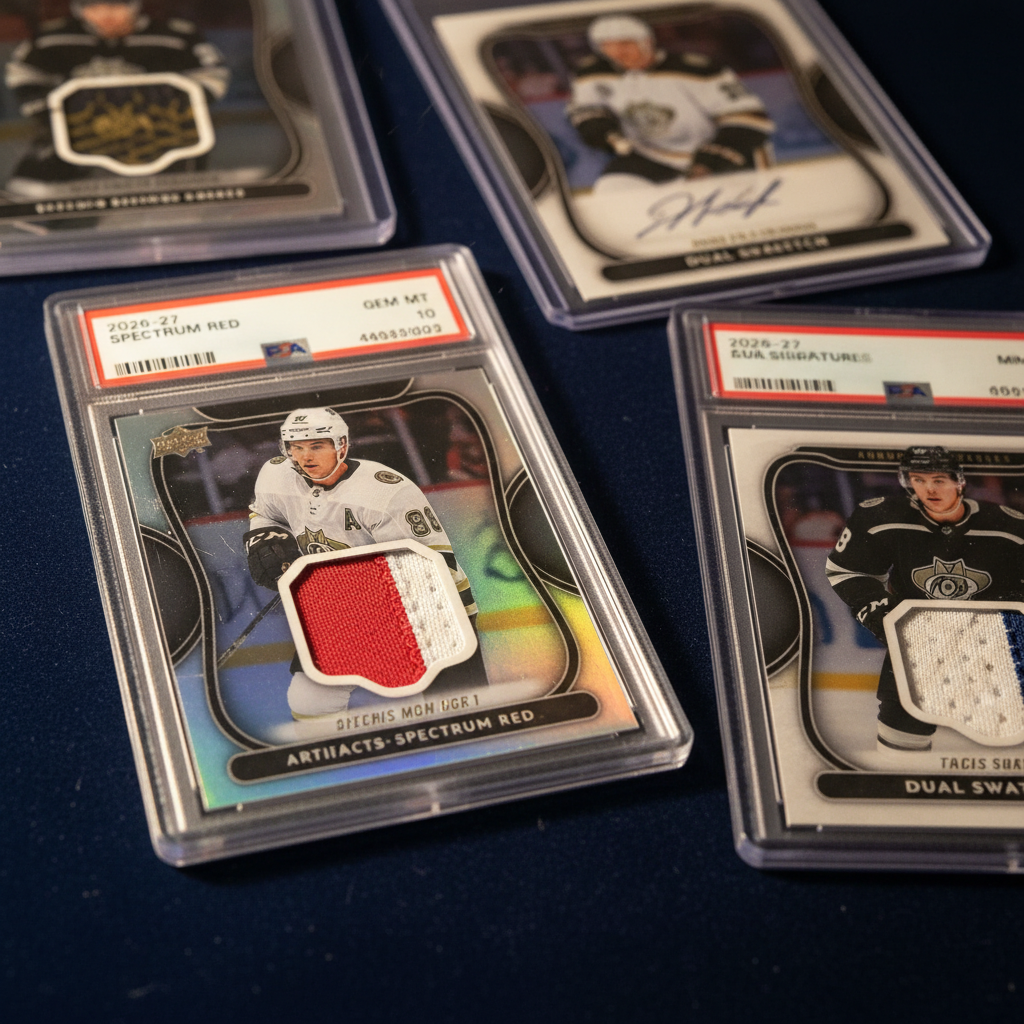
Upper Deck is bringing back one of its most reliable hockey properties for the 2026-27 season, and the early details on Artifacts Hockey suggest the brand is leaning into what has always made it work: deep autograph content, aggressive parallel structures, and the kind of checklist architecture that keeps set builders and hit hunters equally invested.
Artifacts has occupied a dependable mid-to-premium tier in the hockey card market for years — not the flashiest product on the calendar, but consistently one of the better performers for secondary market value retention. The 2024-25 edition saw notable hobby box activity on the resale market, with boxes trading in the $180–$220 range through much of its post-release window, driven largely by on-card auto pulls and numbered parallel demand. The 2026-27 version will need to clear that bar in a market that has grown more selective about what justifies a premium price point.
Box Configuration and Hit Structure
Each hobby box delivers a structured hit configuration built around autographs and memorabilia cards, consistent with the product's historical format. The checklist spans current NHL stars, rookies, and legacy veterans — the kind of cross-era mix that gives Artifacts its broad collector appeal.
Parallels run deep, as expected. Artifacts has long been a parallel-heavy product, with color-tiered versions of base cards numbered down to single digits in some cases. That structure rewards patient collectors willing to chase specific players across multiple tiers, and it creates natural secondary market activity even on non-autographed cards when the print runs are tight enough.
The autograph program includes both sticker and on-card signatures depending on the subset, a distinction that matters more than ever to today's collectors. On-card autos from Artifacts have historically graded well — the card stock holds ink cleanly — and BGS 9.5 or PSA 10 examples of short-printed rookie autos from prior Artifacts sets have moved with real conviction at auction when the right names are attached.
The Bounty Program Returns
Upper Deck is continuing the Bounty program in 2026-27 Artifacts, a redemption-style mechanic that has become one of the product's more distinctive features in recent releases. Bounty cards function as chase incentives beyond the standard hit structure — collectors who pull specific trigger cards can redeem them for exclusive items not available through standard pack odds.
The Bounty mechanic is genuinely smart product design. It extends the life of a release well past its initial opening window, keeps community engagement elevated on social platforms, and creates secondary market demand for the trigger cards themselves. Bounty pulls from recent Artifacts releases have sold anywhere from $40 to several hundred dollars depending on the redemption attached, which is meaningful upside on top of an already hit-driven product.
For dealers and case breakers, that sustained engagement matters. A product that generates conversation and trading activity two or three months after release is a product worth allocating shelf space to.
Market Position and Collector Outlook
Hockey cards have had a complicated few years. The post-pandemic surge that pushed Connor McDavid rookies and Wayne Gretzky vintage to historic highs has largely corrected, with the market settling into a more disciplined baseline. PSA graded McDavid Young Guns, once flipping well above $1,000 in gem mint, have normalized considerably — a reminder that even blue-chip hockey paper isn't immune to broader market gravity.
Against that backdrop, new product has to earn its keep. Artifacts enters the 2026-27 calendar with a few things working in its favor: brand recognition, a proven checklist format, and the Bounty hook that gives it a post-release narrative. What it needs — and what every hockey product needs right now — is rookie class participation. The 2026-27 NHL season will determine which first-year players generate sustained collector demand, and Artifacts' ability to land early autographs from the right names will define its ceiling on the secondary market.
The release date has not been confirmed as of this writing, but Artifacts typically lands mid-to-late in the hobby calendar, giving Upper Deck time to incorporate late-breaking roster developments. Collectors and breakers should watch for checklist confirmation and box pricing announcements as the release window approaches — that's when the real calculus on case allocation begins.