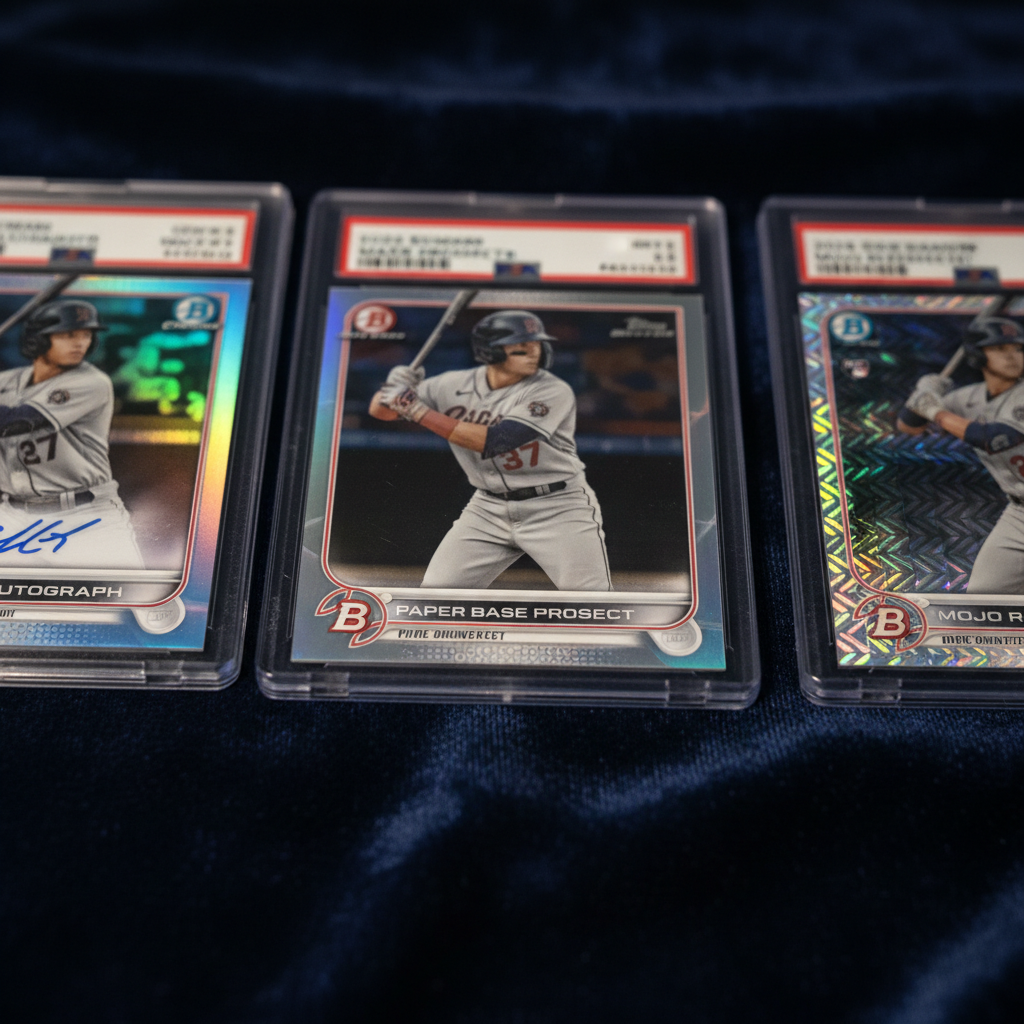
Bowman's annual prospect machine is gearing up for another run, and the 2026 Bowman Mega Box Baseball release is shaping up to be one of the more closely watched retail configurations of the product cycle. For collectors who've been tracking the trajectory of Bowman prospect cards over the past several years — a market that saw rookie autographs from players like Jackson Holliday and Paul Skenes command four-figure prices in their debut seasons — the Mega Box format has become a legitimate entry point worth paying attention to.
Mega Boxes occupy a specific lane in the Bowman ecosystem. They're not hobby boxes, and they're not blasters. They sit in between: higher card counts than a blaster, exclusive parallels that don't appear in standard retail configurations, and a price point that typically lands in the $30–$50 range at major retailers. That exclusivity factor is what drives secondary market demand on the box level, particularly when a breakout prospect surfaces mid-season and collectors scramble backward through retail inventory.
What's Inside the 2026 Configuration
The 2026 Bowman Mega Box follows the structural DNA of recent years. Each box delivers a curated mix of base cards, prospects, and the chrome parallels that have made Bowman the de facto standard for prospect collecting since the early 2000s. Autographs are the headline chase — specifically Bowman Chrome Prospect Autographs, which remain the most liquid and widely graded autograph product in the hobby outside of Topps Chrome.
The Mega Box-exclusive parallel structure is where things get interesting for set builders and speculators alike. Retail-exclusive colorways historically carry lower population counts than hobby parallels simply because the print runs are spread across a wider geographic footprint with less collector concentration. That scarcity dynamic has occasionally produced outsized returns when a player breaks through — a Mega Box-exclusive refractor of a top prospect graded BGS 9.5 or PSA 10 can trade at a meaningful premium to its hobby counterpart if the population stays thin.
- Base Bowman Baseball cards (current MLB players)
- Bowman Prospects (the core of the product)
- Bowman Chrome Prospects
- Chrome Prospect Autographs
- Mega Box-exclusive parallel colorways
- Team set composition across all 30 MLB franchises
The Prospect Market Entering 2026
Context matters here. The Bowman prospect market has been recalibrating since its speculative peak in 2020–2021, when pandemic-era hobby inflation pushed first-year autographs to prices that, in hindsight, were disconnected from realistic career probability curves. A 2020 Bowman Chrome Draft autograph of a high-ceiling prep arm that hasn't reached Double-A yet is worth a fraction of its 2021 peak. The market learned a hard lesson about buying prospect hype before the player proves anything above rookie ball.
That correction has actually made 2026 a more interesting entry point for disciplined collectors. Prices on unproven prospects have compressed, which means the upside on a legitimate breakout — think the trajectory of a card like a 2021 Bowman Chrome Gerrit Cole or the more recent Skenes wave — is proportionally larger for buyers who get in early at rational prices rather than chasing inflated pre-debut hype.
The 2026 MLB draft class and the current top-100 prospect landscape will heavily influence which names in this checklist matter. Players already on Baseball America and MLB Pipeline radars entering 2026 will see their Bowman cards trade actively from day one. The unknowns — the mid-round sleepers who emerge during the season — are where Mega Box retail configurations historically create their best stories, because those cards are already in circulation before anyone knows to look for them.
Grading and the Retail Card Question
One persistent debate in the Bowman community concerns whether retail cards are worth grading at the same rate as hobby pulls. The short answer: it depends entirely on the player and the grade. PSA and BGS both process Mega Box pulls at the same scale as hobby product, and a PSA 10 Chrome Prospect Auto carries the same certification regardless of where the card originated. The population dynamics, however, differ. Retail product gets submitted less frequently by percentage, which can create lower PSA 10 populations on certain retail-exclusive parallels — a fact that sophisticated buyers have been exploiting quietly for years.
For the 2026 Mega Box specifically, the calculus is straightforward: pull a Chrome Prospect Auto of a name with genuine upside, assess the centering and surface quality immediately, and make a submission decision before the product has been in the market long enough for population counts to climb. The window for advantageous grading economics on a hot prospect card is shorter than most collectors realize — sometimes a matter of weeks after a player's first major league call-up.
The 2026 Bowman Mega Box won't reinvent the format. It doesn't need to. Bowman's institutional dominance in the prospect space is self-reinforcing at this point — collectors buy Bowman because that's where the prospect market lives, and the market lives there because collectors buy Bowman. What matters for 2026 is who's in the checklist. Everything else is just cardboard.