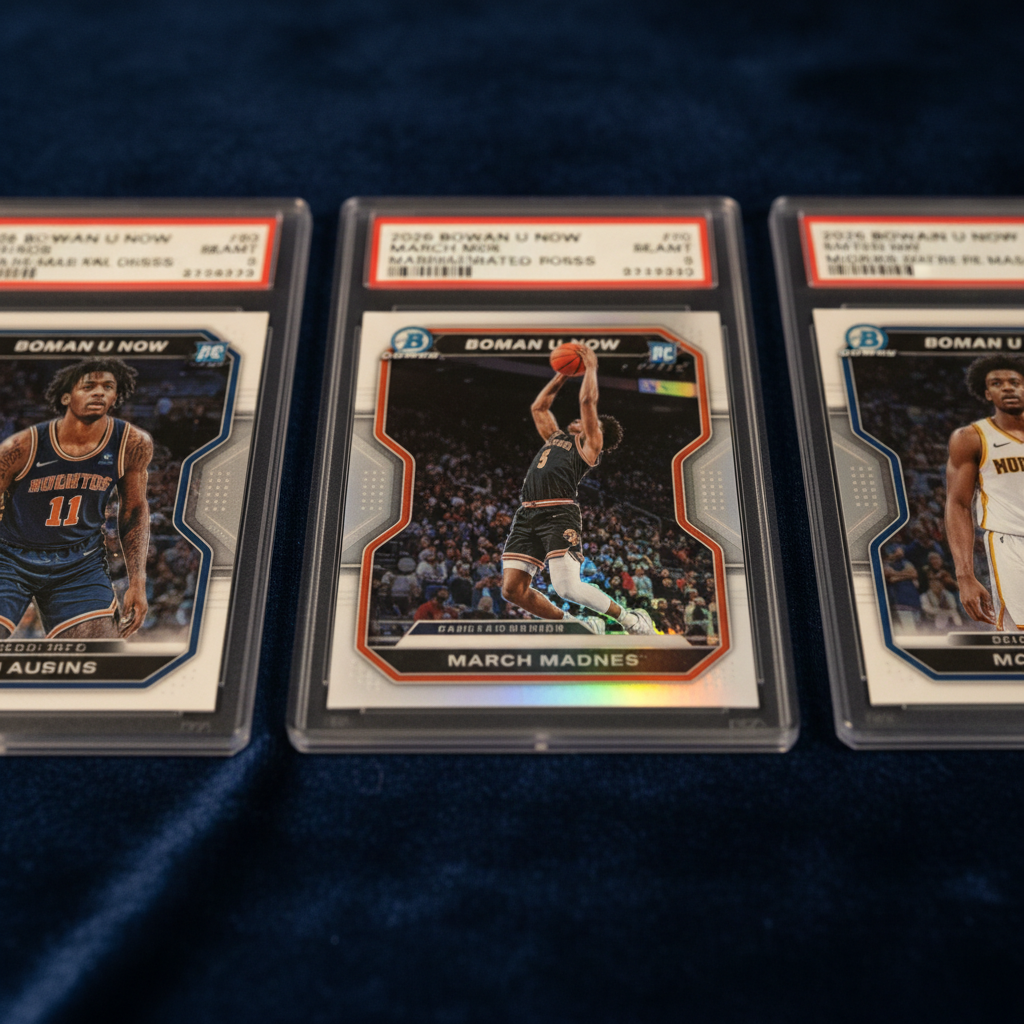
Topps is tapping into college basketball's biggest moment with 2026 Bowman U Now March Madness Basketball, a tournament-timed release designed to capture prospect hype at its annual peak. The product targets the window when amateur players are most visible to the mainstream — and when the secondary market for their cards tends to spike hardest.
Bowman U Now has carved out a distinct lane in the college card space since Topps secured its NCAA licensing foothold. Unlike traditional hobby boxes with fixed checklists, the U Now model operates as an on-demand platform: cards are produced to order during a limited window, then closed out. That structure keeps print runs tight by design, though it also means population data won't crystallize until weeks after the order window shuts.
What's in the Checklist
The March Madness edition leans into the tournament bracket moment, building its checklist around players who are generating the loudest draft buzz heading into the spring evaluation period. Autographs are the primary driver here, as they are across virtually every Bowman U Now release. Expect on-card signatures — the format's calling card — alongside memorabilia cards featuring swatches tied to collegiate game-worn material.
Parallels are structured in the tiered fashion collectors have come to expect from the line:
- Base parallels in multiple color tiers with escalating scarcity
- Autograph parallels numbered down to single digits at the top end
- Memorabilia autograph combos for the product's top names
- 1/1 superfractors anchoring the parallel ladder
The checklist composition will hinge almost entirely on which prospects are still dancing deep into the tournament — and which freshmen and sophomores have declared their draft intentions. That real-time relevance is the entire editorial premise of the U Now format. A player who drops 30 points in a Sweet 16 game and then declares for the NBA Draft the following week is exactly the kind of moment this product is engineered to monetize.
The Market Dynamics at Play
College basketball cards have had a complicated relationship with the secondary market. The gap between a player's collegiate card and their first NBA licensed product creates a speculative window that can produce enormous returns — or complete collapses, depending on draft slot and early NBA performance.
The most instructive recent comp is Caitlin Clark, whose Bowman U Now cards traded in the hundreds of dollars during her Iowa run and then exploded further once her WNBA trajectory became clear. On the men's side, the pattern is familiar: high-ceiling prospects generate strong presale and early secondary action, then either sustain or crater based on lottery positioning.
For the 2026 March Madness release specifically, the value calculus will depend heavily on which programs advance deep into the bracket. A mid-major Cinderella story produces a different collector response than a blue-blood powerhouse. Duke, Kentucky, Kansas, and Gonzaga prospects tend to carry built-in collector bases; a breakout player from a smaller program can generate a short, sharp spike that fades quickly if the team exits early.
The on-demand production model is a double-edged sword. It prevents the artificial scarcity that can make traditional hobby products feel manipulative, but it also means that a widely-ordered card won't carry the same long-term upside as a legitimately short-printed rookie. Collectors who've been in the Bowman U Now ecosystem for a few cycles understand this — the parallel ladder matters enormously here, and raw base autos from high-order-volume players tend to settle at modest prices once the tournament hype fades.
Timing the Entry Point
The strategic play with U Now releases is almost never to order at launch. The window between order close and card delivery creates a secondary market gap where prices often run hot, then correct once physical cards start arriving and PSA or BGS submission batches return. Collectors who've tracked the 2024 and 2025 Bowman U Now cycles have seen this pattern repeat consistently — early eBay raw sales at peak hype, followed by a 20-40% pullback once graded copies enter the market at volume.
That said, for a player who goes top-5 in the NBA Draft and immediately looks like a franchise piece, the correction is temporary. The floor resets higher. The risk is paying tournament-window prices for a player who slides to the second round.
A specific release date for the 2026 Bowman U Now March Madness order window has not been confirmed at publication time. Given prior-year cadence, expect the window to open concurrent with the tournament's second weekend and close shortly after the Final Four concludes. Collectors should monitor the Topps platform directly for order window announcements — these openings are rarely telegraphed far in advance.
The college card market is still finding its equilibrium after years of licensing uncertainty. But if March Madness delivers its usual share of breakout performances and draft-eligible stars, Bowman U Now will be positioned to capture every bit of it.