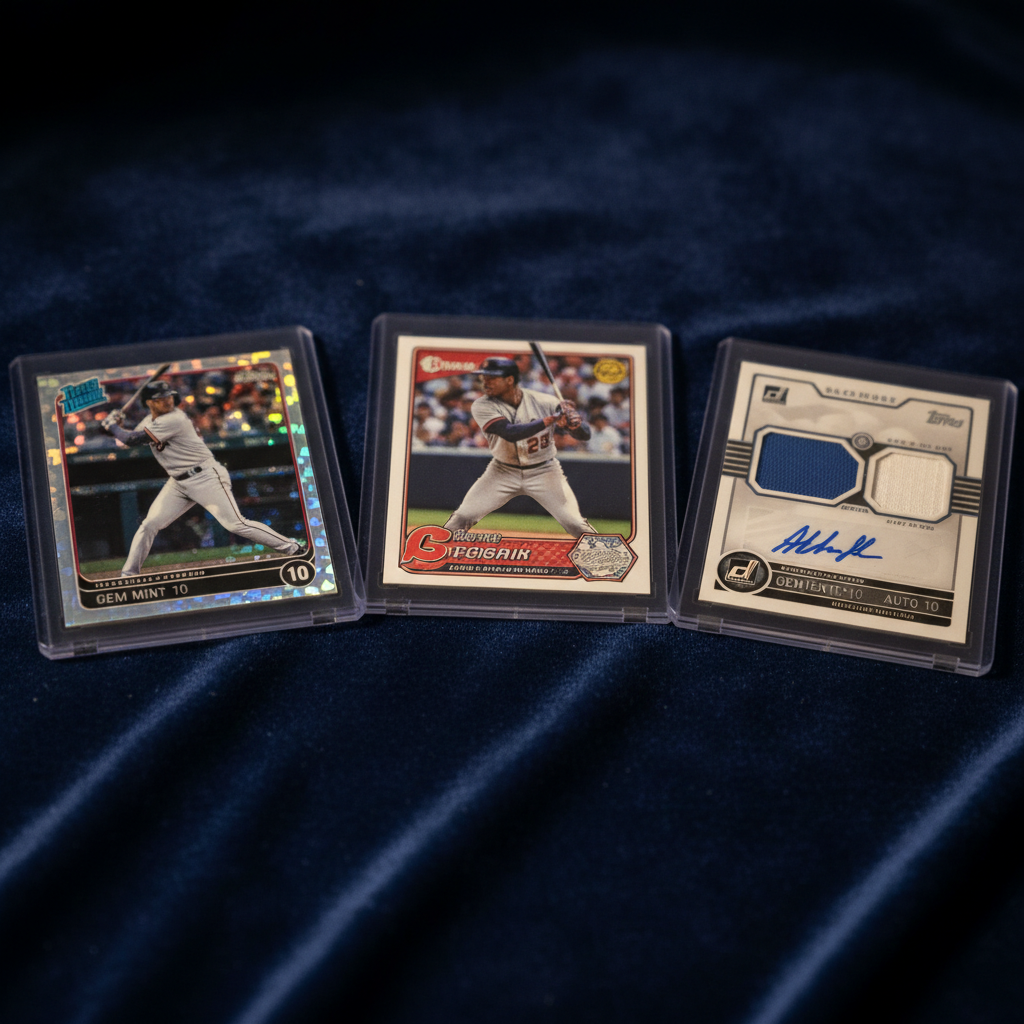
Panini's 2026 Donruss Baseball is locked in and heading to hobby shops, and the early checklist details confirm the brand is doing exactly what it's always done best — leaning hard into its classic aesthetic while threading in enough modern autograph and parallel content to keep the investor crowd engaged. For a product that has never carried an MLB license, Donruss continues to punch well above its weight in the mid-tier hobby market.
The base set structure follows the familiar Donruss blueprint: clean borders, bold typography, and a design language that traces directly back to the 1981 original. That continuity isn't nostalgia for its own sake — it's a calculated brand identity that has kept Donruss relevant through decades of licensing chaos, company sales, and market upheaval that buried dozens of competing sets.
What's Inside the Hobby Box
Hobby configuration details place the product squarely in Panini's accessible mid-range tier. Collectors can expect autographs and numbered parallels distributed across the standard hobby box format, with the checklist spanning veterans, rookies, and retired legends — the latter made possible by Panini's robust alumni licensing agreements that sidestep the MLB exclusivity held by Topps.
The insert lineup includes the returning Diamond Kings subset, one of the most recognizable insert brands in the hobby's history, dating to Donruss's earliest years. Rated Rookies, the other cornerstone of the Donruss identity, anchor the rookie content. These aren't flashy innovations — they're load-bearing walls. The collectors who buy Donruss year after year know what they're getting, and Panini has learned not to fix what isn't broken.
Parallels run the usual spectrum of colors and print runs, with the lowest-numbered versions carrying the most secondary market heat. On the 2025 Donruss release, short-printed parallels of top rookies like Paul Skenes moved briskly on the secondary market, with some numbered-to-25 versions clearing well above box cost on platforms like eBay and PWCC Marketplace. Whether 2026 produces a comparable breakout name depends entirely on how the rookie class shakes out — and right now, that class looks deep.
The Unlicensed Card Market in 2026
Donruss operates without official MLB logos or team names on uniforms, a limitation Panini has navigated creatively for years. Collectors who came up in the licensed-card era sometimes dismiss unlicensed product reflexively, but the data doesn't support that bias at the high end. Graded Donruss autographs of elite players — think Fernando Tatis Jr. rookie autos or Wander Franco early-career parallels — have held value in ways that embarrass plenty of licensed mid-tier competitors.
PSA and BGS both grade Donruss product without hesitation, and the population reports on key Donruss rookies are thinner than most collectors assume. That relative scarcity, combined with the brand's collector loyalty, gives Donruss an underrated floor in the resale market.
The broader context here matters: Fanatics' acquisition of Panini's licensing business is still working through its transition, and the future of the Donruss brand name under Fanatics remains one of the hobby's open questions. If 2026 Donruss Baseball ends up being among the final releases under the current structure, that adds a layer of historical significance that could accelerate collector interest in key pulls down the road. Scarcity narratives have driven premiums on far less compelling products.
Rookie Class and Key Names to Watch
The 2026 rookie class is where most of the speculative energy will concentrate. Early checklist details suggest strong representation across all 30 organizations, with Rated Rookies autographs serving as the primary target for player collectors and prospectors alike. Historically, a single breakout Rated Rookie auto can define an entire Donruss release — the 2011 Bryce Harper Rated Rookie remains one of the most recognizable modern rookies in the hobby, graded copies in PSA 10 still trading in the $80–$150 range depending on parallel.
The team set structure gives player collectors and team collectors alike a clean organizational framework, which is one of the underappreciated strengths of the Donruss format. It's a product that works for the casual team collector buying a single team set and the serious investor chasing numbered autos — a range most mid-tier releases can't credibly claim.
Release date and final pricing details are still being confirmed through distribution channels, but hobby boxes are expected to land in the range consistent with recent Donruss releases. For a product without a license, it consistently delivers more per dollar than its critics give it credit for. That's been true since 1981, and nothing about 2026 suggests the formula is changing.