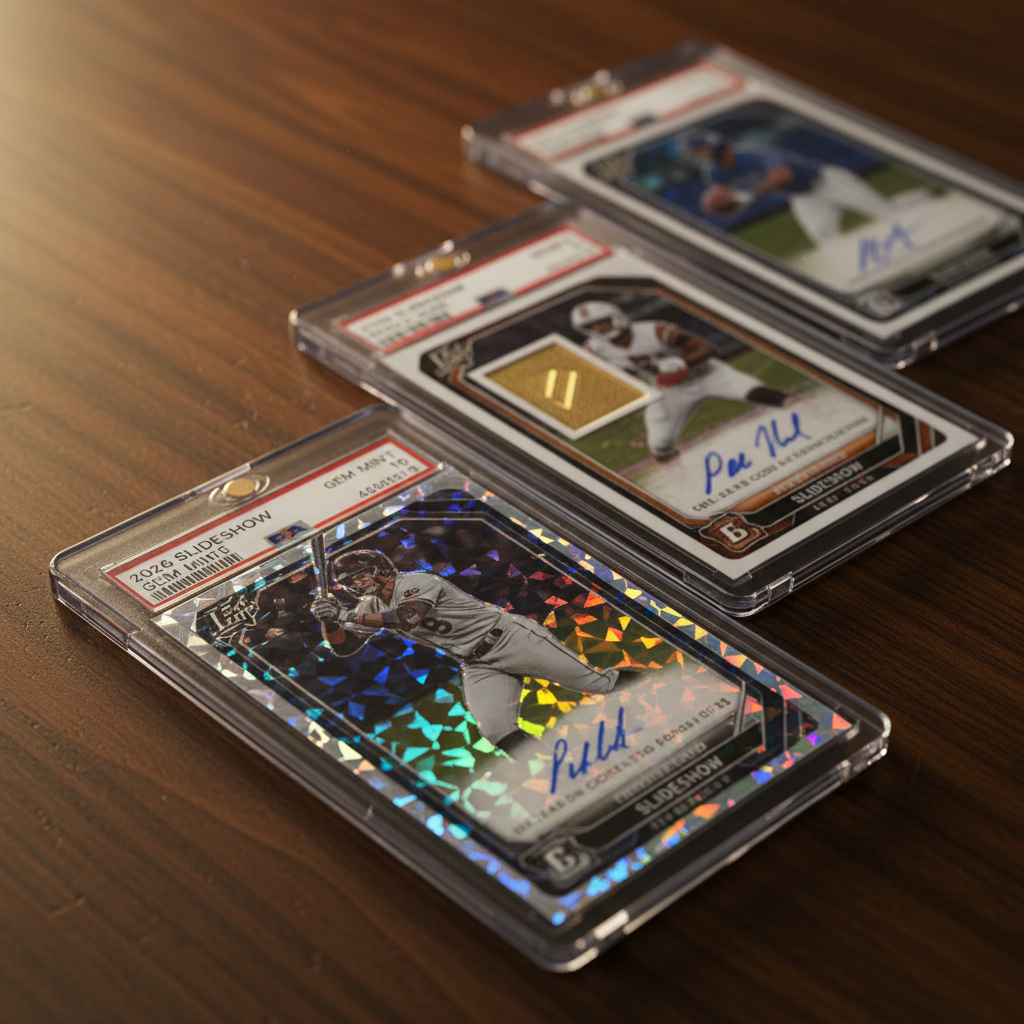
Leaf Trading Cards is bringing back one of its more visually distinctive product concepts with 2026 Leaf Slideshow, a set built around acetate-style photography and tiered autograph content that targets the mid-range hobby market. Full checklist details, hobby box configurations, print runs, and parallel structures have now been confirmed.
This is a product worth paying attention to — not because Leaf dominates the premium card space (they don't), but because Slideshow has historically punched above its price point in terms of on-card autograph volume and low-numbered parallel accessibility. For collectors who've been priced out of Panini's high-end football or Topps' flagship tiers, products like this fill a real gap.
Box Configuration and What You're Actually Pulling
Each hobby box delivers a focused hit count with an emphasis on autographed content rather than padding the configuration with memorabilia filler. Leaf has structured Slideshow around a checklist-first philosophy — meaning the autograph subjects drive the value proposition rather than relic windows or manufactured patches.
Print runs across the base autograph tier are limited, with parallels cascading down to single-digit numbered cards at the top of the rainbow. The parallel structure typically follows Leaf's established tiering:
- Base Autographs — numbered to /25 or higher depending on subject
- Silver/Holo parallels — typically /10 or /15
- Gold parallels — /5
- Red or Black 1/1s — true one-of-ones, printer's proof or superfractor-style finish
Exact per-subject print runs vary based on signing agreements, which is standard across unlicensed Leaf releases. High-demand signers will carry lower print runs; depth-of-checklist names run higher. That asymmetry is where the secondary market opportunity lives.
The Checklist and Why Leaf's Unlicensed Model Still Works Here
Leaf operates without the major league licenses held by Topps and Panini, which means no team logos, no official uniforms in photography. For some collectors, that's a dealbreaker. For others — particularly those focused on the autograph itself as the asset — it's a non-issue. A low-numbered on-card auto from a legitimate prospect or retired star holds value on its own merits, logo or not.
Slideshow's checklist has historically leaned into a mix of football and baseball prospects alongside retired veterans, giving the product cross-sport appeal. The 2026 edition appears to continue that approach. Prospect autos in particular carry speculative upside: a player signed to Slideshow before their breakout season can see secondary market prices move dramatically once they establish themselves at the major league or NFL level.
The comp history supports this. Early Leaf autos of players who later became stars — pulled from products that originally retailed under $50 per box — have cleared three and four figures at auction on Heritage and Goldin once the player's career trajectory became clear. That's the lottery-ticket appeal Leaf products have always offered, and Slideshow is structured to maximize it.
The acetate and clear-card elements in the Slideshow design also give the product a tactile differentiation that photographs well for social media — a factor that genuinely moves product in 2025's hobby landscape. Presentation matters for resale, and Leaf knows it.
Release Timing and Secondary Market Outlook
A firm release date hasn't been locked in publicly, but 2026 Leaf Slideshow is expected to hit hobby distribution channels in the first half of 2026, consistent with Leaf's typical product calendar. Hobby-exclusive distribution means this won't be a retail blaster situation — you're looking at box and case purchases through established distributors and local card shops.
At launch, expect hobby boxes to land in the $40–$70 range based on comparable Leaf releases. That price point makes it accessible for case-breakers and group breaks, which is realistically where a significant portion of Slideshow inventory moves. The low-numbered parallels and 1/1s are the break drivers.
For grading purposes, Leaf's card stock on acetate-adjacent products tends to grade well at PSA and BGS when pulled cleanly — the thicker stock resists edge wear better than standard cardboard. Collectors chasing high-grade copies of key autographs should pull from fresh boxes and sleeve immediately.
Slideshow won't rewrite the hobby's record books. But as a value-accessible, autograph-dense product with genuine upside on the right prospects, it's doing exactly what it's supposed to do — and doing it better than most products at this price tier bother to try.