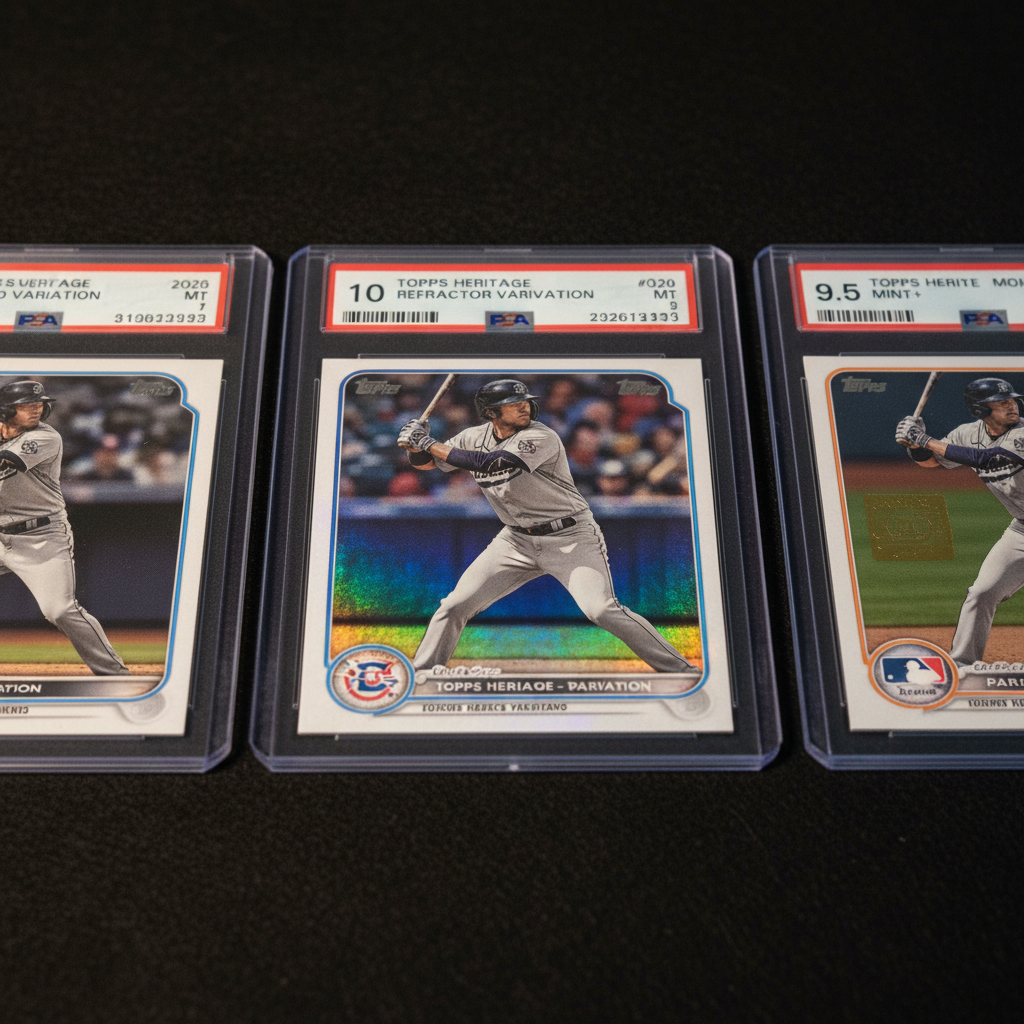
Topps Heritage variations have always been the product's hidden economy — the layer beneath the base set where real money moves and patient collectors get rewarded. With the 2026 Topps Heritage Baseball checklist now in circulation, the variation hunting season is officially open, and knowing what to look for before prices settle is half the battle.
Heritage's design conceit — faithfully reproducing a vintage Topps set, this year mirroring the 1977 Topps template — makes variations both more satisfying and more visually subtle than in flagship products. The differences can be a single word on a banner, a swapped action photo, or an icon that appears on fewer than one in several hundred packs. That scarcity, combined with the set's broad collector base, is exactly why Heritage variations consistently outperform their print-run implications at auction.
The Variation Types You Need to Know
The 2026 Heritage variation landscape breaks down into several distinct categories, each with different rarity profiles and market ceilings.
Image Variations are the most visually dramatic and historically the strongest performers. These swap the base card photo for an alternate shot — often a more dynamic or iconic image of the same player. For star players, image variations can trade at 5x to 15x the base card price on the secondary market, particularly in early-release windows before population counts normalize expectations. A Shohei Ohtani or Juan Soto image variation in a high PSA grade has historically cleared four figures within weeks of a Heritage release.
Alternate Banner Variations replace the team name text on the card front with a different designation — think position descriptors or legacy team names pulled from the original 1977 design era. These are subtler, which means they're easier to miss in bulk breaks and more likely to slip through at base card prices on secondary marketplaces. That's the opportunity.
- Image Variations — Alternate photography; highest ceiling for star players
- Alternate Banner Variations — Modified team/position text on card front
- All-Star Icon Variations — Added or altered All-Star designation on select players
- Nickname Variations — Player's nickname substituted for legal name on card front
All-Star Icon Variations and Nickname Variations round out the checklist's variation tier. All-Star Icons tend to carry moderate premiums — collectible, but the market for them is narrower than image swaps. Nickname cards, though, can punch above their weight when the nickname itself carries cultural resonance. A card calling a player by a well-known moniker rather than their given name has a storytelling quality that resonates with vintage-minded collectors who drive Heritage demand in the first place.
How Heritage Variations Have Performed Historically
The Heritage variation market has a reliable rhythm. In the first 30 to 60 days post-release, prices spike on anything that gets attention on social media or breaks through in high-profile case breaks. By month three, population data from PSA and BGS starts to clarify true scarcity, and prices either hold — indicating genuine short supply — or correct toward a sustainable floor.
Looking at recent cycles: 2024 Topps Heritage image variations for Elly De La Cruz and Gunnar Henderson were trading at premiums of $80 to $200 in raw form within the first two weeks, with PSA 10 copies of the most sought-after pulls clearing $400 to $600 on Goldin and eBay's verified sales. By contrast, lesser-star image variations settled in the $15 to $40 range — still a meaningful premium over base, but not the windfall early buyers hoped for.
The lesson the data keeps teaching: variation premiums are almost entirely player-dependent. The format is the vehicle; the star power is the engine. A variation of a fringe roster player is a curiosity. A variation of a generational talent is a collectible with real secondary market legs.
BGS grading has become increasingly relevant for Heritage variations specifically because the BGS 9.5 — with its subgrade transparency — gives buyers more confidence in a card's centering and surface quality than a raw or even PSA-graded copy. Heritage cards, printed on vintage-style stock, are notoriously susceptible to print defects and off-centering, which makes the grading calculus more consequential than with modern chrome products.
Building a Strategy Around the 2026 Checklist
The collectors who consistently win in the Heritage variation market aren't the ones chasing every variation indiscriminately. They're targeting two or three players they believe in long-term, identifying which variation types have historically moved for those player categories, and acquiring strategically in the first 45 days before population reports tighten the narrative.
For 2026, the names to watch in the variation market are the usual suspects at the top of the hobby's attention economy — Ohtani, Soto, Witt Jr., De La Cruz — but don't sleep on second-year players who had breakout 2025 seasons and are appearing in Heritage for effectively the first time as established stars. Those cards carry a novelty premium that the market hasn't fully priced in yet.
Variation guides like the one Beckett publishes serve a real function here: they create a shared visual reference that reduces the information asymmetry between sophisticated collectors and casual buyers. Once a variation is documented and widely circulated, prices rationalize. The window to buy undervalued variations is almost always before the guide goes live — or in the hours immediately after, before the listings catch up.
The 2026 Heritage variation checklist is now your roadmap. Whether you use it to buy, sell, or simply know what's in your breaks, the collectors who read it carefully will have an edge over those who don't. In this hobby, that's usually enough.