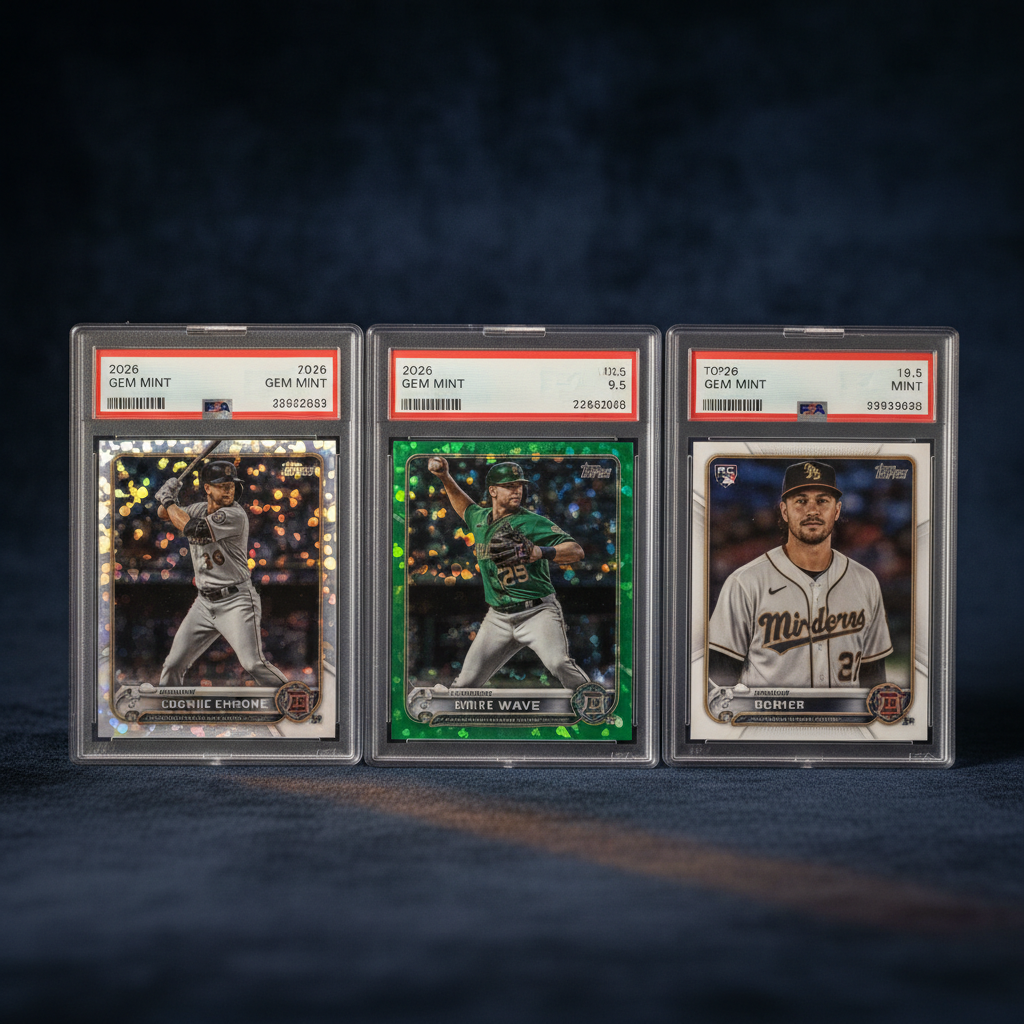
Topps Now is back for 2026, and the on-demand model that reshaped how collectors engage with in-season baseball cards is running its familiar playbook — short print windows, tiered parallels, and a checklist that grows week by week through the MLB calendar. For collectors who've been in the Topps Now ecosystem since its 2016 debut, the structure is well-worn. For those still on the fence, this is the format that essentially invented the modern sports card drop culture.
The 2026 edition carries forward the core mechanics: cards are available for a limited 24-to-48-hour ordering window tied to on-field performance, milestones, or weekly highlights. Final print runs are determined entirely by order volume — no artificial scarcity, no predetermined caps. That transparency is the product's defining feature, and it's also what makes the secondary market so legible. A card with a print run of 47 copies trades very differently than one that printed at 2,300, and buyers know exactly what they're getting.
What's in the 2026 Checklist
The checklist structure follows the established Topps Now hierarchy. Base cards anchor each release, with parallels layered on top — typically including Blue, Gold, Red, and Black tiers, each with progressively lower print runs. Autograph versions and relic cards appear selectively, reserved for milestone moments or featured player drops rather than every release. Team set collectors can build complete rosters across the season, with Topps organizing team-specific groupings as the year progresses.
Short prints and variation cards have become a more deliberate part of the Topps Now formula in recent years. The 2024 and 2025 runs both featured SP photo variants that generated outsized secondary market activity — a single SP from a high-profile player's record-breaking game can command multiples of the base card price even at identical print runs. Expect 2026 to continue that trend.
Autograph availability remains the most unpredictable variable. Topps has historically secured signatures from a rotating cast of stars and rookies, but the timing is tied to player agreements and availability rather than a set schedule. When a legitimate superstar auto drops on a meaningful moment card, the print run window becomes critical — collectors who miss the 48-hour order period are immediately at the mercy of the secondary market.
The On-Demand Economics
The Topps Now pricing structure has held relatively steady: base cards typically run in the $9.99–$14.99 range at issue, with parallels and autos priced significantly higher at the point of sale. The real story is what happens after the window closes.
Low-print-run releases tied to historic moments can appreciate sharply and quickly. The secondary market on platforms like eBay and PWCC Marketplace shows consistent patterns: cards commemorating no-hitters, milestone home runs, or postseason heroics with print runs under 100 copies regularly sell at 5x to 15x their original issue price within weeks. Cards from routine weekly highlight sets at print runs above 1,000 tend to trade at or below issue price on the secondary market — the collector base is broad but not deep enough to sustain premiums on high-volume drops.
That dynamic makes Topps Now a genuinely bifurcated market. Patient collectors who order strategically — targeting milestone moments, emerging stars, and low-print parallels — have historically done well. Bulk buyers hoping volume alone generates returns have generally not.
One underappreciated angle: graded Topps Now cards have carved out a real niche in the PSA and BGS ecosystems. Because the cards are printed on modern stock and handled carefully by collectors who ordered them specifically, gem mint populations tend to be proportionally high. But with low overall print runs, even a PSA 10 population of 30 or 40 copies on a 47-print card is a meaningful market. Heritage Auctions and Goldin have both moved high-grade Topps Now singles in the four-figure range when the underlying card — player, moment, parallel tier — checks the right boxes.
How to Approach the 2026 Season
The collectors who get the most out of Topps Now are the ones treating it like a living checklist rather than a static set. Following the MLB schedule closely, identifying which players are on milestone trajectories, and being ready to pull the trigger during the order window — that's the actual skill set the format rewards.
Rookie cards are worth particular attention in 2026. Several high-profile prospects are expected to debut this season, and a Topps Now rookie card tied to a first MLB hit or first home run, especially at a low print run, has historically been among the format's most durable long-term holds. The 2017 Cody Bellinger and 2019 Pete Alonso Topps Now rookie cards remain reference points for what the format can produce when a player's trajectory aligns with a memorable moment.
Topps Now won't be mistaken for a flagship set. It doesn't pretend to be. What it offers is immediacy — a card in your hands within weeks of the moment it commemorates, with a print run you can verify and a price point that doesn't require a second mortgage. In a market that increasingly rewards patience and specificity, that's a more compelling pitch than it might look on the surface.